
Musculoskeletal System Practice Test Questions
$69.00
- Buy to unlock unlimited access to all Quiz questions.
- After purchase you can print a PDF of the whole quiz at any point. The PDF will contain the questions and the correct answers.
About this Exam
The musculoskeletal system forms the bedrock of human anatomy, encompassing the complex interplay of bones, muscles, cartilage, tendons, and ligaments that support the body, allow movement, and protect vital organs. Mastery of this system is fundamental for students pursuing careers in healthcare, sports medicine, biology, and physical therapy. This practice test is designed to provide a comprehensive review and self-assessment opportunity for individuals preparing for exams in anatomy and physiology, nursing school entrance, or certification programs like personal training. It allows learners to gauge their understanding of core concepts and identify areas needing further study.
Ready to test your knowledge?
Buy Now to Access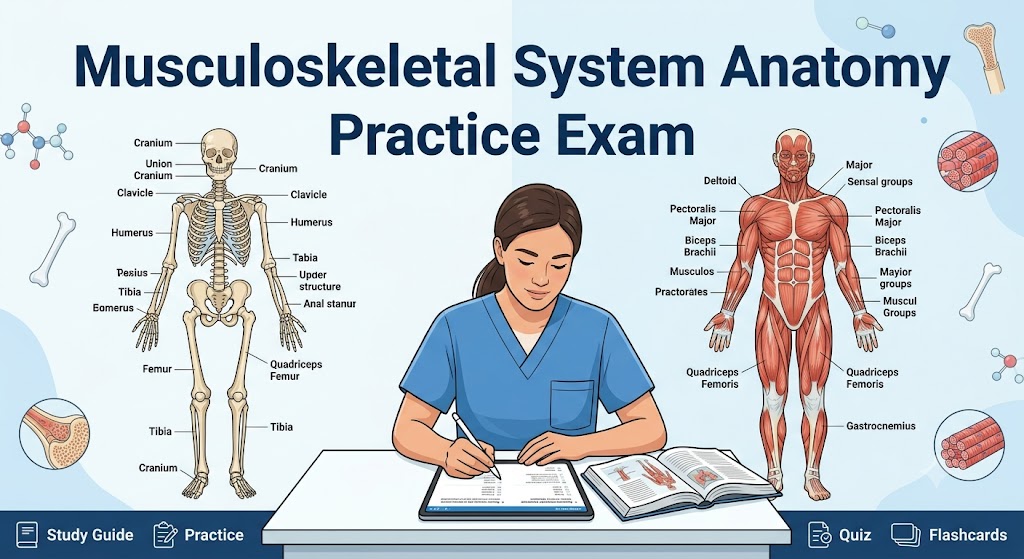
Additional Information
What the Course Entails and Exam Details
This comprehensive practice exam covers all critical components of the musculoskeletal system. You can expect questions focusing on skeletal anatomy, including the identification of major bones (axial and appendicular skeleton), bone structure, and joint classifications (fibrous, cartilaginous, synovial). Furthermore, it heavily features muscular anatomy, requiring knowledge of major muscle groups, their origins, insertions, and primary actions. Functional physiology is also covered, testing understanding of muscle contraction mechanisms (sliding filament theory) and the role of the skeleton in support, protection, and mineral storage. The syllabus effectively mirrors the depth found in standard introductory anatomy courses.
What to Expect in the Final Exam
While formats may vary slightly depending on the specific institution or certification body you are testing with, standard anatomy exams typically follow a predictable structure. Most professional exams are comprised primarily of multiple-choice questions (MCQs), often featuring diagrams requiring the correct identification of anatomical structures. You might also encounter short answer questions or matching exercises regarding muscle functions or joint types. Timed formats are common, requiring efficiency and quick recall. Passing scores generally range from 70% to 80% for certification. Practicing with timed mock exams is crucial for simulating the pressure of the actual test day.
How to Study and Exam Centers
Effective study strategies are paramount for success in anatomy. Utilize flashcards extensively for memorizing bones, muscles, and terminology. Active recall and spaced repetition techniques are highly effective for long-term retention. Regularly label blank anatomy diagrams to solidify spatial relationships of structures. Form study groups to discuss challenging concepts and test each other’s knowledge. Reviewing incorrect answers on practice tests is perhaps the most valuable study method, highlighting specific knowledge gaps.
Official proctored exams are typically administered through secure online portals or authorized physical testing centers, such as Pearson VUE, especially for national certifications. If you are taking this exam as part of a university or college course, it will likely be conducted on campus within designated computer labs or classrooms under instructor supervision.
Job Opportunities from the Course
A strong foundational understanding of the musculoskeletal system is essential for numerous rewarding career paths in healthcare and fitness. Here are some of the job opportunities unlocked by mastering this core anatomical knowledge:
Personal Trainer
Physical Therapist Assistant (PTA)
Massage Therapist
Occupational Therapy Assistant (OTA)
Medical Assistant
Orthopedic Technician
Exercise Physiologist
Surgical Technologist
Frequently Asked Questions
Reviews
5.0
Based on 0 reviews
Leave a Review
No reviews yet. Be the first to review!