
ATI Content Mastery Fundamentals Practice Exam
$69.00
- Buy to unlock unlimited access to all Quiz questions.
- After purchase you can print a PDF of the whole quiz at any point. The PDF will contain the questions and the correct answers.
About this Exam
The ATI Content Mastery Series Fundamentals Practice Exam is a crucial stepping stone for students enrolled in nursing programs, specifically designed to prepare them for the secure, proctored ATI Fundamentals assessment.
This practice exam serves as a diagnostic tool, mimicking the style, content, and difficulty of the actual test. By taking this practice assessment, nursing students gain a realistic preview of the concepts they must master to progress through their curriculum and eventually succeed on the NCLEX licensure exam. It is an essential component for any student aiming to build a strong foundational knowledge of nursing care principles and critical thinking.
Ready to test your knowledge?
Buy Now to Access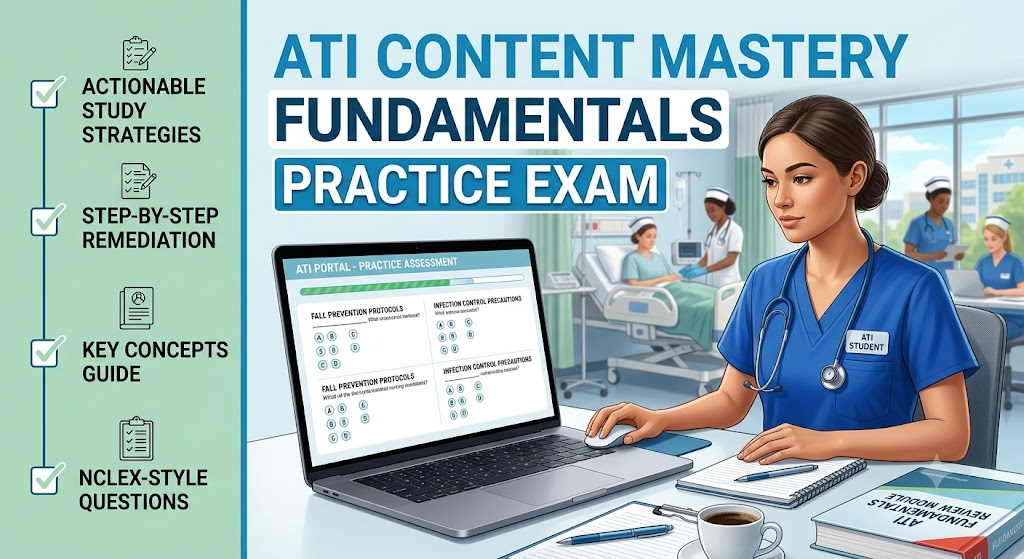
Additional Information
What the Course Entails and Exam Details
This practice exam is not a standalone course but a key assessment component integrated into a nursing curriculum's fundamental nursing course. The exam measures a student's mastery of essential nursing concepts and skills necessary for safe, effective client care. The core domains covered align directly with the NCLEX test plan and include:
Foundations of practice: Legal and ethical responsibilities, communication, clinical judgment, and nursing history.
Basic nursing care: Safety, infection control, medication administration, hygiene, wound care, and basic client comfort.
Support of psychosocial needs: Cultural and spiritual health, coping mechanisms, therapeutic communication, and end-of-life care.
Support of physiological needs: Management of oxygenation, circulatory, fluid and electrolyte, acid-base balance, elimination, and mobility.
Health assessment: Techniques for vital signs, general, and system-specific assessments.
What to Expect in the Final Exam
While the exact structure can vary, students taking the ATI Content Mastery Series Fundamentals Practice Exam can generally expect a format that mirrors the proctored version:
Format: The exam predominantly consists of multiple-choice questions. It may also include Next Generation NCLEX (NGN) style items, such as case studies or drag-and-drop questions, designed to test clinical judgment.
Items: The practice exam typically contains approximately 60 to 70 questions, similar to the 70 items on the proctored assessment.
Time Limit: Students are usually allowed 90 minutes to complete the practice exam, encouraging efficiency and time management.
Scoring: A passing score is determined by the specific nursing program. However, ATI reports scores that classify student mastery into levels (Level 1, 2, or 3), helping individuals identify their strong areas and priority areas for remediation.
How to Study and Exam Centers
Preparation for the actual proctored exam using this practice assessment involves deliberate, consistent practice:
Actionable Study Strategies: Treat the practice exam as a mock test. Sit in a quiet environment, avoid distractions, and adhere to the time limit. The most valuable learning occurs after the exam. Diligently review the detailed rationales for every question, both those you answered correctly and incorrectly. This reinforces key concepts and corrects misunderstandings. Utilize ATI’s Focused Review tool to access targeted remediation materials, including Review Modules (eBooks) and Active Learning Templates (ALTs), which emphasize fundamental principles.
Exam Location and Details: Proctored ATI exams are taken exclusively at authorized educational institutions, such as nursing schools or universities, through the ATI online portal. These tests are administered in a secure, supervised environment to ensure academic integrity. Students will be informed by their program administrators of the specific testing dates, locations, and procedures, which may occasionally include virtual proctoring options.
Job Opportunities from the Course
A single practice exam does not directly unlock job opportunities. However, the ATI Fundamentals assessment is a critical component of a student's nursing education. Successfully passing this exam, and the overall nursing program, ultimately leads to licensure as a Registered Nurse (RN) or Licensed Practical Nurse (LPN), opening countless doors in the healthcare field. A partial list of careers made possible by a nursing degree includes:
Registered Nurse (RN) in Acute Care (Hospitals)
Licensed Practical Nurse (LPN) in Long-Term Care Facilities
Emergency Room (ER) Nurse
Pediatric Nurse
Operating Room (OR) Nurse
Intensive Care Unit (ICU) Nurse
Home Health Nurse
Public Health Nurse
Occupational Health Nurse
Research Nurse
Frequently Asked Questions
Reviews
5.0
Based on 0 reviews
Leave a Review
No reviews yet. Be the first to review!