
ASNT Level III Basic Practice Exam
$69.00
- Buy to unlock unlimited access to all Quiz questions.
- After purchase you can print a PDF of the whole quiz at any point. The PDF will contain the questions and the correct answers.
About this Exam
The ASNT Level III Basic examination is a prerequisite for achieving the prestigious American Society for Nondestructive Testing (ASNT) Level III certification. This certification represents the highest level of qualification in the Nondestructive Testing (NDT) field.
It is designed for experienced NDT professionals who are moving into supervisory, managerial, or consulting roles. The Basic exam assesses a candidate’s broad knowledge of NDT methods, their understanding of certification programs (specifically SNT-TC-1A and CP-189), and their familiarity with materials, manufacturing, and product technology. Achieving Level III status validates your expertise and commitment to safety and quality in industry.
Ready to test your knowledge?
Buy Now to Access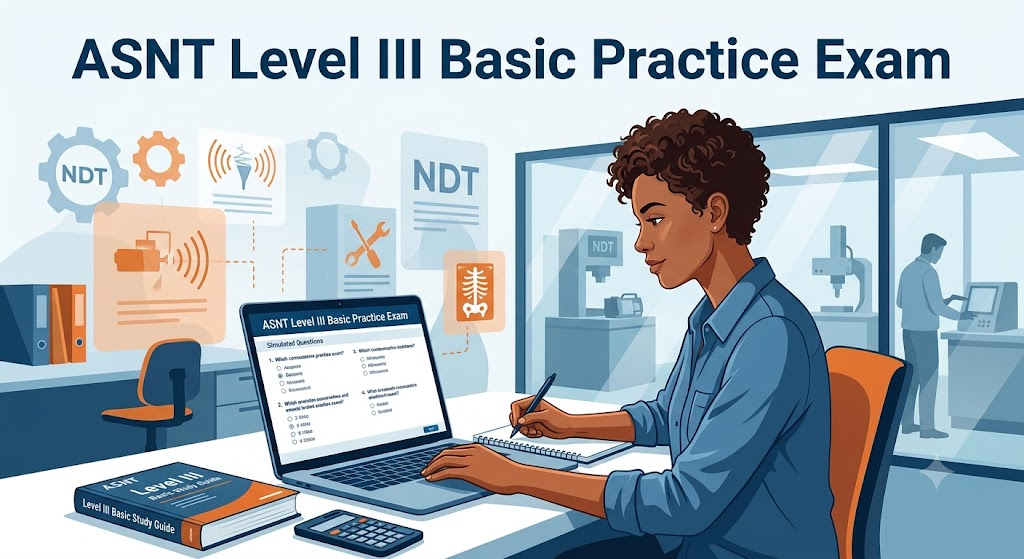
Additional Information
What the Course Entails and Exam Details
Preparation for the ASNT Level III Basic exam covers several critical areas. While it is not a "course" itself, candidates must master the Body of Knowledge outlined by ASNT. The core topics include:
ASNT Administration and Certification Programs: Detailed knowledge of SNT-TC-1A (Personnel Qualification and Certification in Nondestructive Testing) and ANSI/ASNT CP-189 (Standard for Qualification and Certification of Nondestructive Testing Personnel). You must understand the requirements for employer-based certification programs, qualification requirements for all levels, and standard practices.
General NDT Method Knowledge: A fundamental understanding of the principles, equipment, and applications of multiple NDT methods. Although the Level III specialist exams cover individual methods in depth, the Basic exam requires general familiarity with methods such as Radiographic Testing (RT), Ultrasonic Testing (UT), Magnetic Particle Testing (MT), Liquid Penetrant Testing (PT), Eddy Current Testing (ET), Visual Testing (VT), Leak Testing (LT), and Acoustic Emission Testing (AE).
Materials, Fabrication, and Product Technology: Understanding basic materials science, including properties of common engineering materials. This section also covers manufacturing processes (casting, welding, forging) and the types of discontinuities that may be introduced during fabrication and service.
What to Expect in the Final Exam
The ASNT Level III Basic exam is a computer-based test (CBT) administered at authorized testing centers.
Format: The exam consists entirely of multiple-choice questions.
Number of Questions: There are typically 135 questions on the Basic exam.
Time Limit: Candidates are usually allotted four (4) hours to complete the examination.
Passing Score: A passing score of 70% is required to successfully pass the Basic exam.
Rules: The exam is closed-book, meaning no outside reference materials are allowed during the test.
How to Study and Exam Centers
Effective preparation is key to passing the ASNT Level III Basic exam. Since this is an advanced certification, a combination of self-study and professional training is highly recommended. Actionable strategies include:
Review the ASNT Body of Knowledge (BoK): Carefully review the specific BoK outlined in ASNT’s CP-105 for the Basic exam. This lists the exact topics and subtopics you will be tested on.
Utilize ASNT Study Guides: ASNT publishes official study guides and collections of practice questions specifically for the Level III Basic exam. These are essential resources.
Analyze Key Documents: Thoroughly study the latest editions of SNT-TC-1A and CP-189. Create summaries and flashcards for the qualification requirements of each level.
Take Practice Exams: Use practice tests to familiarize yourself with the question format and manage your time effectively. Identify weak areas for focused review.
Attend Preparatory Courses: Many ASNT local sections, specialized training companies, and colleges offer Level III Basic exam preparation courses. These provide structured learning and expert instruction.
Exam Centers: ASNT Level III examinations, including the Basic exam, are administered worldwide through Pearson VUE testing centers. You must apply through ASNT first; once approved, you can schedule your exam at a convenient Pearson VUE location.
Job Opportunities from the Course
Achieving ASNT Level III status—starting with passing the Basic exam—opens doors to advanced, well-compensated career paths in quality assurance and engineering. The specific job titles this certification unlocks include:
NDT Level III Consultant
Corporate Level III
Quality Assurance (QA) Manager
Quality Control (QC) Manager
NDT Supervisor or Department Head
NDT Inspector (Level III in specific methods)
NDT Instructor / Trainer
Responsible Level III for specialized industries (Aerospace, Oil & Gas, Nuclear)
Frequently Asked Questions
Reviews
5.0
Based on 0 reviews
Leave a Review
No reviews yet. Be the first to review!