
ASE Structural Analysis & Damage Repair (B4) Practice Test
$69.00
- Buy to unlock unlimited access to all Quiz questions.
- After purchase you can print a PDF of the whole quiz at any point. The PDF will contain the questions and the correct answers.
About this Exam
The ASE Structural Analysis & Damage Repair (B4) certification is a prestigious credential for automotive professionals specializing in the intricate work of assessing and repairing the structural integrity of vehicles. This certification, part of the ASE Collision Repair & Refinish Test Series (B Series), is designed for experienced technicians, body shop professionals, and collision repair specialists. It validates their expertise in analyzing complex damage to vehicle frames, unibody structures, and related components.
Achieving the ASE B4 certification demonstrates a high level of competency and commitment to safety, precision, and adherence to industry standards in collision repair. It serves as a strong signal to employers and customers that the certified technician possesses the specialized knowledge required to restore a vehicle to its safe and proper operating condition after significant structural damage. For many technicians, it is a significant step towards achieving ASE Master Collision Repair Technician status.
Ready to test your knowledge?
Buy Now to Access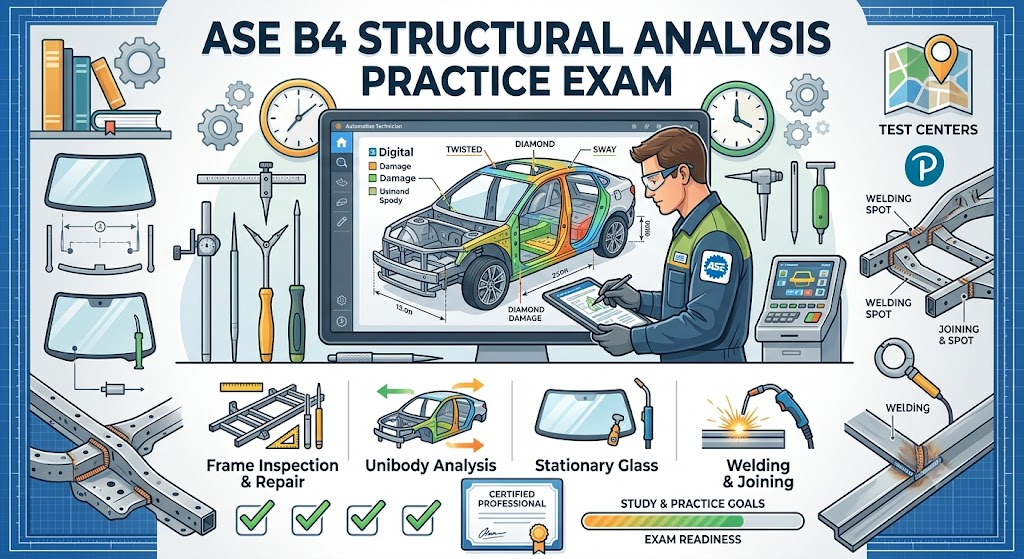
Additional Information
What the Course Entails and Exam Details
This comprehensive course, and the corresponding examination, focuses on critical competencies in automotive structural repair. Professionals preparing for this test must master a variety of skills and knowledge areas.
The core domains covered in the ASE B4 exam typically include:
Frame Inspection and Repair: Detailed techniques for inspecting and accurately measuring full-frame vehicle structures, analyzing various types of damage like twist, sway, and diamond, and executing precise repair procedures, including the use of frame machines and measuring systems.
Unibody and Unitized Structure Inspection, Measurement, and Repair: Understanding the unique characteristics of unibody construction, employing proper techniques for structural mapping and 3D measuring, and applying advanced repair methods specific to high-strength steels and modern unibody designs.
Stationary Glass: Proper procedures for removal, installation, and sealing of stationary vehicle glass, including windshields, rear windows, and quarter panels, with a focus on structural contribution and safety.
Welding, Cutting, and Joining: Expertise in various welding techniques (MIG/GMAW, resistance spot welding), oxy-fuel cutting, and modern adhesive bonding methods used in structural repairs, emphasizing safety, quality, and proper joint configuration.
Key Exam Details (Standard Certification):
Number of Scored Questions: Typically 50 multiple-choice questions.
Unscored Research Questions: The exam often includes an additional 10 unscored research questions, which will not affect your final score. They are used for future test development.
Total Questions: Approximately 60 questions.
Time Limit: Usually 75 minutes.
What to Expect in the Final Exam
The final ASE B4 examination is a rigorous, computer-based test consisting entirely of multiple-choice questions. These questions are often based on real-world scenarios, requiring test-takers to apply their practical knowledge and diagnostic skills, not just recall facts.
Candidates can expect questions that describe specific vehicle damage symptoms or situations and ask for the most likely cause, the correct measurement procedure, the appropriate repair technique, or the relevant safety precautions. Each question will present a situation and four potential answers. The challenge lies in selecting the single best answer based on established industry practices and ASE standards.
A significant aspect of the final exam process is the scaled scoring system. Instead of a simple percentage, ASE converts your raw score into a scaled score ranging from 1 to 100. The minimum passing score for nearly all ASE certifications, including B4, is a scaled score of 70. This ensures that all versions of the test, regardless of their slight variations in difficulty, are evaluated with a fair and consistent standard.
On test day, you should be prepared for typical proctored exam conditions. This includes arriving early, presenting valid government-issued photo identification, and adhering to strict rules prohibiting electronics, study materials, and other personal items in the testing room. The computer interface is user-friendly, allowing you to flag questions for review and manage your time effectively within the 75-minute limit. You will not be allowed to use personal calculators, although an on-screen calculator may be provided for certain calculation-intensive questions if relevant.
How to Study and Exam Centers
Effective Study Strategies:
Utilize Official ASE Study Guides: The primary and most reliable resource is the official study guide provided by ASE. These guides detail the exact task lists and knowledge areas the exam will cover. Reviewing these lists thoroughly is essential.
Take Multiple Practice Tests: Practicing with realistic ASE-style practice exams, like the one this guide supports, is crucial. It helps you become familiar with the question format, time constraints, and the types of concepts tested. Analyze not just why the correct answer is right, but also why the incorrect options are wrong.
Review Key Terminology: The automotive and collision repair industry has a specific vocabulary. Mastering terms related to structural components, measuring systems, welding processes, and damage types will improve your speed and comprehension.
Leverage Illustrated Guides and Videos: Visual aids are highly beneficial for understanding complex repair procedures, frame and unibody diagrams, and measuring system operations. Look for study resources that include detailed illustrations, animations, or instructional videos.
Focus on Diagnostic Logic: Practice critical thinking and diagnostic logic. For scenario-based questions, try to systematically eliminate incorrect options before choosing the best answer.
Study in Focused Sessions: Don't try to cram everything at once. Break your study time into focused, subject-specific sessions. Consistency over time is more effective.
Exam Centers and Registration: ASE exams are delivered through a network of nearly 500 secure, proctored testing centers across the country, many of which are managed by well-known testing providers like Pearson VUE. These centers offer professional environments with flexible scheduling options throughout the week, and in some locations, evenings or weekends.
To take the ASE B4 exam, you must first register and purchase the test through your official myASE account on the ASE website. Once you have purchased the test and any associated registration fees are paid, you will receive information and instructions on how to locate an authorized testing center and schedule your specific exam date and time. It is highly recommended to schedule your appointment well in advance, especially if you have preferences for a particular center, date, or time slot. Some schools and training programs may also be authorized to administer ASE entry-level tests, but the full professional certification exams typically require a proctored, commercial testing center.
Job Opportunities from the Course
Earning your ASE B4 Structural Analysis & Damage Repair certification opens a range of exciting and specialized career paths within the automotive and collision repair industry. It is a credential valued by many different types of employers, from independent body shops and dealership collision centers to insurance companies and equipment manufacturers.
Here is a list of job opportunities and career advancements that can be unlocked by this certification:
Collision Repair Technician
Structural Repair Specialist
Unibody and Frame Technician
Automotive Structural Analyst
Body Shop Lead Technician or Foreman
Collision Estimator (especially with advanced structural knowledge)
Collision Repair Shop Manager or Owner
Automotive Technical Trainer (specializing in structural repair)
Collision Industry Appraiser or Claims Adjuster (benefitting from technical depth)
Master Collision Repair Technician (a significant step toward Master level)
Quality Control Inspector in Collision Repair
Automotive Refinish & Damage Analyst
By dedicating yourself to thorough preparation and passing the ASE B4 exam, you are not only proving your skill in a critical area but also significantly enhancing your employability, earning potential, and long-term career prospects in the vibrant field of collision repair. Stay focused, practice consistently, and you can achieve this respected milestone. Good luck with your studies!
Frequently Asked Questions
Reviews
5.0
Based on 0 reviews
Leave a Review
No reviews yet. Be the first to review!