
ASCP Parasitology Practice Exam
$69.00
- Buy to unlock unlimited access to all Quiz questions.
- After purchase you can print a PDF of the whole quiz at any point. The PDF will contain the questions and the correct answers.
About this Exam
The ASCP Parasitology Practice Exam is a dedicated study resource created for laboratory professionals who are preparing for the parasitology section of American Society for Clinical Pathology (ASCP) Board of Certification (BOC) exams, specifically for the Medical Laboratory Scientist (MLS) or the Specialist in Microbiology (SM) certifications. It is an ideal tool for individuals aiming to refine their skills in identifying and diagnosing human parasites. This practice exam is designed for medical laboratory scientists, technologists, technicians, and international candidates seeking to demonstrate their expertise in a critical sub-discipline of microbiology.
Ready to test your knowledge?
Buy Now to Access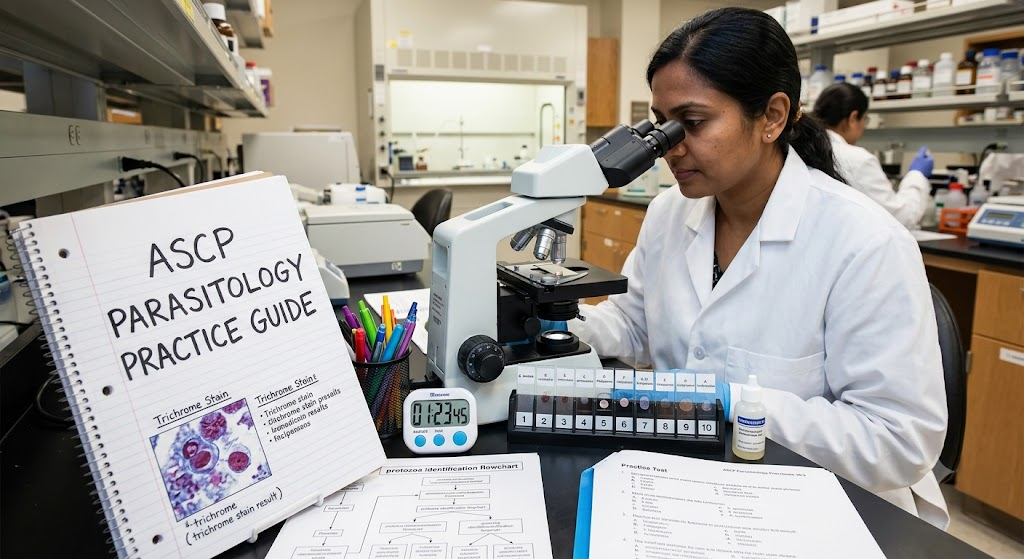
Additional Information
What the Course Entails and Exam Details
This specialized practice content covers the full spectrum of medical parasitology relevant to human health. It aims to build your capability to analyze and report findings accurately. The core areas you must master include:
Protozoa: Identification of intestinal, blood, and tissue protozoa, understanding their life cycles, and pathogenicity (e.g., Entamoeba, Giardia, Plasmodium, Leishmania, Trypanosoma).
Helminths: Comprehensive knowledge of nematodes (roundworms), trematodes (flukes), and cestodes (tapeworms), including egg and adult morphology, life cycles, and associated disease states (e.g., Ascaris, Enterobius, Schistosoma, Taenia).
Arthropods: Identification of medically important arthropods which act as vectors of disease or are directly parasitic (e.g., ticks, mites, lice, fleas).
Diagnostic Procedures: Proficiency in pre-analytic factors (specimen collection, transport, and preservatives), analytic procedures (principles and interpretation of stains like trichrome, iron hematoxylin, and acid-fast), concentration techniques, and newer molecular and antigen detection methods.
Clinical Correlation: Relating laboratory findings to clinical presentation and treatment, focusing on the pathogenesis of parasitic infections.
What to Expect in the Final Exam
It is important to clarify that "ASCP Parasitology Practice Exam" is a designation for focused study. While there is not a standalone official exam with this specific name, mastering this content is essential for success in the parasitology analytic procedures portion of the primary ASCP certifications. Based on standard ASCP BOC procedures for exams like MLS or SM, here is what you can expect when you sit for your official certification:
Format: The official exam is administered as a Computer Adaptive Test (CAT). The complexity of questions adapts to your performance; if you answer correctly, the next question becomes more difficult, and if you answer incorrectly, it becomes easier.
Question Type: The vast majority of questions are multiple-choice, many of which are graphic-intensive, requiring you to identify a parasite from a high-quality microscopic image.
Number of Questions: The total number of questions for a full certification exam (like MLS) is typically 100. The number of specific parasitology questions is proportional to its weight in the microbiology section, which is a major content area.
Time Limit: You will have approximately 2 hours and 30 minutes to complete the full examination.
Passing Score: ASCP BOC exams use a scaled scoring method. The scores range from 0 to 999, with a minimum passing score of 400. You will receive a preliminary pass/fail result immediately upon finishing.
How to Study and Exam Centers
Preparation is key to conquering the complex and image-heavy nature of parasitology questions.
How to Study Effectively:
Use Official Resources: The ASCP BOC Study Guide (the "Bottom Line Approach") is indispensable. Pair this with the suggested ASCP reading list, which includes authoritative textbooks such as Garcia’s "Diagnostic Medical Parasitology" and Ash and Orihel’s "Atlas of Human Parasitology."
Master Microscopic Identification: This is non-negotiable. Spend significant time reviewing high-resolution images of all diagnostic stages (trophozoites, cysts, larvae, eggs) of human parasites, noting key distinguishing features.
Practice Question Banks: Use the comprehensive simulated tests provided within this practice material repeatedly. Focus on understanding the why behind every correct and incorrect answer.
Create Flowcharts and Tables: Organize your knowledge by parasite group, focusing on specimen source, key morphologic identifiers, unique life cycle elements, and clinical signs.
Utilize Flashcards: Create or use flashcard decks (physical or apps like Anki) for parasite names, images, and life cycle diagrams.
Where to Take the Exam:
For the "ASCP Parasitology Practice Exam," you take it entirely online through this study portal, allowing for self-paced learning from any location.
For your official ASCP BOC certification (e.g., MLS or SM), exams are administered at authorized Pearson VUE professional testing centers located globally. After your application is approved, ASCP will issue an Admission Notification, which contains your unique ID. You must then schedule an appointment directly with Pearson VUE.
Job Opportunities from the Course
A strong score in the parasitology section is vital for achieving ASCP certification. Obtaining credentials as an MLS or a Specialist in Microbiology, backed by demonstratable expertise in parasitology, opens diverse and rewarding career paths. This specialization is highly valued and often distinguishes a candidate for advanced or supervisory roles.
Job roles that utilize deep knowledge of parasitology include:
Clinical Microbiologist (ASCP MLS or SM)
Specialist in Microbiology (ASCP SM)
Public Health Microbiologist
Reference Laboratory Parasitology Supervisor
Infection Control Practitioner
Veterinary Diagnostic Laboratory Technologist
Research Associate in Infectious Diseases
Global Health Laboratory Consultant
Academic Educator (Clinical Laboratory Science)
Industrial Microbiologist (Focus on Diagnostics or Treatment)
Frequently Asked Questions
Reviews
5.0
Based on 0 reviews
Leave a Review
No reviews yet. Be the first to review!