
ASCP Clinical Chemistry Practice Test
$69.00
- Buy to unlock unlimited access to all Quiz questions.
- After purchase you can print a PDF of the whole quiz at any point. The PDF will contain the questions and the correct answers.
About this Exam
The ASCP Clinical Chemistry certification is a prestigious credential for medical laboratory personnel.
This exam is designed for medical laboratory scientists (MLS) and technologists looking to specialize in the complex field of clinical chemistry.
Earning this certification demonstrates your mastery of analyzing chemical elements in biological fluids to aid in patient diagnosis, treatment, and ongoing monitoring.
This guide provides a roadmap to help you prepare effectively for this specialized exam.
Whether you are aiming for the Technologist in Chemistry (C) or Specialist in Chemistry (SC) level, a robust understanding of the core concepts and test format is crucial for success.
Ready to test your knowledge?
Buy Now to Access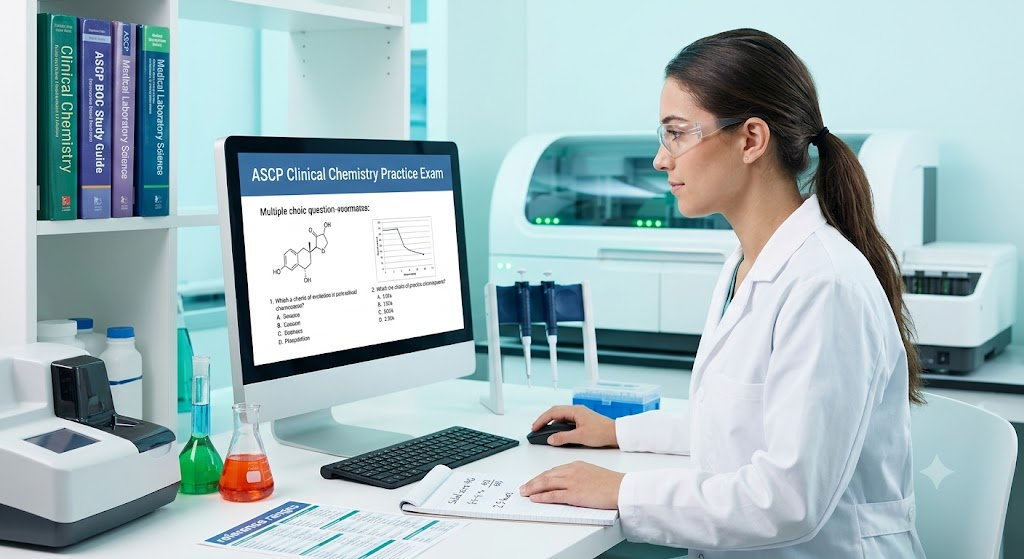
Additional Information
What the Course Entails and Exam Details
Preparing for the ASCP Clinical Chemistry exam is more of a comprehensive study process rather than a structured course.
It involves meeting eligibility requirements and then deeply studying the designated content areas.
The exam content generally encompasses a wide range of analytical methodologies, clinical applications, laboratory management, and quality control.
Here are the key areas you can expect to be covered:
Clinical Biochemistry & Physiology: Fundamentals of metabolic processes, organ function (liver, kidney, thyroid, etc.), and the chemical components involved.
Electrolytes & Acid-Base Balance: Analysis of crucial body ions and the measurement of pH and blood gases.
Specific Content Areas: Comprehensive study of proteins, enzymes, lipids, hormones, carbohydrates, therapeutic drugs, and toxicology.
Methodology & Instrumentation: Understanding various analytical techniques like spectrophotometry, chromatography, immunoassay, and automation in the lab.
Laboratory Operations: Principles of quality control, quality management, regulatory compliance, laboratory safety, and calculations.
Data Interpretation & Correlation: The ability to not only perform tests but also interpret results in the context of disease states.
The eligibility pathways, specific application fees, and the exact mix of clinical versus Specialist (SC) topics will vary.
You must refer to the current ASCP Board of Certification (BOC) guidelines for the most accurate and up-to-date information for the specific credential you are seeking.
What to Expect in the Final Exam
The actual ASCP Clinical Chemistry exam is typically administered in a multiple-choice format.
It uses a sophisticated system known as Computer Adaptive Testing (CAT).
This means the exam dynamically adjusts the difficulty of the questions based on your performance.
If you answer a question correctly, the next question will be slightly more challenging.
If you answer incorrectly, the system presents an easier question to gauge your knowledge level in that specific area.
There is no pre-determined number of questions that guarantees a pass; the test proceeds until your performance demonstrates mastery above the passing standard or your time limit expires.
Typically, you can expect an indicative timeframe of around 2.5 hours and around 100 questions for some levels, but this can vary.
The specific number of questions and time limit will be confirmed in your examination details.
To pass, you must achieve a scaled score, which is typically around 400 out of a range that often goes up to 999. This scaled score is calculated based on the number and difficulty of the questions you answer correctly.
Be prepared for a testing environment with security protocols, requiring proper identification. You are usually not allowed to bring outside resources, calculators, or electronic devices into the testing area, and simple calculators are often provided.
How to Study and Exam Centers
Preparation for this challenging exam requires dedication, strategy, and consistent effort.
Review Official ASCP BOC Guidelines: This should be your first step. Thoroughly understand the content outline, recommended study resources, and exam format.
Utilize ASCP-Recommended Textbooks & Publications: Standard laboratory medicine and clinical chemistry textbooks are vital. Look for publications and practice questions specifically recommended by the ASCP.
Practice with Multiple-Choice Questions: Invest in high-quality question banks and practice exams. Simulating the adaptive test environment can build confidence and improve timing.
Create a Study Schedule: Break down the content outline into manageable topics and dedicate specific study time for each. Consistent daily or weekly study is more effective than cramming.
Focus on Weak Areas: Use your practice test results to identify and prioritize your review of topics where you need improvement.
Stay Healthy: Good sleep, a balanced diet, and effective stress management are all essential for optimal cognitive function and focus during your preparation and on exam day.
The ASCP exams are typically taken at authorized Pearson VUE testing centers.
Book Your Appointment: You will receive an Authorization to Test (ATT) email from the ASCP once your application is approved. This will provide instructions and a unique link to schedule your exam through the Pearson VUE online portal.
Find a Local Center: You can search for and select a Pearson VUE testing center near your location that offers the specific ASCP examination. Physical testing centers are available globally.
Check Availability: Be mindful of scheduling, as appointments can fill up. It's often recommended to book your preferred time well in advance.
Confirm Regulations: Familiarize yourself with all the specific rules and requirements of the chosen testing center before your exam date. This includes arrival time and required documentation.
Job Opportunities from the Course
A certification from the ASCP Board of Certification is highly respected and can significantly enhance your career in the medical laboratory field.
The job titles below represent potential pathways for those who achieve certification in Clinical Chemistry.
Clinical Chemistry Specialist
Technologist in Chemistry
Specialist in Chemistry
Medical Laboratory Scientist (Specializing in Chemistry)
Laboratory Supervisor (Chemistry Department)
Toxicology Analyst
Quality Control Specialist
Research Assistant/Scientist (Clinical Diagnostics)
Public Health Laboratory Scientist (Chemistry Division)
These roles can be found in various settings, including:
Hospitals and Medical Centers
Clinical Reference Laboratories
Public Health Departments
Diagnostic Instrument and Reagent Manufacturers
Educational Institutions
Becoming certified shows your commitment to quality and patient care, often leading to increased responsibility, higher compensation, and a more fulfilling professional journey.
Frequently Asked Questions
Reviews
5.0
Based on 0 reviews
Leave a Review
No reviews yet. Be the first to review!