
ASAP Emergency Department Fundamentals (ASAP ED 100) and Administrator (ASAP ED 500) Practice Test
$69.00
- Buy to unlock unlimited access to all Quiz questions.
- After purchase you can print a PDF of the whole quiz at any point. The PDF will contain the questions and the correct answers.
About this Exam
The ASAP Emergency Department pathway consists of two essential parts, Fundamentals (ED 100) and Administrator (ED 500). This certification stream is uniquely designed for healthcare professionals, clinical analysts, and IT administrators working within or supporting dynamic Emergency Departments that utilize the Epic EHR system.
The combined knowledge base ensures clinical staff can chart efficiently, provide excellent care, and triage effectively within the system, while also empowering administrative teams and informatics specialists to build, manage, and optimize the backend settings. Whether you are a clinician looking to master workflow or an analyst aiming to configure track boards and user roles, mastering the content covered in these modules is crucial. The comprehensive practice exam in our title is an indispensable tool in this journey, simulating real test scenarios and cementing vital concepts across both clinical and administrative domains.
Ready to test your knowledge?
Buy Now to Access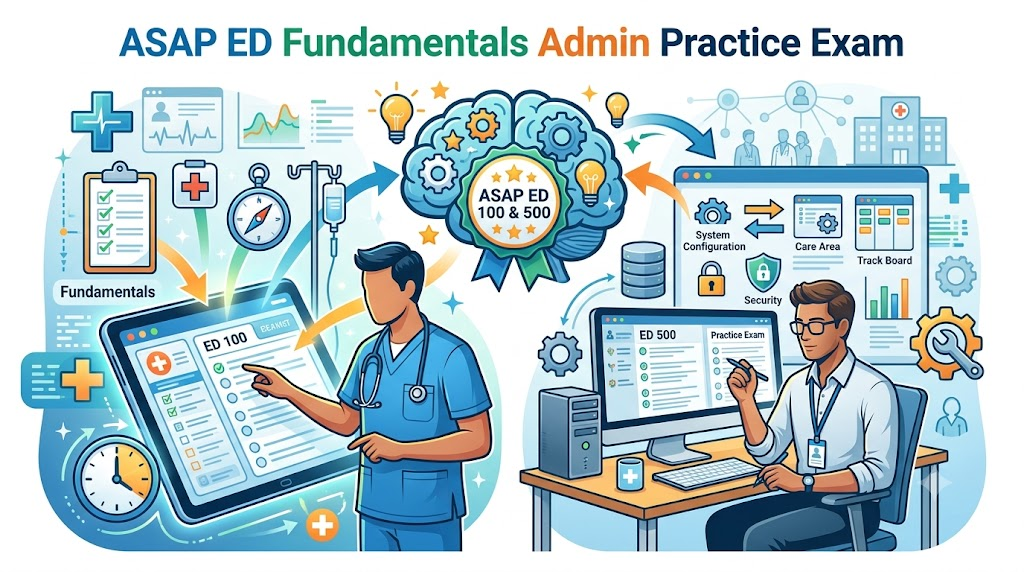
Additional Information
What the Course Entails and Exam Details
The course material is divided into fundamental clinical usage and advanced administrative configuration, preparing you for separate yet related components of the final assessment.
ASAP Emergency Department Fundamentals (ED 100) covers the day-to-day operations and workflow for clinical and support staff. Key topics include:
System Navigation: Mastering the interface, activities, navigators, and basic documentation within the ASAP module.
Patient Arrival & Triage: Efficiently managing the initial stages of a patient's ED visit within the system.
Workflow for Doctors & Nurses: Exploring charting, order entry, problem lists, medication administration, and notes.
Result Review & Documentation: Utilizing tools to efficiently access information and complete patient charts, including the use of SmartTools.
Discharge & Disposition: Documenting the final steps of care and concluding the patient's ED stay.
ASAP ED Administrator (ED 500) delves into the backend configuration, logic, and management required to tailor the system to an institution's specific needs. Core topics include:
Department & Location Setup: Configuring the facility structure, Care Areas, and patient lists.
Workflow Engine Rules: Creating logic and rules to automate tasks and guide clinical workflows based on specific conditions.
Track Board & ED Manager Views: Designing and customizing essential tracking tools for visibility and efficiency.
ADT Status Configuration: Setting up and mapping patient status definitions for seamless movement within the ED.
Security & User Roles: Managing permissions, access levels, and security classes for different staff roles.
Advanced Tools & Customization: Utilizing Narrator Admin, custom reports, and configuration for optimal system performance and troubleshooting.
What to Expect in the Final Exam
While specific details can vary by institution and vendor (e.g., specific organization proctoring or vendor systems), the final certification often follows a clear format to validate mastery of both clinical application and system configuration. The comprehensive preparation this guide provides is geared towards preparing you for these structures.
Format: The primary format is typically online and multiple-choice questions. Depending on the exact certification type (clinical proficiency vs. full build certification), you may also encounter practical scenarios or simulated case studies that require specific application of knowledge within the Hyperspace/Hyperdrive environment.
Questions: Expect questions that assess both your conceptual understanding and your ability to apply logic or configure system settings. They often require critical thinking about workflows, troubleshooting, and complex rule building, particularly for the ED 500 content.
Open Resource Status (Variable): CRITICAL: You must verify this with your training coordinator, organization, or the specific examining body. Traditionally, some professional certification exams, particularly for specific vendors, have allowed the use of official, unannotated training materials and internal system guides. However, this is NOT a universal rule. It is imperative to confirm whether you can access resources (digital companions, PDFs, search functions, training environment) and what exactly is permitted before starting the exam.
Time Limits & Passing Score: Expect specific time limits (e.g., 60-120 minutes per exam part) and a predetermined passing score (often in the range of 70-80%). These factors are designed to evaluate both accuracy and efficiency under pressure. Results are typically provided immediately or very shortly after submission.
How to Study and Exam Centers
Preparation is key to success on both components of this crucial certification. The combination of clinical knowledge and administrative logic requires dedicated effort and strategic study methods.
Official Training Materials: Fully engage with all provided courses, curriculum, slideshows, and official curriculum companions. Use the Ctrl+F search function effectively within digital resources to locate specific details and context – this skill is vital for both study and potentially the exam.
Utilize Practice Environments: If provided by your employer or the training vendor, spend significant time in the training/playground environment. Actively practice navigating clinical workflows for ED 100 and configuring settings/building rules for ED 500. This hands-on practice is irreplaceable.
Review Practice Tests: The practice exam included in our title is an essential tool. Use it to identify knowledge gaps, familiarize yourself with the type and phrasing of questions, and practice managing time. Go over your incorrect answers thoroughly, referencing official material to understand the logic.
Study Groups & Discussion: Collaborate with colleagues or search for study forums. Discussing complex topics, sharing insights, and reviewing concepts with others can provide new perspectives and reinforce understanding.
Time Management: As both exams likely have strict time limits, practice answering questions efficiently and knowing when to mark a question and return to it.
Exam Centers: The actual final exam is typically administered in one of the following ways, determined by your sponsoring organization:
Employer/Organization-Based: Many large healthcare institutions implement the Epic system and facilitate the exams themselves. This might involve an on-site testing area, virtual proctoring from within the organization, or a controlled online environment through an internal portal.
Authorized Proctoring Services: Exams might be administered through recognized online proctoring vendors (e.g., Prometric, or organization-specific services), allowing you to take the test in a secure, monitored environment (often from your own computer with proper setup).
Epic Training Centers: In some rare cases, for specific advanced certifications or roles, exams might be taken at an official training facility (such as in Verona, WI), but this is less common for general staff certification and more relevant to initial vendor-sponsored training.
You will receive specific instructions from your employer’s informatics or training department regarding where and how you must register for and take your finalized exam.
Job Opportunities from the Course
Earning certification in ASAP ED Fundamentals and Administrator unlocks numerous valuable career paths within the intersection of healthcare and technology, particularly within the vast network of institutions using the Epic EHR. The following are typical roles this qualification can lead to:
Clinical Informatics Specialist (ED focus): A hybrid role bridging clinical experience and system expertise. This position acts as a liaison between ED staff and IT, training clinicians on best practices, optimizing clinical workflow, and analyzing system usage.
ASAP Analyst (Certification required/preferred): Dedicated to the design, build, configuration, and ongoing support of the ASAP module. Responsibilities include building rules, customizing track boards, and managing system logic. This role can range from entry-level to senior positions.
Emergency Department Operations Manager: A purely administrative role overseeing the day-to-day operations and strategic management of the Emergency Department. System knowledge from this course is highly valued for understanding and improving ED metrics and workflow.
Epic System Administrator (ASAP): A highly technical IT position responsible for the overall configuration, maintenance, security, and performance of the specific ASAP application and its integration with other Epic modules.
Clinical Informaticist Nurse/Physician Liaison: Senior roles, often requiring extensive clinical experience, dedicated to championing EHR optimization from a provider perspective within the ED and other departments.
EHR Training Specialist (ED): Specializes in designing curriculum and training newly hired or existing clinical and administrative staff on proficient use of the ASAP module.
Healthcare Consultant (Epic ASAP module): Experienced individuals can transition into consulting, advising multiple institutions on implementation, build quality, and optimization strategies for their ASAP systems.
Informatics Project Manager: Leadership roles managing projects related to EHR optimization, module upgrades, or new feature implementations within the Emergency Department setting.
Frequently Asked Questions
Reviews
5.0
Based on 0 reviews
Leave a Review
No reviews yet. Be the first to review!