
ARRL Technician Practice Exam
$69.00
- Buy to unlock unlimited access to all Quiz questions.
- After purchase you can print a PDF of the whole quiz at any point. The PDF will contain the questions and the correct answers.
About this Exam
The ARRL Technician Class Amateur Radio license is the entry-level ticket to the exciting world of amateur radio in the United States. Designed for newcomers of all ages, this certification requires no prior experience or knowledge of Morse code. The exam validates that you possess the basic knowledge and understanding of electronic principles, FCC rules, operating procedures, and safety necessary to operate an amateur radio station safely. It is perfect for people interested in local and regional communication, experimentation with radio technology, or serving their communities during emergencies.
Ready to test your knowledge?
Buy Now to Access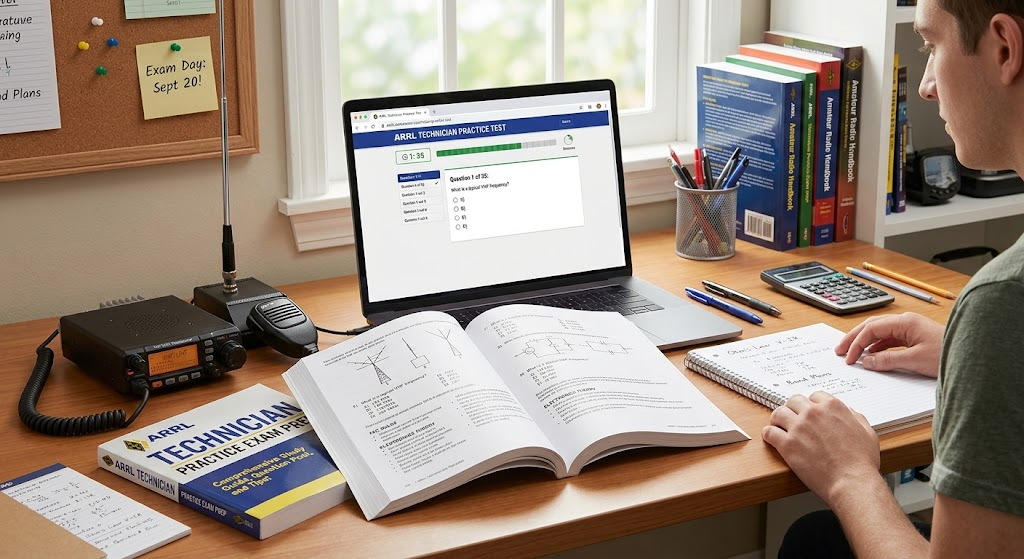
Additional Information
What the Course Entails and Exam Details
Preparing for the Technician license means gaining a foundational understanding of a range of technical and regulatory subjects. While you can self-study with a variety of materials, most successful candidates study a comprehensive question pool of hundreds of possible multiple-choice questions. The core topic areas you must master include:
Commission's Rules (FCC Regulations): Fundamental regulations governing the Amateur Radio Service in the US, including permissible uses, licensing terms, station identification, and prohibited actions. (Typically 6 questions on the final exam)
Operating Procedures: Best practices for communicating on amateur radio, using common modes like FM and repeaters, proper calling frequencies, band plans, and emergency operations. (3 questions)
Radio Wave Propagation: How radio signals travel at different frequencies, including ground wave, skip (ionospheric reflection), scatter, and general characteristics like polarization. (3 questions)
Amateur Radio Practices: Station setup, essential tools and equipment, grounding, Mobile operations, and basic station configuration. (2 questions)
Electrical Principles: Fundamental concepts of electronics like voltage, current, resistance, power, Ohm’s Law, and how they interact in DC and simple AC circuits. (4 questions)
Electronic and Electrical Components: Identifying and understanding common components such as resistors, capacitors, inductors, transistors, diodes, and switches. (4 questions)
Practical Circuits: Understanding schematic symbols and how components combine into simple filter, amplifier, and oscillator circuits. (3 questions)
Signals and Emissions: Types of modulation, spectrum usage, different modes like voice, CW, and digital data, and signal bandwidth. (4 questions)
Antennas and Feed Lines: Principles of antenna design, common types, feed line characteristics, and matching antenna impedance. (2 questions)
Safety: Protecting yourself and others, including electrical safety in the shack, RF exposure considerations, and antenna installation safety. (4 questions)
The entire study guide revolves around the officially published FCC Technician question pool, which is updated every four years. This ensures that everyone studying has access to the exact questions and multiple-choice answers that could appear on the actual exam. The final test will consist of 35 multiple-choice questions selected randomly from the various pools and categories mentioned above.
What to Expect in the Final Exam
The final step in earning your Technician license is passing a 35-question multiple-choice exam. The test session is administered by a group of Volunteer Examiners (VEs), seasoned hams who have been certified to conduct amateur radio exams by a Volunteer Examiner Coordinator (VEC) like the ARRL.
Format: The exam consists of 35 multiple-choice questions, each with four potential answers. Only one answer is correct for each question. The specific questions are randomly selected from the public domain question pool, so you won’t know exactly which questions you'll get but will have studied all possibilities.
Passing Score: To achieve your license, you must answer at least 26 questions correctly. This equates to a minimum passing score of 74%.
Time Limits: There are typically no formal time limits for completing the ARRL Technician exam. The VEs understand that some people take longer than others, and the primary goal is to assess understanding rather than speed. A typical candidate can complete the test in 15 to 45 minutes. The only time constraint is the overall duration of the VE session you attend.
Rules & Materials: The exam is typically closed-book. You are not allowed to use any study materials, smartphones, tablets, or the internet during the test. The VEs will provide you with a test booklet (or present questions on a screen in some remote sessions) and a separate answer sheet. A basic non-programmable calculator is often permitted, subject to the inspection and approval of the VEs. You must also bring a form of photo identification and the required exam fee, as well as your FCC-issued FCC Registration Number (FRN), which you must obtain beforehand.
How to Study and Exam Centers
Earning your license is a structured process of study and testing. While there are paid classes and tutors, many people successfully self-study.
How to Study:
Get the Official Study Materials: ARRL publishes a comprehensive "Ham Radio License Manual" for the Technician Class. This is the gold standard, providing the study text and the complete question pool with answers and explanations. There are also reputable online and app-based study guides, practice tests, and question pool review tools (like ARRL’s own Exam Review for Ham Radio).
Focus on the Question Pool: Because the actual exam questions come directly from a public pool, your most critical study strategy is to thoroughly review that entire pool multiple times. Make flashcards or use study software that tracks your progress on every single question.
Understand the "Why": Don't just memorize the correct letter answers. Read the explanatory text and understand the underlying concepts. This knowledge is essential for safe and responsible operating.
Take Multiple Practice Exams: Consistently take randomly-generated practice exams. These simulate the real test experience in content, structure, and timing. Aim for a regular score of at least 85% on these practice runs to give yourself a safety buffer on exam day.
Find Local Resources: Consider joining a local amateur radio club. Clubs often host "ham classes" and their members, "Elmers" as they're known in the hobby, can provide priceless advice, mentoring, and support.
Exam Centers:
AMRRL exams are administered by dedicated Volunteer Examiners in person at physical locations across the country, as well as via remote video test sessions. Finding an exam center is made easy by the ARRL's online tools.
Finding an In-Person Session: Use the ARRL website’s "Find an Amateur Radio License Exam Session" search feature. You can search by ZIP code or state to find upcoming test dates and locations in your community, often hosted by local libraries, churches, emergency centers, or radio club meetings.
Finding a Remote/Online Session: While ARRL also coordinates some remote sessions, you may need to use similar search features and resources to find VECs and VE teams that specialize in video-supervised online testing. This requires a stable internet connection, specific camera setups, and adherence to strict protocols for academic integrity. The ARRL search results typically indicate whether a session is in-person or remote.
Regardless of the method you choose, you will need to pay a small exam fee to cover the VEs' administrative costs.
Job Opportunities from the Course
While amateur radio is fundamentally a non-commercial, skilled hobby, the technical and regulatory knowledge validated by the Technician Class license opens doors to a variety of related fields. It demonstrates a foundational proficiency in electronics and communication that employers in numerous industries value. The certification effectively showcases your ability to master technical concepts and your commitment to a specialized discipline. Here is a list of specific job titles and career paths where the knowledge gained through this certification is directly applicable and highly beneficial:
Electronics Technician
RF (Radio Frequency) Technician
Broadcasting Technician / Engineer
Satellite Technician / Installer
Telecommunications Support Specialist
Avionics Technician / Electronics Installer (Aviation)
Emergency Communications Specialist / Dispatcher (Many volunteer roles exist, but paid roles often prioritize candidates with relevant technical communication skills)
Marine Electronics Technician
Amateur Radio Equipment Sales & Support
RF Safety Officer / Consultant
Tower Technician (Antenna Installation/Maintenance)
Communication & Security Systems Technician
Any technical or engineering support role involving radio communications
Beyond specific job titles, having an amateur radio license can make your resume stand out in various technical and service-oriented fields, signaling technical aptitude, problem-solving skills, and a potential for public service.
Frequently Asked Questions
Reviews
5.0
Based on 0 reviews
Leave a Review
No reviews yet. Be the first to review!