
Arizona State University (ASU) Fin300 Fundamentals of Finance Final Practice Exam
$69.00
- Buy to unlock unlimited access to all Quiz questions.
- After purchase you can print a PDF of the whole quiz at any point. The PDF will contain the questions and the correct answers.
About this Exam
The Arizona State University (ASU) Fin300 Fundamentals of Finance course is a critical milestone for undergraduate business students. This comprehensive course serves as the gateway to advanced finance topics, designed to equip students with the analytical tools necessary for making sound financial decisions in both corporate and personal environments.
The Fin300 Final Practice Exam is not just a quiz; it is a rigorous simulation designed to test your mastery of core financial principles. Whether you are an on-campus student or enrolled in ASU Online, this practice exam mirrors the format, difficulty, and scope of the actual final. It is intended to identify your strengths and weaknesses, ensuring you are fully prepared for the high-stakes final assessment that determines your success in the course.
Ready to test your knowledge?
Buy Now to Access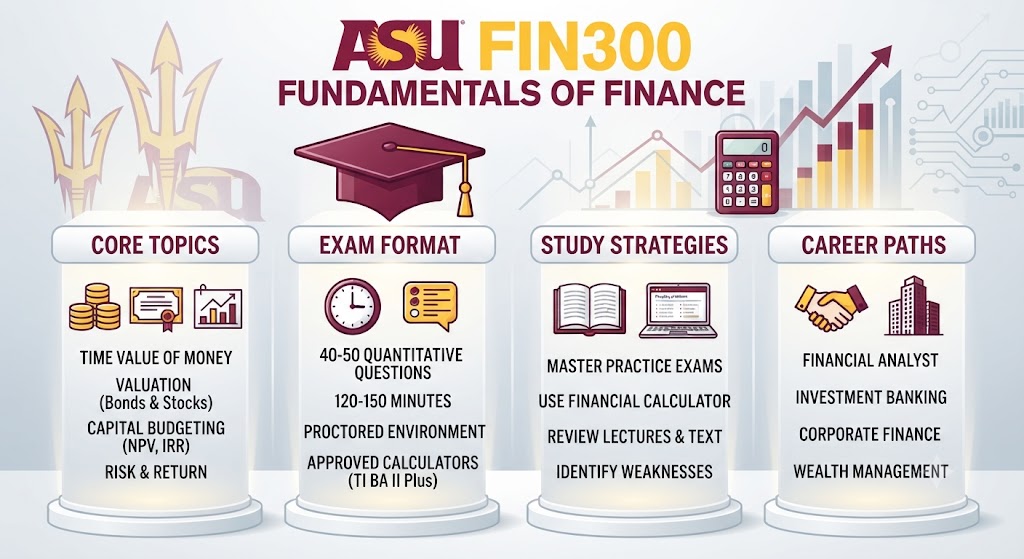
Additional Information
What the Course Entails and Exam Details
ASU’s Fin300 covers a broad spectrum of financial theory and
application. To succeed in the course and on the final practice exam, you must
demonstrate proficiency in several key areas:
- Time
Value of Money (TVM): This is the foundation of all finance. You must
be highly competent in calculating present value (PV), future value (FV),
annuities, and perpetuities using financial calculators (like the BA II
Plus) or Excel.
- Valuation
of Securities: The exam will test your ability to value both stocks
(using the Gordon Growth Model/DDM) and bonds (calculating yield to
maturity and price).
- Capital
Budgeting: You will need to apply techniques like Net Present Value
(NPV), Internal Rate of Return (IRR), Payback Period, and Profitability
Index to evaluate potential investment projects.
- Risk
and Return: Understanding the relationship between risk and reward is
crucial. Expect questions on calculating expected returns, standard
deviation, and utilizing the Capital Asset Pricing Model (CAPM).
- Financial
Statement Analysis: You must be able to interpret financial statements
and calculate key ratios (liquidity, profitability, leverage, and
efficiency ratios) to assess a firm's financial health.
- Cost
of Capital: The exam covers calculating the Weighted Average Cost of
Capital (WACC) and understanding its role in investment decisions.
What to Expect in
the Final Exam
The ASU Fin300 Final Exam is a comprehensive, proctored
assessment. While the specific format may vary slightly depending on the
semester and instructor (e.g., Professor Michael Groom or others), students
should generally prepare for the following structure:
- Format:
The exam typically consists of 40–50 multiple-choice questions. These are
not simply definitional; they are predominantly quantitative, requiring
multi-step calculations.
- Duration:
You will generally have 120 to 150 minutes (2 to 2.5 hours) to complete
the exam. This requires not only accuracy but also speed in performing
calculations.
- Materials:
This is a closed-book exam. However, you are usually permitted a specific,
approved financial calculator (most commonly the Texas Instruments BA II
Plus or BA II Plus Professional). Instructors often provide a formula
sheet, but you must know how and when to apply these
formulas rather than just relying on the sheet.
- Proctoring:
The exam is heavily proctored, either in person at an ASU testing center
or via an online proctoring service like Honorlock, which requires a
webcam and microphone.
- Passing
Score: While a "D" is technically passing for credit, most
business school programs require a "C" or better to progress to
upper-division finance courses. A high score on the practice exam is the
best indicator of your ability to achieve this.
How to Study and
Exam Centers
Effective preparation for the Fin300 Final Practice Exam
requires a strategic approach. Do not attempt to cram; this material is
cumulative and complex.
- Master
the Practice Exam: Treat the practice exam as a primary study tool,
not just a test. Take it under simulated conditions (no notes, timed).
Afterward, review every single question—not just the ones you got wrong.
Understand the methodology used to reach the correct answer.
- Utilize
the Financial Calculator: Speed is essential. Ensure you are fluent in
using your BA II Plus. Practice complex TVM and cash flow worksheet
functions repeatedly so that inputting data becomes second nature during
the actual exam.
- Work
Practice Problems: Textbook problems and additional problem sets
provided by your instructor are invaluable. The more variations of
problems you solve, the more comfortable you will be when faced with novel
questions on the exam.
- Identify
Weaknesses Early: If you struggle with a specific concept (e.g., WACC
or bond duration), do not move on until you understand it. Review lecture
recordings, read the textbook chapter again, and attend office hours or
tutoring sessions.
- Where
and How to Take the Exam: The official final exam must be taken as
scheduled by ASU. For online students, this is typically facilitated
through the course’s online portal (like Canvas) using a remote proctoring
service. For immersion (on-campus) students, the exam is usually administered
in a designated physical testing center on campus.
Job Opportunities from the Course
Mastering the Fundamentals of Finance is the first step
toward a lucrative career in the financial services industry and beyond. While
this specific course is foundational, it opens doors to numerous career paths
that require strong analytical and quantitative skills:
- Financial
Analyst: Corporate finance roles analyzing budgets, forecasts, and
operational performance.
- Investment
Banking Analyst: Entry-level roles focused on financial modeling,
valuation, and creating pitch books for M&A and capital raising.
- Credit
Analyst: Evaluating the creditworthiness of individuals or businesses
for banks and lending institutions.
- Personal
Financial Advisor: Helping individuals manage their money,
investments, and retirement planning.
- Budget
Analyst: Assisting public and private organizations in organizing
their finances and preparing budget reports.
- Commercial
Real Estate Analyst: Analyzing the financial viability of real estate
investments and developments.
- Corporate
Treasurer: Managing a company's cash flow, liquidity, and financial
risk.
Frequently Asked Questions
Reviews
5.0
Based on 0 reviews
Leave a Review
No reviews yet. Be the first to review!