
Arizona State University (ASU) BIO320 Fundamentals of Ecology Exam 3 Practice
$69.00
- Buy to unlock unlimited access to all Quiz questions.
- After purchase you can print a PDF of the whole quiz at any point. The PDF will contain the questions and the correct answers.
About this Exam
Welcome to your essential resource for mastering the Arizona State University (ASU) BIO320: Fundamentals of Ecology Exam 3. This comprehensive study guide and accompanying practice exam are meticulously designed for students currently enrolled in ASU's BIO320 course, whether through the online campus or in-person. It is specifically tailored to help you consolidate your understanding of the complex ecological principles covered in the third major section of the syllabus. By using this practice tool, you will gain confidence, identify knowledge gaps, and familiarize yourself with the type of critical thinking and problem-solving required to excel in your upcoming examination
Ready to test your knowledge?
Buy Now to Access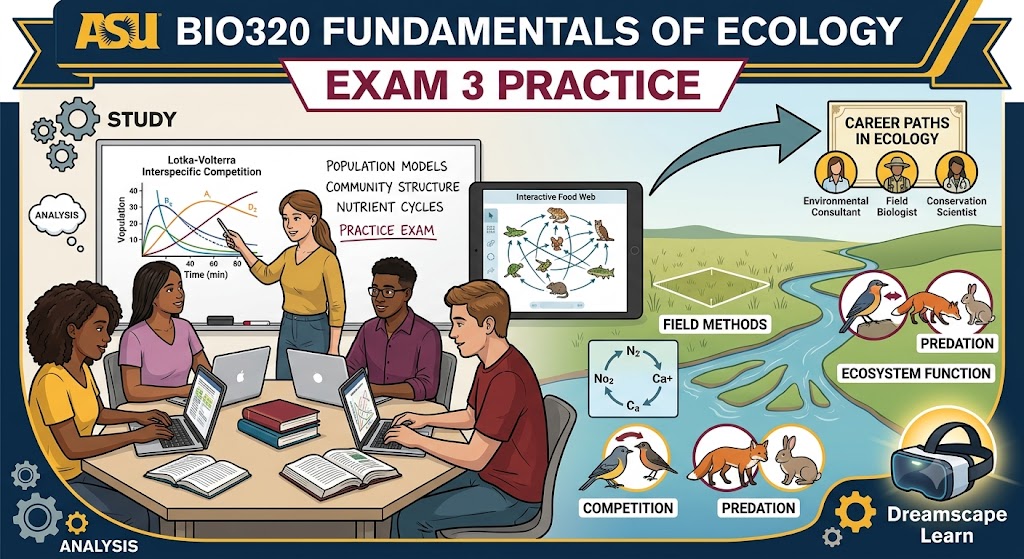
Additional Information
What the Course Entails and Exam Details
BIO320 Fundamentals of Ecology at ASU is a rigorous
exploration of the interactions that determine the distribution and abundance
of organisms. Exam 3 typically marks a transition from foundational population
ecology to more complex community and ecosystem-level processes. Based on
common course structures, the core topics and skills covered for this exam
include:
- Population
Interactions: In-depth study of competition (interspecific and
intraspecific), predation, herbivory, parasitism, and mutualism.
- Community
Structure: Concepts of species diversity, richness, evenness, and food
webs. You should be able to analyze community dynamics and successional
patterns.
- Ecosystem
Function: Flow of energy through trophic levels and the cycling of
critical biogeochemical nutrients (carbon, nitrogen, phosphorus).
- Applied
Ecology and Conservation: Application of ecological models (like
Lotka-Volterra) and principles to address real-world problems such as
invasive species, habitat fragmentation, and biodiversity loss.
- Data
Analysis: Interpreting graphs, population growth curves, and
experimental data common in ecological research.
What to Expect in
the Final Exam
While this practice tool is an exceptional resource, please
remember that this practice exam is not the official final exam for the
course. It is a preparatory simulation. The official ASU BIO320 final exam
will be administered by your instructor and will be comprehensive, covering
material from the entire semester. However, knowing what to expect on your
final can help structure your studies:
- Format:
The actual final is often a blend of multiple-choice questions, quantitative
problem-solving (interpreting data/models), and short-answer/essay
questions requiring synthesis of concepts.
- Time
Limit: Expect a strict time limit (typically 110 minutes for standard
lecture exams).
- Passing
Score: The passing score is determined by the overall grading scale
outlined in your specific course syllabus, but a final grade of C or
better is usually required to count toward major requirements in life
sciences.
- Specific
Rules: You will take the final through ASU's official proctoring
systems (like Honorlock for online students or in-person with TA
proctors). Be prepared to follow all academic integrity policies.
How to Study and
Exam Centers
Effective study for BIO320 involves active engagement with
the material, not just passive reading. Use this guide and practice exam as
followsDiagnostic Test: Take the practice exam first, under timed
conditions if possible, without notes. This will instantly show you which areas
(e.g., population modeling vs. nutrient cycles) need the most work.
Active Review: Do not just check the correct answers.
For every question you missed, go back to your textbook, lecture slides, and
notes to understand why the correct answer is correct and why
your initial choice was wrong.
Collaborative Study: Join a study group through your
course’s Canvas discussion boards or a student-led platform to discuss
difficult concepts, especially the mathematical models of ecology.
How to Take the Actual Final:
The official final exam is a proctored event. Online students access the
exam via the ASU Canvas portal, utilizing the required proctoring software.
In-person students will be informed by their instructor of the specific
physical lecture hall or test center designated for the final exam. Always
check your syllabus for official dates, times, and location details.
Job Opportunities
from the Course
A strong foundation in ecology unlocked by BIO320 and your
subsequent degree prepares you for a diverse and impactful range of careers.
Completing this course and a degree in Biological Sciences (Conservation
Biology and Ecology) is a direct pathway to roles such as:
- Ecologist
- Field
Biologist
- Conservation
Scientist
- Restoration
Ecologist
- Wildlife
Biologist
- Environmental
Consultant
- Park
Naturalist
- Natural
Resource Manager
- Research
Assistant (in academic, government, or NGO laboratories)
- Science
Educator/High School Teacher
Frequently Asked Questions
Reviews
5.0
Based on 0 reviews
Leave a Review
No reviews yet. Be the first to review!