
ARDMS Ultrasound Physics & Instrumentation Practice Exam
$69.00
- Buy to unlock unlimited access to all Quiz questions.
- After purchase you can print a PDF of the whole quiz at any point. The PDF will contain the questions and the correct answers.
About this Exam
The ARDMS Sonography Principles & Instrumentation (SPI) examination is a critical credentialing step for professionals seeking to become Registered Diagnostic Medical Sonographers (RDMS), Registered Diagnostic Cardiac Sonographers (RDCS), Registered Vascular Technologists (RVT), or Registered Musculoskeletal Sonographers (RMSKS). This exam is a prerequisite for nearly all ARDMS specialty exams, making it the gateway to a successful career in ultrasound. It is designed to evaluate a candidate’s fundamental understanding of the physical principles that underpin diagnostic ultrasound, as well as the instrumentation used to create these images. Passing the SPI is a key requirement for achieving professional recognition in the field and demonstrates your competence to provide high-quality patient care.
Ready to test your knowledge?
Buy Now to Access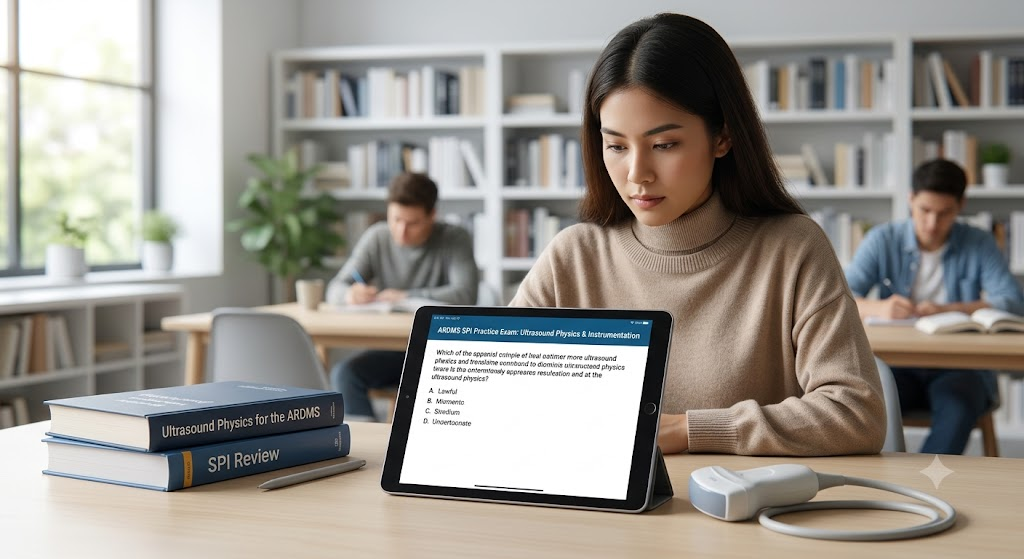
Additional Information
What the Course Entails and Exam Details
The ARDMS SPI examination is focused on assessing your grasp of the fundamental physics and instrumentation principles that create, display, and analyze ultrasound images. The core content areas covered include:
Ultrasound Physics: You must deeply understand how ultrasound waves are generated, propagated through tissue, and interact with different anatomical structures. This includes knowledge of parameters like frequency, period, wavelength, and propagation speed, as well as attenuation, absorption, scattering, and reflection.
Transducers: A key component is understanding the different types of transducers (linear, curved, phased, etc.) and their specific applications. You must know how they work and the factors influencing their performance.
Beam Formation and Imaging: This area involves the mechanics of beam steering, focusing, and the resulting image resolution. You will need to understand the differences between A-mode, B-mode, and M-mode displays.
Instrumentation and Controls: You must know how to operate ultrasound equipment effectively. This includes knowledge of a variety of controls like gain, depth, dynamic range, time gain compensation (TGC), and output power.
Doppler Ultrasound: This topic covers the principles of both spectral and color Doppler, which are crucial for assessing blood flow. You should understand frequency shift, velocity calculations, and how to optimize Doppler settings.
Artifacts: Recognizing and minimizing image artifacts is essential for accurate diagnosis. You need to understand common artifacts, including aliasing, shadowing, and reverberation.
Quality Assurance and Safety: This part ensures you understand the importance of quality control procedures and adhere to established safety guidelines.
Patient Safety and Communication: The exam also includes questions related to proper patient care, communication, and ethical considerations.
The SPI is a computer-based, multiple-choice, multiple-response, point-and-click, and hot spot test with approximately 110 questions, including some unscored pretest questions. The time limit is approximately 2 hours, and you need to achieve a scaled score of at550 or higher to pass.
What to Expect in the Final Exam
When you sit for the ARDMS SPI final exam, you can anticipate a computer-based test that is both comprehensive and demanding. The exam consists of approximately 110 multiple-choice, multiple-response, point-and-click, and hot spot questions, which are presented one by one. While some pretest questions might be included, you will not know which ones they are. The total time allocated for the exam is 2 hours.
You will have to read the questions carefully and select the best answer. The multiple-choice format requires choosing a single correct answer, while multiple-response questions may have more than one. In point-and-click questions, you will have to select specific areas on an image or diagram. The hot spot format is similar but may require a more precise selection. You must achieve a scaled score of 550 or higher to pass. Your score will be calculated based on your correct answers.
It is critical to arrive at the testing center at least 30 minutes before your scheduled appointment time. You must bring a valid government-issued photo ID. There is a specific set of rules and procedures you must follow, such as storing personal items in a locker, not bringing any study materials or electronic devices into the testing room, and avoiding any communication with other candidates.
How to Study and Exam Centers
Preparing for the ARDMS SPI exam requires a combination of structured learning, practical application, and consistent review. Here is a plan to help you succeed:
Master the Core Concepts: Spend time deeply understanding the fundamental physics principles and instrumentation concepts covered in the content areas. Use reliable study materials such as textbooks like Edelman’s "Ultrasound Physics and Instrumentation" or Kremkau’s "Diagnostic Ultrasound: Principles and Instruments."
Practice with Real Questions: Consistent practice is crucial. Use a reputable online ARDMS SPI practice exam to get familiar with the test format, assess your knowledge gaps, and build test-taking stamina. Look for platforms that offer detailed explanations for both correct and incorrect answers.
Utilize Official Resources: Check the ARDMS website for official study resources, including their examination content outline, a list of suggested study materials, and information about the exam structure and policies.
Join Study Groups: Interacting with peers can be very beneficial. Sharing knowledge, discussing complex topics, and testing each other's understanding can reinforce your learning.
Attend Review Courses: Consider attending a reputable ARDMS SPI review course, whether in-person or online. These courses are often taught by experienced instructors and can provide a structured learning path.
Review Regularly: Consistency is key. Create a study schedule and dedicate time each day to review material and take practice questions.
Time Management: As the exam is timed, practice managing your time effectively. During your practice exams, aim to answer each question within a reasonable time.
The ARDMS SPI exam is administered at Pearson VUE testing centers worldwide. To schedule your exam, you must first create an account on the Pearson VUE website and pay the registration fee. Once registered, you can choose a convenient test center, date, and time. Ensure you read the full rules and regulations of the specific center you choose.
Job Opportunities from the Course
Upon achieving your ARDMS SPI credential, which is a key stepping stone towards full ARDMS certification, you will be well-positioned to unlock numerous job opportunities in the rapidly growing field of sonography. Some of the most common job titles that become accessible include:
Registered Diagnostic Medical Sonographer (RDMS)
Registered Diagnostic Cardiac Sonographer (RDCS)
Registered Vascular Technologist (RVT)
Registered Musculoskeletal Sonographer (RMSKS)
Diagnostic Medical Sonographer
Ultrasound Technologist
Cardiac Sonographer
Vascular Sonographer
General Sonographer
OB/GYN Sonographer
Abdominal Sonographer
Breast Sonographer
With your SPI credential, you can pursue jobs in a wide variety of medical settings, including hospitals, clinics, private practices, and imaging centers. The demand for qualified sonographers is consistently high, and this certification can provide a stable and fulfilling career with opportunities for growth and advancement.
This comprehensive study guide for the ARDMS SPI exam provides you with the crucial knowledge and actionable strategies to excel in this essential test. By diligently applying these principles, you will be well-equipped to achieve success and open the door to a rewarding career as a certified ultrasound professional. Best of luck on your exam!
Frequently Asked Questions
Reviews
5.0
Based on 0 reviews
Leave a Review
No reviews yet. Be the first to review!