
ARDMS Abdomen Board (AB) Practice Exam
$69.00
- Buy to unlock unlimited access to all Quiz questions.
- After purchase you can print a PDF of the whole quiz at any point. The PDF will contain the questions and the correct answers.
About this Exam
The ARDMS Abdomen Board (AB) exam is the crucial step required to earn the Registered Diagnostic Medical Sonographer (RDMS) credential with an Abdomen specialty. This comprehensive examination validates the candidate’s mastery of the clinical knowledge and skills necessary for high-level abdominal imaging. It is designed for sonography students who have completed their foundational education and experienced sonographers looking to specialize and demonstrate their proficiency. Passing this exam signifies a deep understanding of abdominal anatomy, physiology, and pathology, ensuring patient care and diagnostic excellence in a variety of healthcare settings. Utilizing a high-quality ARDMS Abdomen Board (AB) Practice Exam is an essential strategy for identifying personal knowledge gaps and becoming familiar with the types of questions used in the actual board certification.
Ready to test your knowledge?
Buy Now to Access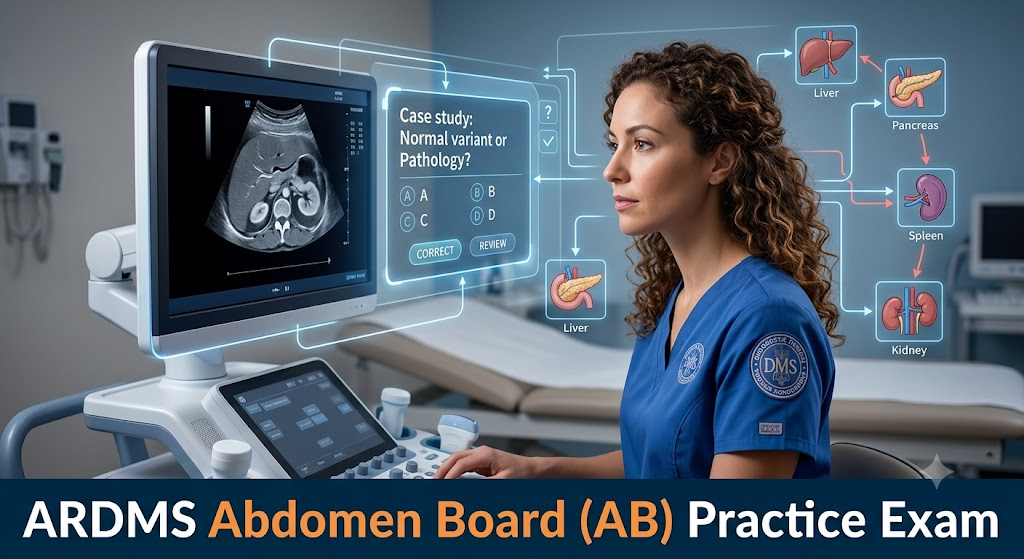
Additional Information
What the Course Entails and Exam Details
Preparing for the Abdomen Board exam requires a deep dive into several core areas of diagnostic medical sonography. Although often taken as part of a larger sonography curriculum, the specific knowledge base for the AB exam is codified in the official exam content outline. A successful study guide, mirrored by any comprehensive ARDMS Abdomen Board (AB) Practice Exam, must cover these primary domains:
Anatomy, Perfusion, and Function (approx. 25%): This section tests your ability to identify normal abdominal structures, such as the liver, kidneys, pancreas, and spleen, including their relational anatomy, blood flow patterns (perfusion), and physiological function. Candidates must be able to distinguish normal findings from anatomical variants and correlate imaging with clinical data.
Pathology, Vascular Abnormalities, Trauma, and Postoperative Anatomy (approx. 40%): As the largest portion of the exam, this area focuses on recognizing disease processes, vascular issues, traumatic injuries, and surgical alterations within the abdomen. This requires the ability to differentiate benign from suspicious findings and synthesize complex information to suggest a differential diagnosis.
Abdominal Physics (approx. 15%): While many candidates take the separate SPI physics exam, this domain tests the practical application of physics principles specific to abdominal imaging, such as appropriate transducer selection, optimization of imaging controls, harmonic imaging, and the recognition and resolution of artifacts.
Clinical Care, Practice, and Quality Assurance (approx. 20%): This domain ensures you are prepared for the professional demands of the field. It covers professional standards of practice, patient safety protocols, infection control, documentation accuracy, and interventional procedures where a sonographer may assist.
What to Expect in the Final Exam
The actual ARDMS Abdomen Board exam is a rigorous, standardized test administered on a computer. Candidates must be prepared for a long and focused testing session. Understanding the exact structure can help alleviate anxiety:
Format: The exam currently consists of 165 multiple-choice questions. These questions evaluate both foundational knowledge and clinical reasoning skills. Many questions are based on scenarios or require the interpretation of high-quality abdominal ultrasound images.
Time Limit: You are allotted a total of 3 hours (180 minutes) to complete the examination. This time includes a mandatory 5-minute survey. This structure means you have slightly more than 60 seconds per question, making time management a vital skill.
Scoring: ARDMS utilizes scaled scoring to ensure fairness across different versions of the exam. The scores range from 300 to 700. A score of 555 is required to pass the Abdomen Board exam.
Rules: Strict testing center rules apply. Candidates must present a valid, non-expired, government-issued photo ID with a signature. All personal items must be stored, and no reference materials are allowed in the testing room.
How to Study and Exam Centers
Effective preparation for the ARDMS Abdomen Board exam typically involves a dedicated study period of 12 to 16 weeks. Experts often recommend candidates first take the Sonography Principles and Instrumentation (SPI) exam to solidify their physics foundation before tackling the clinical specialty exams.
Actionable Study Strategies:
Master Normal Anatomy: Do not jump straight to pathology. A thorough knowledge of normal sonographic appearances, standard measurements, and anatomical relationships is the foundation for recognizing any abnormality.
Focus on Pathology: Since this is the most heavily weighted domain, create extensive flashcards for each organ. Detail common pathologies, their specific sonographic patterns (e.g., "starry sky" liver), associated clinical lab values, and key clinical history points.
Learn Pattern Recognition: Train your eye to recognize key visual cues. Practice identifying classic artifacts and distinguishing between complex fluid collections, such as an abscess versus a hematoma.
Use Practice Exams: This is crucial. A realistic ARDMS Abdomen Board (AB) Practice Exam allows you to identify your weak areas, get accustomed to the question phrasing, and practice the necessary pacing to complete the full 165 questions within the time limit.
Taking the Exam:
ARDMS does not offer exams in a home environment or online portals. All board examinations must be scheduled and taken in person at authorized Pearson VUE testing centers. These secure centers are located worldwide in major cities, within some universities, and on select military bases. When scheduling, you will choose a specific physical testing center from the official ARDMS partner network.
Job Opportunities from the Course
Earning your ARDMS credential with an Abdomen specialty provides immediate professional validation and unlocks numerous career paths within diagnostic medical imaging. It is the primary requirement for employment at top-tier medical facilities.
Career Paths and Job Titles Include:
Registered Diagnostic Medical Sonographer (RDMS)
Abdominal Sonographer / Ultrasound Technologist
Hospital-Based Staff Sonographer
Outpatient Imaging Center Sonographer
Lead Sonographer / Ultrasound Department Supervisor
Travel Sonographer / Mobile Ultrasound Specialist
Clinical Applications Specialist (for ultrasound manufacturers)
Sonography Educator / Clinical Instructor
Frequently Asked Questions
Reviews
5.0
Based on 0 reviews
Leave a Review
No reviews yet. Be the first to review!