
Architecture Board Exam - Site Planning Practice
$69.00
- Buy to unlock unlimited access to all Quiz questions.
- After purchase you can print a PDF of the whole quiz at any point. The PDF will contain the questions and the correct answers.
About this Exam
Welcome to the definitive study guide for the Architecture Board Exam – Site Planning Practice section. This critical examination is designed to test your competency in analyzing and synthesizing the complex physical, environmental, and regulatory factors that influence architectural site selection and design.
This exam is not just about memorizing zoning codes; it is a rigorous assessment of your ability to integrate these constraints into a coherent, functional, and sustainable design proposal. It is mandatory for licensure candidates who wish to demonstrate their proficiency in managing the crucial early phases of architectural projects, ensuring that the built environment respects its context and serves the community effectively. Whether you are a recent graduate or an experienced designer, mastering this subject is essential for your professional advancement.
Ready to test your knowledge?
Buy Now to Access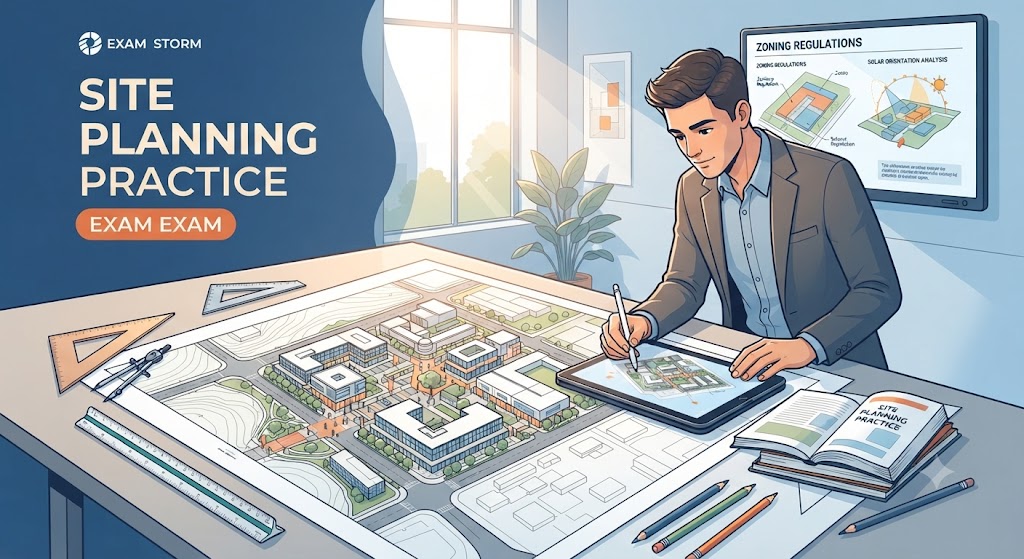
Additional Information
What the Course Entails and Exam Details
The Architecture Board Exam – Site Planning Practice section
covers a broad spectrum of knowledge areas critical to the practice of
architecture. To pass, you must demonstrate mastery of the following core
topics:
- Site
Analysis and Inventory: Understanding how to survey a site to document
its physical characteristics, including topography, vegetation, hydrology,
and existing structures. This involves analyzing microclimates, solar
orientation, and prevailing winds.
- Zoning
and Land Use Regulations: Interpreting and applying local ordinances,
zoning maps, building codes, and overlay districts that dictate
permissible land uses, density, setbacks, height restrictions, and parking
requirements.
- Site
Programming: Translating client goals and project requirements into a
comprehensive spatial program that informs the site design. This includes
analyzing project feasibility and budget constraints.
- Environmental
Considerations and Sustainability: Identifying and mitigating
environmental hazards (e.g., wetlands, floodplains, hazardous materials).
Implementing sustainable design principles, such as Low Impact Development
(LID), stormwater management, and erosion control.
- Infrastructure
and Utilities: Planning for the integration of essential services,
including water supply, sanitary sewers, storm drainage, electricity, gas,
and telecommunications infrastructure.
- Vehicular
and Pedestrian Circulation: Designing efficient and safe systems for
vehicular access, parking, loading docks, and pedestrian pathways that
promote accessibility (ADA compliance) and connectivity.
- Site
Grading and Earthwork: Applying principles of grading, cut-and-fill
calculations, and retaining wall design to manage site drainage and create
usable building platforms.
- Landscape
Architecture and Site Amenities: Incorporating planting design,
hardscape elements, outdoor spaces, and site amenities that enhance the
aesthetic quality and usability of the site.
What to Expect in the Final Exam
The Site Planning Practice exam is a comprehensive,
high-stakes examination that typically utilizes multiple-choice questions (MCQ)
and advanced item types, such as hot-spots and drag-and-place questions, to
simulate real-world problem-solving scenarios.
- Exam
Format: The exam consists of approximately 80-100 scored questions.
You will be presented with project scenarios, site plans, and regulatory
documents and asked to make informed decisions based on the data provided.
- Time
Limit: Candidates are usually given 3.5 to 4 hours to complete the
entire section. This includes time for reviewing tutorials and any
scheduled breaks. Time management is critical.
- Passing
Score: The passing score is determined by a psychometric analysis and
is scaled. There is no fixed percentage required, but you must demonstrate
a minimum level of competency across all content areas.
- Rules
and Regulations: This is a proctored exam, either administered at a
physical test center or via an online proctoring service. Strict security
protocols are in place. You will typically have access to an on-screen
reference guide and calculator. Personal items, including phones and study
materials, are prohibited in the testing area.
How to Study and Exam Centers
Passing the Site Planning Practice exam requires a strategic
and disciplined study plan.
- Develop
a Study Schedule: Allocate dedicated study time over several weeks or
months. Break down the syllabus into manageable sections and commit to a
regular review schedule.
- Utilize
Official Resources: Start with the official exam candidate handbook
provided by your architecture board or the National Council of
Architectural Registration Boards (NCARB). This is your roadmap.
- Core
Textbooks: Review standard architectural references, such as Site
Planning by Kevin Lynch, Architectural Graphic Standards, and
study guides specifically focused on the ARE 5.0 Site Planning &
Design division.
- Practice
Questions and Simulations: This is the most effective way to prepare.
Use commercially available practice exams and question banks that
replicate the exam format. Focus on understanding why an answer is
correct, not just memorizing it. Pay close attention to the
"vignette" style questions that require graphic solutions.
- Join
Study Groups: Collaborate with peers who are also preparing for the
exam. Discussing complex site planning scenarios and challenging zoning
problems can deepen your understanding.
- Where
and How to Take the Exam: The exam is primarily administered by NCARB
through its authorized test delivery partner, Pearson VUE. You must first
establish eligibility with your local architecture board and then schedule
your exam via your NCARB record online. Testing centers are located
globally. When scheduling, you will have the option to select a physical
test center or, where available, an online proctored exam from your home
or office.
Job Opportunities
from the Course
Successfully passing the Architecture Board Exam – Site
Planning Practice section is a major milestone that unlocks numerous career
opportunities and professional advancements. This certification validates your
expertise in a critical area of architectural practice, making you a valuable
asset to any design team.
This exam prepares you for the following specific job titles
and career paths:
- Licensed
Architect: With full licensure, you can legally stamp and seal
drawings, assume liability for projects, and practice independently.
- Project
Architect: Lead the development and coordination of architectural
projects, from initial site analysis through construction documents.
- Site
Planner / Urban Designer: Specialize in the master planning of
large-scale developments, campuses, and urban revitalization projects.
- Land
Development Manager: Oversee the feasibility, due diligence, and
entitlement process for real estate development projects.
- Sustainability
Consultant: Advise design teams on sustainable site strategies, LEED
certification, and environmental compliance.
- Zoning
and Planning Consultant: Assist clients in navigating complex zoning
codes, securing variances, and obtaining necessary permits.
- Principal
/ Firm Owner: Advance to a leadership role where you are responsible
for firm strategy, business development, and overall project delivery.
Frequently Asked Questions
Reviews
5.0
Based on 0 reviews
Leave a Review
No reviews yet. Be the first to review!