
Aquatic Science Plate Tectonics Practice Test
$69.00
- Buy to unlock unlimited access to all Quiz questions.
- After purchase you can print a PDF of the whole quiz at any point. The PDF will contain the questions and the correct answers.
About this Exam
Welcome to your essential preparation resource for the Aquatic Science Plate Tectonics Practice Exam. This practice test is specifically designed for students studying marine science, oceanography, or earth science who need to master the geological processes that shape our ocean basins. It is ideal for high school students preparing for unit exams, college students reviewing core concepts, or anyone seeking to validate their understanding of how dynamic earth processes impact marine environments. This test will gauge your knowledge of the mechanisms driving plate movements and the resulting seafloor features that define the aquatic world.
Ready to test your knowledge?
Buy Now to Access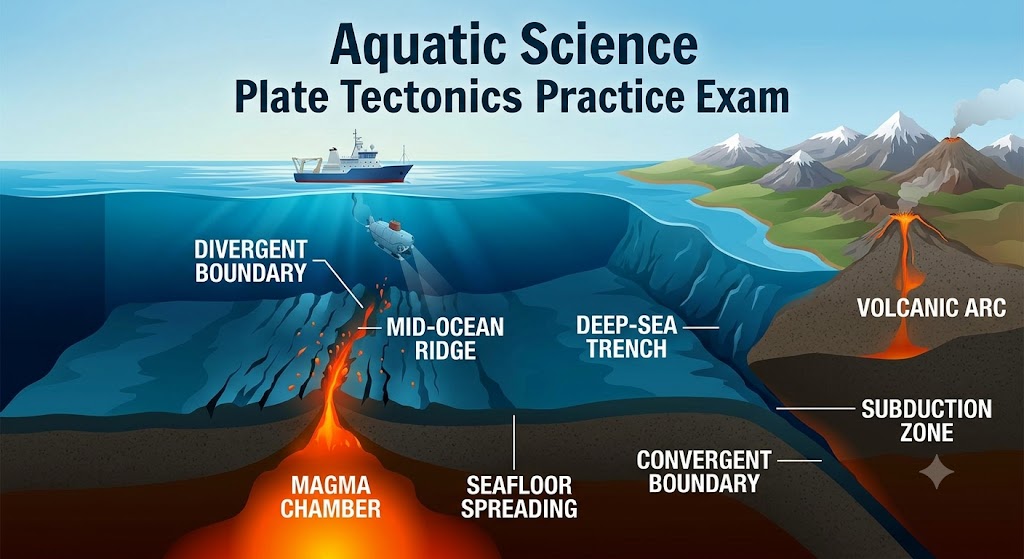
Additional Information
What the Course Entails and Exam Details
This examination focuses on the crucial intersection of
geology and oceanography. To succeed, students must demonstrate a deep
understanding of the theory of plate tectonics, including the evidence
supporting continental drift and seafloor spreading. The syllabus covers the
composition and physical properties of the Earth's layers, specifically the
lithosphere and asthenosphere. Candidates are expected to identify and explain
the processes occurring at divergent, convergent, and transform plate boundaries.
Special emphasis is placed on marine geological features such as mid-ocean
ridges, hydrothermal vents, deep-sea trenches, island arcs, and the process of
subduction. The assessment also probes knowledge of how these tectonic
activities cause marine natural hazards like underwater earthquakes and
tsunamis.
What to Expect in the Final Exam
As this is a comprehensive practice exam, you should
anticipate a challenging assortment of question types designed to test
different levels of cognition. The test consists primarily of multiple-choice
questions that assess factual recall and conceptual understanding.
Additionally, there are diagram-based questions requiring you to identify
specific tectonic features on cross-sections of the ocean floor or map-based
questions asking you to locate major tectonic plates and boundary types. While
passing scores for individual courses vary by institution, aiming for at least
80% on this practice test indicates strong readiness for your official
assessment. The final test is generally closed-book and must be completed
within a standard time limit, typically 60 to 90 minutes.
How to Study and
Exam Centers
Effective preparation for this exam requires a strategic
approach. Start by thoroughly reviewing your course textbook and lecture notes,
focusing heavily on visual diagrams of plate boundaries. Practice drawing and
labeling these boundaries yourself, as visualizing the processes is key to
retention. Utilize online resources, interactive maps, and flashcards for key
geological terminology. Taking this practice exam multiple times under timed
conditions will help you manage your time effectively and identify weak areas
that require further review. This specific practice exam is available through
online educational portals and Learning Management Systems (LMS) used by
participating schools and institutions. For official course exams, testing
typically occurs within your school's designated testing center, classroom, or
through an authorized online proctoring service.
Job Opportunities from the Course
Mastery of plate tectonics within the context of aquatic
science is a foundational requirement for numerous rewarding career paths in
earth and marine sciences. A strong understanding of this subject can unlock
opportunities in the following roles:
- Oceanographer
- Marine
Geologist
- Seismologist
- Geophysicist
- Environmental
Consultant
- Hydrographic
Surveyor
- Coastal
Geomorphologist
- Science
Educator
- Paleoceanographer
Frequently Asked Questions
Reviews
5.0
Based on 0 reviews
Leave a Review
No reviews yet. Be the first to review!