
Apprentice Lineman General Practice Test
$69.00
- Buy to unlock unlimited access to all Quiz questions.
- After purchase you can print a PDF of the whole quiz at any point. The PDF will contain the questions and the correct answers.
About this Exam
The Apprentice Lineman General Practice Test is a critical preparatory tool designed for individuals aspiring to enter the electrical power line industry. This practice exam simulates the rigorous conditions and knowledge requirements of the actual apprenticeship entrance exams or first-year certification tests. It is specifically designed for candidates who have a high school diploma or GED and are seeking to demonstrate their aptitude for mechanical reasoning, electrical theory, safety protocols, and mathematical concepts. Passing this evaluation is often a mandatory step for gaining entry into highly competitive union (IBEW) or non-union apprenticeship programs, marking the official start of a rewarding career as a journeyman lineman.
Ready to test your knowledge?
Buy Now to Access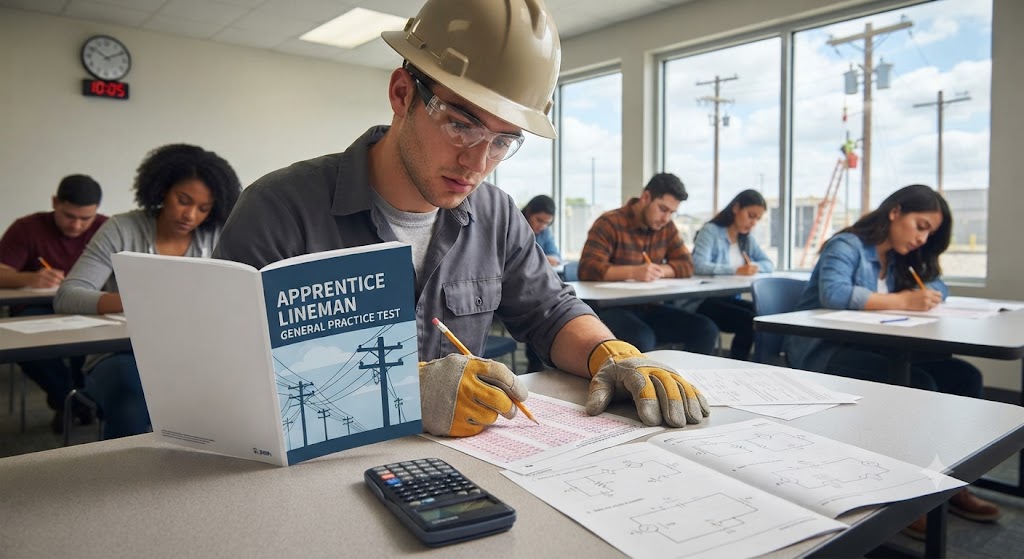
Additional Information
What the Course Entails and Exam Details
While this is a practice exam, it covers the foundational
knowledge typically acquired during the first phase of an apprenticeship or
pre-employment vocational training. The content is structured to evaluate a
candidate's readiness to handle the intellectual demands of the trade.
The exam generally focuses on the following core areas:
- Mathematics:
Proficiency in basic arithmetic, algebra, geometry, and specifically, the
ability to work with fractions, decimals, and formulas relevant to
electrical calculations.
- Mechanical
Aptitude: Understanding mechanical principles such as leverage,
pulleys, gears, simple machines, and spatial relations, which are
essential for daily field tasks.
- Reading
Comprehension: The ability to read, understand, and apply technical
information, safety manuals, and procedural documents.
- Electrical
Theory: Fundamental concepts of electricity, including voltage,
current, resistance, Ohm's Law, and basic series and parallel circuits.
- Safety
Practices: Knowledge of industry-standard safety rules, including OSHA
regulations, Personal Protective Equipment (PPE), and recognizing job site
hazards.
What to Expect in the Final Exam
The official exam is typically a timed, proctored assessment
administered either by a local Joint Apprenticeship and Training Committee
(JATC), a training center, or a third-party testing service contracted by a
utility company.
- Format:
The exam is usually comprised of multiple-choice questions, though some
sections may involve diagrams or practical simulations of mechanical
reasoning.
- Time
Limits: This is a fast-paced exam. Candidates are generally given a
strict time limit for each section, requiring them to work efficiently and
accurately under pressure. The total exam time often ranges from two to
four hours.
- Passing
Score: There is no universal passing score. Each JATC or employer sets
their own standards, but given the competitive nature of these programs,
applicants should aim for a score well above 80% to be considered for an
interview.
- Rules:
Strict rules apply. Calculators are usually not permitted (testing basic
math fluency is a key goal), and scratch paper will be provided. Photo ID
is required, and late arrivals are typically not allowed to test.
How to Study and Exam Centers
Success on the Apprentice Lineman General Practice Test
requires dedicated preparation using targeted study materials.
- Actionable
Study Strategies:
- Review
Math Basics: Go back to basics. Focus on fractions, decimals, and
unit conversions. Use online tutorials to brush up on basic algebra and
geometry.
- Utilize
Study Guides: Invest in reputable apprenticeship entrance exam study
guides (such as those published by the ARCO or Peterson's) which offer
focused content reviews and hundreds of practice questions.
- Take
Multiple Practice Tests: The value of practice tests lies in
identifying your weak areas. Take this practice test multiple times under
timed conditions to build speed and stamina.
- Focus
on Mechanical Reasoning: Practice visualizing how gears, pulleys, and
levers work. There are many online resources and apps specifically
designed to improve mechanical aptitude.
- Where
and How to Take the Exam:
- Apprenticeship
Programs (JATC): Contact your local IBEW JATC or the National
Electrical Contractors Association (NECA) chapter. They administer the
Electrical Training ALLIANCE aptitude test. This is the most common route
for union apprenticeships.
- Utility
Companies: Large private or municipal utility companies (e.g., Con
Edison, PG&E, TVA) often administer their own internal pre-employment
tests. Check their career portals for testing information.
- Vocational
Schools: Some community colleges and trade schools offering
Pre-Apprenticeship Lineworker (PAL) programs may administer the entrance
exam on-site as part of the admission process.
Job Opportunities from the Course
Successfully passing the apprentice lineman exam is the
gateway to a highly structured and lucrative career path in the energy sector. This
is not just a job; it is a skilled trade that offers lifelong stability and
advancement opportunities.
Completing this entry-level examination and beginning your
apprenticeship unlocks the following career progression and job titles:
- Groundman:
The entry-level position where you support the crew from the ground,
learning tools, materials, and basic safety before beginning climbing
training.
- Line
Apprentice (Step 1 through Step 7/8): A multi-year, on-the-job
training program where you progressively learn the skills of the trade,
moving from basic tasks to complex energized line work under the
mentorship of a Journeyman.
- Journeyman
Lineman: The ultimate goal. Upon completing the apprenticeship, you
are a fully qualified, certified professional capable of constructing,
maintaining, and repairing overhead and underground power distribution and
transmission systems.
- Foreman/General
Foreman: Experienced Journeymen who lead crews and manage large-scale
construction projects.
- System
Operator/Load Dispatcher: Roles within the utility's control center
that manage the flow of electricity across the grid.
- Substation
Technician: A specialized role focusing on the equipment within
electrical substations.
Frequently Asked Questions
Reviews
5.0
Based on 0 reviews
Leave a Review
No reviews yet. Be the first to review!