
3rd Year Lineman Apprentice Practice Exam
$69.00
- Buy to unlock unlimited access to all Quiz questions.
- After purchase you can print a PDF of the whole quiz at any point. The PDF will contain the questions and the correct answers.
About this Exam
The 3rd Year Lineman Apprentice Practice Exam is a critical assessment designed for aspiring lineworkers approaching the final stages of their formal training journey. This comprehensive test evaluates the advanced theoretical knowledge and practical understanding required to move beyond the foundational skills of an apprentice and begin performing more complex tasks independently. It is specifically built for apprentices who have successfully completed their first two years of curriculum and field work, typically serving as a prerequisite for advancement to the next apprenticeship level or a milestone on the final path to becoming a certified Journeyman Lineman. This exam ensures that you are prepared to safely handle the rigorous demands of construction, maintenance, and repair of high-voltage electrical distribution and transmission systems.
Ready to test your knowledge?
Buy Now to Access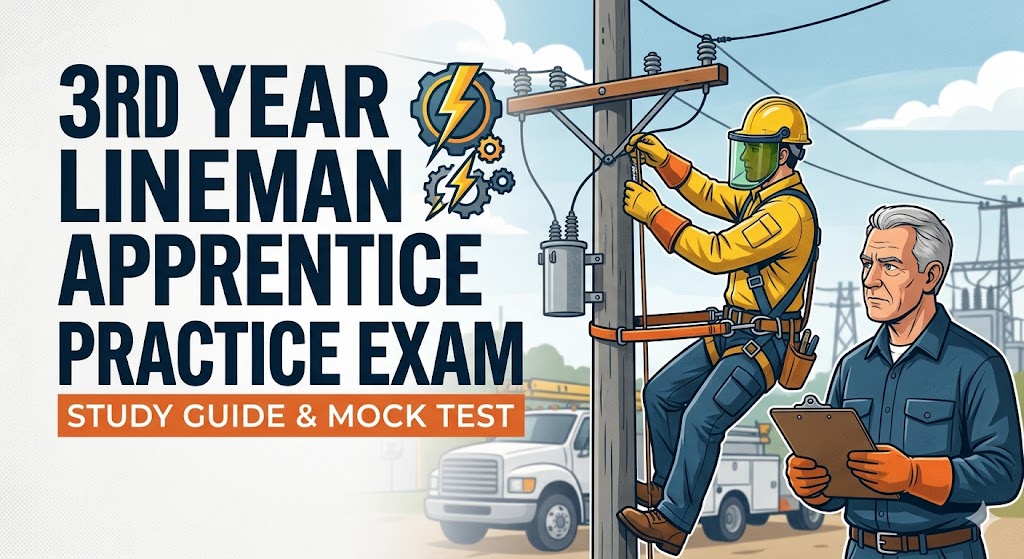
Additional Information
What the Course Entails and Exam Details
This examination is not merely a memory test; it is a
rigorous simulation of the real-world knowledge you will use daily as a skilled
lineman. The practice exam mirrors the core topics typically covered in the
third-year apprenticeship curriculum of leading electrical training
organizations, such as the Electrical Training Alliance (formerly NJATC) or
utility-specific programs.
A 3rd Year Lineman Apprentice Practice Exam will challenge
you across several advanced domains, including:
- Three-Phase
Systems: You will need to demonstrate mastery of three-phase power
calculations, understanding phase relationships, angular displacement, and
balancing loads in Y (Wye) and Delta configurations.
- Transformer
Theory and Application: This is a heavy-focus area. Expect detailed
questions on single-phase and three-phase transformer connections (e.g.,
Delta-Delta, Delta-Wye), transformer troubleshooting, T-connections,
testing procedures, and calculating appropriate transformer sizing for
specific load requirements.
- Voltage
Regulation: Topics cover the operational principles of step-voltage
regulators, their control systems, and troubleshooting practices to
maintain proper voltage levels on a circuit.
- Energized
Work Procedures: A significant portion tests your understanding of
safe practices when working on energized lines, including the correct
application of rubber insulating equipment (gloving), the use of hot line
tools (hot sticks), and the specific procedures for various standard
industry tasks performed from a bucket truck or pole.
- Troubleshooting
and Diagnosis: You must apply logical steps to identify and rectify
common distribution system faults, hardware failures, and power outage
issues in a simulation of field conditions.
- National
Electrical Safety Code (NESC) and OSHA Standards: Mastery of advanced
safety codes, grounding practices, and regulations relevant to
high-voltage linework is essential.
What to Expect in the Final Exam
While exact parameters vary by training sponsor, a final
3rd-year exam is typically a formal, proctored experience designed to ensure
high standards of safety and proficiency. Candidates must be prepared for a
comprehensive assessment that often includes both a written (knowledge)
component and a practical (skills) evaluation.
Written Examination Format:
- Type:
The knowledge portion is almost always comprised of complex
multiple-choice questions. These are scenario-based, requiring you to
apply calculations, diagnose issues, or identify the correct safety
procedure for a given situation.
- Time
Limit: You will be under strict time constraints, often ranging from
two to four hours, depending on the number of questions.
- Calculators:
Standard non-programmable scientific calculators are often permitted but
verify this beforehand with your testing coordinator.
- Passing
Score: The required passing score is typically high, often around 70%
or 75%, reflecting the critical nature of the trade’s safety and technical
accuracy.
Practical Examination Component:
- Type:
You may be required to demonstrate proficiency in core skills, such as
pole climbing with advanced tasks, fabricating complex transformer
connections, performing an emergency rescue scenario (like a pole top or
bucket rescue), and operating heavy equipment safely.
- Scoring:
Practical exams are often graded on a pass/fail basis for essential safety
actions, combined with a points-based system for procedural accuracy and
efficient technique.
How to Study and Exam Centers
Successfully passing the 3rd Year Lineman Apprentice Exam
requires a dedicated and structured study plan. Our specialized practice exam
is a powerful tool, but it should be part of a broader strategy:
- Actionable
Study Strategies:
- Review
Your Curriculum: Your primary resource is the textbooks and workbooks
from your apprenticeship program. Systematically review the entire
third-year syllabus, focusing on complex transformer connections and
three-phase math.
- Simulate
Exam Conditions: Use our practice exams not just to check answers, but
to build stamina and time management skills. Take a full practice test in
one sitting, mimicking the final exam’s time constraints.
- Master
the Math: Create formula sheets for three-phase power calculations,
transformer ratios, and basic circuit theory. Practice these calculations
until they are second nature.
- Form
a Study Group: Collaborative learning with fellow apprentices can
clarify difficult concepts, especially during hands-on practice.
Where to Take the Exam:
Apprentice exams are not standardized through a single
central testing agency like Pearson VUE. Instead, they are managed and
administered by the specific organization sponsoring your apprenticeship.
- NJATC/Electrical
Training Alliance: If you are in an IBEW/NECA program, your final exam
will be scheduled and administered by your Local Joint Apprenticeship and
Training Committee (JATC) at their designated training facility.
- Utility-Specific
Programs: If you are an apprentice for a major utility (e.g.,
PG&E, Duke Energy), your exams will be administered by the company’s
internal training department at one of their regional training centers.
- Authorized
Schools: Some private lineman colleges or technical schools may host
proctored exams for independent apprentices, but this is less common and
must be confirmed with your specific program sponsor.
Job Opportunities from the Course
Passing the 3rd Year Lineman Apprentice Practice Exam is the
gateway to the final phase of your apprenticeship and prepares you for the full
responsibilities of a Journeyman. This critical achievement opens doors to
specialized roles and sets you on a path toward a highly secure, high-paying
career.
This certification milestone unlocks job titles such as:
- Journeyman
Lineman (upon completion of the full program)
- Qualified
Electrical Worker (QEW)
- Lead
Lineman / Crew Foreman
- Transformer
Technician / Substation Technician
- Power
Line Troubleshooter
- Transmission
Lineman (High Voltage Specialization)
- Underground
Distribution Specialist
Frequently Asked Questions
Reviews
5.0
Based on 0 reviews
Leave a Review
No reviews yet. Be the first to review!