
Apprentice Aptitude Battery Test (ALBAT) Practice Test
$69.00
- Buy to unlock unlimited access to all Quiz questions.
- After purchase you can print a PDF of the whole quiz at any point. The PDF will contain the questions and the correct answers.
About this Exam
The Apprentice Aptitude Battery Test (ALBAT), often just called the ALBAT test, is the gateway to a rewarding career in the Electrical Construction and Line trades. Administered by the National Joint Apprenticeship and Training Committee (NJATC), which is a partnership between the National Electrical Contractors Association (NECA) and the International Brotherhood of Electrical Workers (IBEW), this aptitude test ensures candidates have the necessary foundation for a demanding and skilled career. Successfully completing the ALBAT is the critical first step for individuals seeking an apprenticeship in electrical wiring, telecommunications, outside lineman work, and other related trades.
Ready to test your knowledge?
Buy Now to Access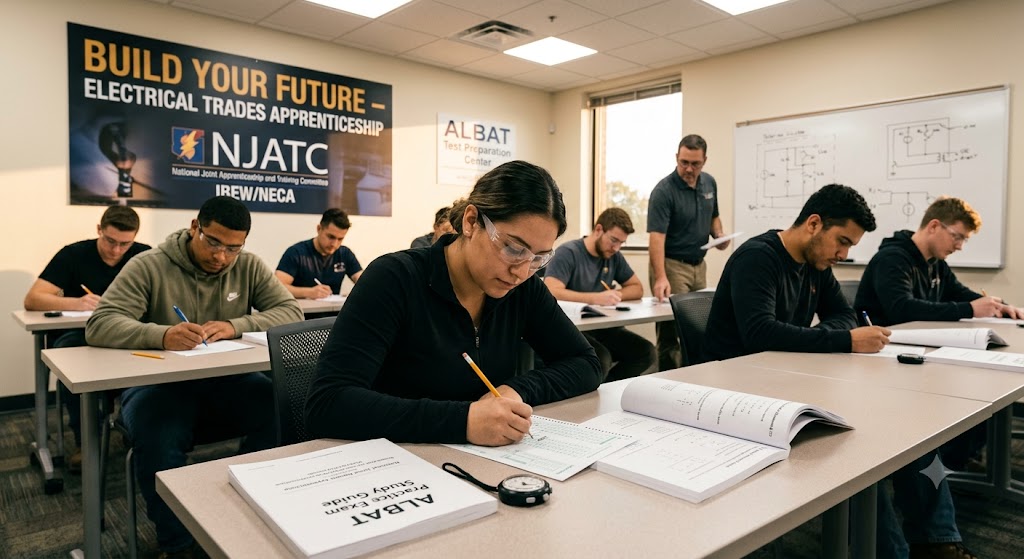
Additional Information
What the Course Entails and Exam Details
The ALBAT doesn't test for prior electrical knowledge.
Instead, it measures your cognitive abilities and mechanical aptitude, which
predict your potential for success in the classroom and on-the-job training.
While often simply referred to as "the ALBAT," it’s actually a
specific battery of tests tailored for these apprenticeship programs. Here are
the core sections you must prepare for:
- Reading
Comprehension: This section tests your ability to read, understand,
and interpret written material. You will be presented with a passage to
read and then asked to answer multiple-choice questions based on that
information. The passages can cover general topics, but some may also be
slightly technical, assessing your ability to find main ideas, interpret
supporting details, and recall specific facts—all essential skills for
reading blueprints, safety manuals, and technical specifications.
- Algebra
and Functions (Math): This is a substantial part of the exam,
emphasizing basic math, number operations, and algebraic principles. You
will encounter questions testing your ability to solve equations, simplify
expressions, work with fractions and percentages, solve basic
inequalities, and interpret graphs. This area assesses the analytical
skills critical for making complex calculations on a job site.
- Mechanical
Aptitude: This section gauges your intuitive understanding of basic
physical and mechanical principles. You might be asked questions about
simple machines (levers, pulleys, gears), force and movement, basic
electrical concepts (sometimes), and physical forces. Your ability to
visualize objects and understand how things fit together is crucial.
Spatial reasoning skills are also commonly assessed alongside mechanical
reasoning.
What to Expect in
the Final Exam
You should prepare for a challenging, strictly timed
examination environment. Here's a typical breakdown of the test structure and
conditions:
- Format:
The entire ALBAT is a multiple-choice examination. For each question, you
will select the best answer from several choices. It is a paper-and-pencil
test at most locations.
- Time
Limits: Time is a critical factor. The test sections are individually
timed and quite fast-paced. You must balance speed and accuracy, as you
won't have time to dwell on any one question. The total testing time,
including instructions and breaks, is typically around 1.5 to 2 hours,
with each subtest having its own strict limit.
- Scoring
and Passing Score: The scoring is based on the number of correct
answers. There is generally no penalty for guessing (only confirm this at
the test), so it’s always better to make an educated guess than to leave a
question blank. The "passing score" isn't a fixed, universal
number. It varies depending on the specific JATC (Joint Apprenticeship and
Training Committee) program and the pool of applicants. You need to
achieve a competitive score compared to other candidates to move to the
interview phase.
- Specific
Rules: Typically, no calculators are allowed. Your arithmetic must be
done by hand or in your head. Personal items, including cell phones, must
be stored away. You must strictly follow the directions given by the
proctor, or you could be disqualified.
How to Study and Exam Centers
Preparation for the ALBAT requires targeted practice rather
than traditional course study. It's about sharpening the cognitive skills you
already possess.
- Identify
Weaknesses: Before you begin, understand your current level. Take an
initial diagnostic practice test to identify which sections (e.g.,
specific types of algebra or spatial visualization) are your biggest
weaknesses.
- Use
Practice Tests Regularly: This is by far the most effective
preparation method. Repeatedly taking full-length, timed ALBAT practice
tests will not only improve your subject matter knowledge but, crucially,
also your time management. The questions in a good practice test should accurately
mimic the format, difficulty, and time constraints of the real exam.
Analyze your mistakes on practice tests to understand the underlying
concepts you missed.
- Strengthen
Math and Mechanical Skills: Focus your study. Review high school
algebra, basic numeric operations, and fundamental concepts of physics and
simple machines.
- Practice
Under Pressure: Mimic test conditions. Find a quiet space, set a
timer, and take whole sections without interruption. Get comfortable with
the brisk pace that you will need to maintain.
- Exam
Centers: You cannot just go to a general testing center like Pearson
VUE for the ALBAT. The exam is administered only by the local JATC in
conjunction with a specific IBEW local union and NECA chapter. When you
apply for the apprenticeship program, the local JATC office will provide
details on where and when you must take the test, which is often held at
their training center, a partnered community college, or a specific local
testing site.
- Job Opportunities from the Course
Passing the ALBAT is the prerequisite for securing an
interview and then an offer to join an IBEW/NECA apprenticeship program. This
structured, earn-while-you-learn program provides both paid on-the-job training
and comprehensive classroom instruction. Successful completion leads to a
highly respected status as a skilled journey-level worker. Here are some of the
career paths and job titles this process leads to:
- Electrical
Apprentice
- Inside
Wireman
- Outside
Lineman
- Telecommunications
Technician
- Residential
Wireman
- Sound
and Communications Technician
- Maintenance
Electrician
- Electrical
Systems Inspector
- Electrical
Estimator (with further career development)
- Electrical
Contractor (eventually, after achieving a Master Electrician license)
By using a targeted study guide and practicing consistently,
you can build the skills and confidence to excel on the ALBAT, paving the way
for a highly valuable and secure career in the electrical trades.
Frequently Asked Questions
Reviews
5.0
Based on 0 reviews
Leave a Review
No reviews yet. Be the first to review!