
Applied Behavior Analysis Technician
$69.00
- Buy to unlock unlimited access to all Quiz questions.
- After purchase you can print a PDF of the whole quiz at any point. The PDF will contain the questions and the correct answers.
About this Exam
The Applied Behavior Analysis Technician (ABAT) certification is a valuable credential for professionals dedicated to the field of behavior analysis. Designed and administered by the Qualified Applied Behavior Analysis Credentialing Board (QABA®), this certification recognizes individuals who have met specific educational, training, and ethical standards to provide behavior-analytic services under supervision. The ABAT designation is perfect for aspiring behavior technicians, direct support professionals, and anyone seeking to build a foundational career in implementing behavior plans for individuals with autism spectrum disorder (ASD), developmental disabilities, or other behavioral challenges. Earning the ABAT demonstrates a commitment to quality care and ethical practice, setting you apart in a growing and impactful field.
Ready to test your knowledge?
Buy Now to Access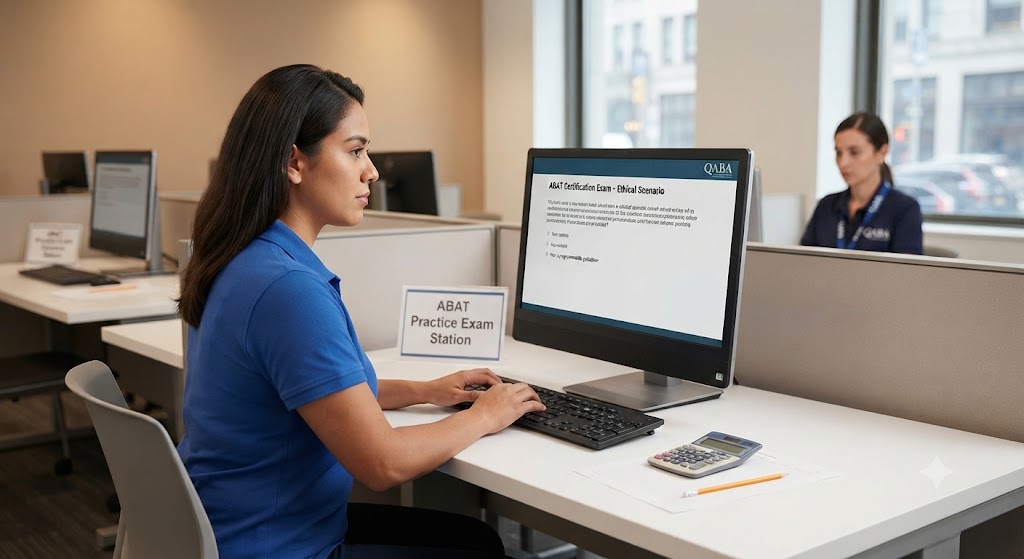
Additional Information
What the Course Entails and Exam Details
Before sitting for the ABAT exam, candidates are typically
required to complete a 40-hour coursework requirement that covers the
fundamental principles and applications of Applied Behavior Analysis (ABA).
This coursework, often referred to as the "40-hour RBT® equivalent"
(though specific to QABA), provides the necessary theoretical knowledge to
understand and apply ABA techniques. The curriculum is comprehensive, aligning
with the QABA ABAT Task List, and generally includes modules on:
- Measurement:
Defining behavior, data collection methods (e.g., frequency, duration,
latency), and graphing data to monitor progress.
- Assessment:
Understanding the purpose of functional behavior assessment (FBA) and
participating in preference assessments.
- Skill
Acquisition: Implementing skill acquisition plans, teaching new
behaviors using techniques like prompting, shaping, and discrete trial
teaching (DTT), and facilitating generalization and maintenance of skills.
- Behavior
Reduction: Implementing behavior intervention plans (BIPs) to decrease
challenging behaviors, using reinforcement strategies, and understanding
functional communication training (FCT).
- Documentation
and Reporting: Accurately recording session notes, summarizing data,
and reporting critical incidents.
- Professional
Conduct and Ethics: Adhering to the QABA Code of Ethics, maintaining
client dignity, and understanding the role of the technician under BCBA or
QASP-S supervision.
The ABAT exam itself is designed to test your understanding
and practical application of these concepts. It ensures that you not only know
the definitions but can also demonstrate sound judgment and effective
implementation in simulated scenarios.
What to Expect in the Final Exam
The ABAT certification exam is a standardized, proctored
examination. It is typically administered via computer-based testing (CBT) at
authorized testing centers or through secure remote proctoring. Here are the
key details of what to expect:
- Exam
Format: The exam consists of multiple-choice questions. These
questions are scenario-based and application-oriented, requiring you to
analyze situations and choose the best course of action based on ABA
principles and ethical guidelines.
- Number
of Questions: The exam typically contains between 100 and 150 scored
multiple-choice questions, plus a small number of unscored pilot
questions.
- Time
Limit: Candidates are usually given 2.5 to 3 hours to complete the
entire examination. This allows ample time to read each scenario carefully
and consider the options.
- Passing
Score: The passing score for the ABAT exam is determined by a
psychometrically valid standard-setting process and is reported as a
scaled score. While the exact percentage required may vary slightly with
each version of the exam, you should aim for a score of roughly 75-80% to
be confident in passing.
- Exam
Content Areas: The questions are distributed across the major content
domains outlined in the Task List, with significant weight given to Skill
Acquisition and Behavior Reduction.
How to Study and Exam Centers
Effective preparation is key to success on the ABAT exam. A
multi-faceted study approach is recommended:
- Master
the Coursework: Thoroughly review the materials from your 40-hour
coursework. Understand the key terms, definitions, and procedures. Don't
just memorize; focus on understanding the why behind each
technique.
- Utilize
the Task List: Download the official ABAT Task List from the QABA
website. Use it as a checklist to ensure you have covered all examinable
topics. Create study notes for each item on the list.
- Practice
with Sample Questions: Take advantage of reputable ABAT practice tests
and study guides. These will familiarize you with the exam format,
question style, and help you identify areas where you need further review.
The QABA website may offer resources or recommend specific study
materials.
- Create
Study Groups: Collaborate with other ABAT candidates. Discussing
scenarios and quizzing each other can reinforce your understanding and
reveal different perspectives.
- Focus
on Ethics: Pay special attention to the ethical guidelines. Many exam
questions will test your ability to recognize and respond to ethical
dilemmas in a professional manner.
Exam Centers and Registration: Once you have met all
prerequisites (coursework, background check, supervision plan), you will apply
to take the exam through the QABA website. After your application is approved,
you will receive instructions to schedule your exam. The exam is administered
by a third-party testing vendor (often Pearson VUE or a similar provider). When
registering, you will be able to select a testing center location convenient to
you or choose the remote proctoring option, which allows you to take the exam
from your home or office under live supervision. Be sure to review all ID
requirements and testing policies before your exam date.
Job Opportunities from the Course
Earning the ABAT certification opens the door to a rewarding
career in the field of behavior analysis, primarily working directly with
individuals with developmental disabilities and other behavioral health needs.
As an ABAT, you will work under the ongoing supervision of a Board Certified
Behavior Analyst (BCBA®) or a Qualified Autism Services Practitioner -
Supervisor (QASP-S). This credential qualifies you for various roles,
including:
- Behavior
Technician (BT): Providing one-on-one ABA therapy to clients in homes,
schools, clinics, or community settings.
- Registered
Behavior Technician (RBT®) Equivalent: While RBT is a separate
credential from the BACB®, the ABAT is widely recognized as its equivalent
in terms of training and scope of practice, qualifying you for identical
roles.
- Direct
Support Professional (DSP): Assisting individuals with daily living
skills and community integration, often incorporating behavioral
principles.
- Autism
Support Specialist: Working within a school district or specialized
program to provide behavioral support to students with ASD.
- Paraprofessional/Teacher's
Aide: Supporting classroom teachers and implementing individualized
education plans (IEPs) with a focus on behavioral interventions.
- Early
Intervention Specialist Assistant: Working with young children at risk
for developmental delays to implement early behavioral and developmental
programs.
The demand for qualified behavior technicians continues to
grow, and the ABAT certification provides a clear pathway to making a
meaningful difference in the lives of others while establishing a stable and
fulfilling career.
Frequently Asked Questions
Reviews
5.0
Based on 0 reviews
Leave a Review
No reviews yet. Be the first to review!