
APM Apprentice Practice Test
$69.00
- Buy to unlock unlimited access to all Quiz questions.
- After purchase you can print a PDF of the whole quiz at any point. The PDF will contain the questions and the correct answers.
About this Exam
The APM Level 4 Associate Project Manager Apprenticeship is a robust, work-based programme designed for individuals to develop the essential skills, knowledge, and behaviours required to manage projects effectively. This apprenticeship is tailored for those already working in a project environment or looking to kickstart their career in project management within a wide range of industries, including construction, healthcare, digital, and finance. The culmination of this apprenticeship is the End-Point Assessment (EPA), which is a rigorous, holistic evaluation that allows the apprentice to demonstrate that they are fully conversant with the Level 4 Associate Project Manager Standard. Successfully passing the EPA not only confirms completion of the apprenticeship but also opens doors to a recognized professional pathway within the project management profession.
Ready to test your knowledge?
Buy Now to Access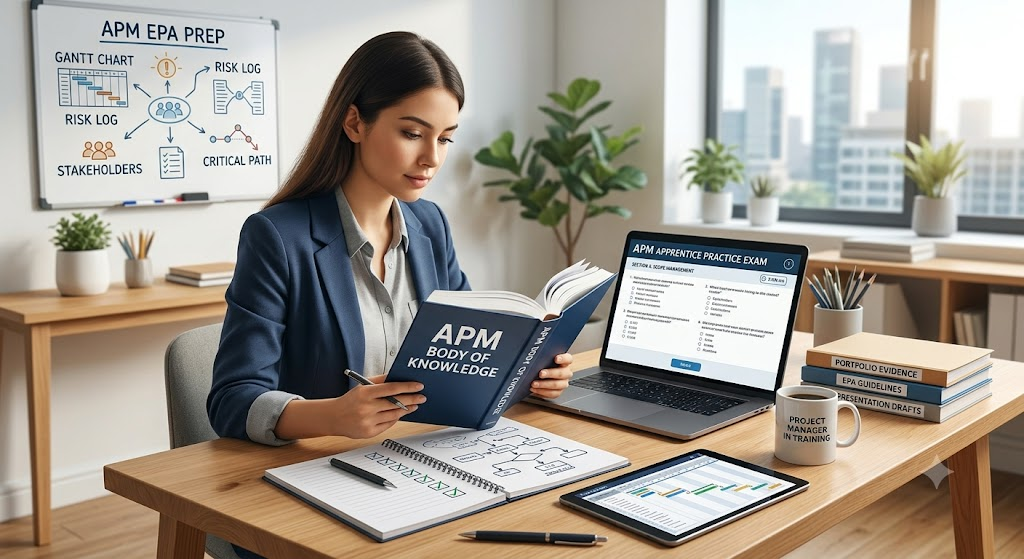
Additional Information
What the Course Entails and Exam Details
The Associate Project Manager Apprenticeship covers a comprehensive spectrum of project management principles, methodologies, and techniques, structured around the APM Body of Knowledge. The course provides training across 17 distinct learning areas, from which the apprentice must demonstrate competence in at least 15 within their portfolio of evidence. Core topics include:
Project governance and lifecycle.
Stakeholder and communications management.
Business case and benefits management.
Scope, schedule, and cost management.
Risk, issue, and quality management.
Contract management and procurement.
Team leadership, ethics, and professional conduct.
The End-Point Assessment (EPA) is the formal "exam" process, and it is composed of three interconnected parts:
Portfolio of Evidence Review: A collection of work-based products, reflective logs, and witness statements compiled during the apprenticeship, demonstrating performance against all aspects of the standard. This is reviewed and assessed prior to the other components.
Presentation on Project Management: A structured presentation by the apprentice, focusing on specific learning areas from their portfolio, followed by a Q&A session.
Professional Discussion: A structured conversation between the apprentice and an Independent End-Point Assessor, exploring the breadth and depth of the apprentice's understanding of the portfolio evidence and its application to real-world scenarios.
What to Expect in the Final Exam
The final APM Apprentice End-Point Assessment is a high-stakes, holistic evaluation. While there isn't a single multiple-choice "final exam" on a specific day, all components are critical to success. Apprentices must ensure they are thoroughly prepared for each part.
Portfolio of Evidence: Although compiled throughout the programme, it must be complete and submitted to the End-Point Assessment Organisation (EPAO) typically one month before the presentation and discussion date. It establishes the foundation for the assessor's questions.
Presentation: This usually lasts between 15 and 20 minutes, including the Q&A. The apprentice must select 5 specific learning areas from their portfolio to base their presentation on. The assessment panel evaluates the apprentice's ability to communicate, articulate complex project concepts, and respond effectively to questions, with a potential total score of 25 points, which accounts for 33.3% of the overall EPA grade.
Professional Discussion: Following the presentation, this is a much deeper dive, typically lasting at least 40 minutes and taking place on the same day. It is an exploration of the apprentice's complete portfolio, allowing the assessor to test the candidate’s knowledge, skills, and behaviours in greater depth, covering all 17 potential learning areas. The overall EPA is graded as Pass, Merit, Distinction, or Fail.
How to Study and Exam Centers
Effective study for the APM Apprentice EPA requires a proactive, evidence-based approach that integrates learning with daily work.
Build an Impactful Portfolio: This is crucial. Collect strong, varied evidence from real projects throughout your apprenticeship. Annotate documents to show exactly how they demonstrate each learning area. Reflective journals are highly effective for capturing behaviours and skills developed.
Master the APM Body of Knowledge: Your core theoretical knowledge should come from the current APM Body of Knowledge and your training provider's resources. Use this to underpin every piece of evidence in your portfolio.
Practice Your Presentation: Don't just prepare slides; rehearse the entire 15-20 minute session multiple times. Practice speaking clearly, making eye contact, and managing time. Seek feedback from mentors, colleagues, and your training provider.
Conduct Mock Professional Discussions: Engage in simulated professional discussions with your mentor or training provider. This will help you get comfortable with the structured questioning and learn how to elaborate on your experiences and justify your decisions effectively.
Review and Reflect: Regularly review your entire portfolio and reflect on your experiences. Be prepared to talk passionately and accurately about any aspect of the work you have submitted.
The final EPA (Presentation and Professional Discussion) is arranged by your employer and training provider in coordination with an approved End-Point Assessment Organisation (EPAO). It is typically conducted online, via platforms like Microsoft Teams or Zoom, allowing flexibility. Physical exam centers or authorized schools are less common for the EPA components but may be used if required by the employer and EPAO. Your training provider will manage all scheduling logistics.
Job Opportunities from the Course
Upon completion of the APM Level 4 Associate Project Manager Apprenticeship, you will unlock numerous career paths in the dynamic world of project management. The specific job titles available reflect a strong foundation in the field, including:
Associate Project Manager
Project Officer
Junior Project Manager
Project Coordinator
Project Assistant
Project Support Officer
Project Analyst
Programme Support Officer
Assistant Project Manager
Project Lead
PMO (Project Management Office) Support
Contract Manager
Cost Engineer
These roles provide a solid platform for further progression, often leading towards Senior Project Manager, Programme Manager, or specialized roles within Project Management Offices, and even Chartered Project Professional (ChPP) status.
Frequently Asked Questions
Reviews
5.0
Based on 0 reviews
Leave a Review
No reviews yet. Be the first to review!