
APICS Master Planning of Resources (MPR) Practice Exam.
$69.00
- Buy to unlock unlimited access to all Quiz questions.
- After purchase you can print a PDF of the whole quiz at any point. The PDF will contain the questions and the correct answers.
About this Exam
The APICS Master Planning of Resources (MPR) exam is a cornerstone module of the prestigious Certified in Planning and Inventory Management (CPIM) designation. It is a rigorous validation for professionals who operate at the interface between top-level strategic plans and ground-level execution, specifically in the realm of mid- to long-term manufacturing and resource planning. This exam is designed for individuals working in supply chain operations, demand management, and materials planning, as well as production managers who need to align company resources with sales and operations goals. Succeeding on the MPR exam demonstrates competency in transforming top-level business plans into a cohesive, achievable production schedule, which is essential for driving organizational efficiency and customer satisfaction.
Ready to test your knowledge?
Buy Now to Access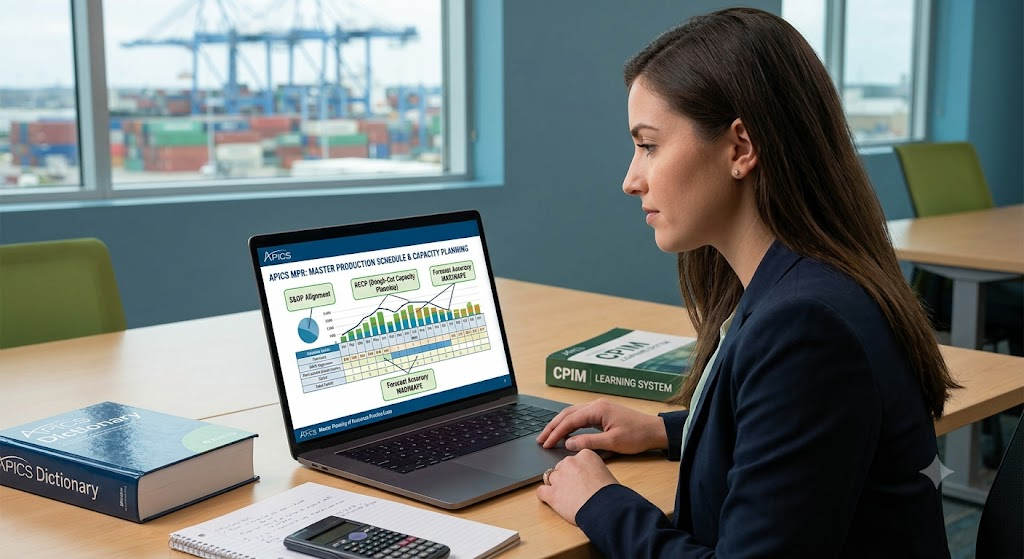
Additional Information
What the Course Entails and Exam Details
The MPR body of knowledge covers the entire spectrum of transforming a strategic business plan into high-level operational guidelines. It focuses on several key domains that are critical for modern manufacturing and distribution. Candidates must master the mechanisms of high-level demand management and the development of integrated, achievable sales and operations plans. The course content is generally broken down into four foundational areas:
Demand Management: This includes understanding the components of demand, selecting appropriate forecasting techniques for different product lifecycles and market environments, measuring forecast accuracy, and managing customer orders.
Sales and Operations Planning (S&OP): Candidates learn how to facilitate and integrate the S&OP process, balancing competing demand, supply, and financial requirements. This domain emphasizes cross-functional planning to create an aggregate plan that is consistent with the business strategic goals.
Master Production Scheduling (MPS): This is the heart of the MPR. Candidates must learn the mechanics of creating and maintaining the MPS, managing the schedule through time fences, and responding to changes in demand or supply. They will also master the critical tool of Rough-Cut Capacity Planning (RCCP) to ensure the MPS is achievable.
Distribution Planning: This covers the physical distribution network, including defining inventory policies, planning the distribution network, and managing distribution replenishment using techniques such as Distribution Requirements Planning (DRP).
What to Expect in the Final Exam
The final APICS Master Planning of Resources exam is a comprehensive assessment of both conceptual knowledge and practical decision-making. The format is entirely multiple-choice, presented as either standalone definition/concept questions or more complex, scenario-based items that require the candidate to analyze a problem and make an operational decision based on APICS terminology and logic. The final, official exam consists of approximately 150 questions, of which a portion (around 20) are pre-test items that do not count towards the final score. Candidates are given a total time limit of 3.5 hours to complete the exam. The scoring is based on a scaled system, ranging from 200 to 350. To achieve a passing score, you must earn a minimum of 300, which reflects the necessary proficiency across the tested content. The exam is closed-book, and no outside materials, such as the APICS Dictionary, are allowed during the test.
How to Study and Exam Centers
Preparation for the APICS MPR exam requires a combination of structured learning and familiarization with the unique vocabulary of the APICS Body of Knowledge. The official resource is the APICS CPIM Learning System, which includes print and e-reader textbooks, an interactive online platform, and official practice questions. A foundational step is to master the "APICS Dictionary," as many exam questions test precise knowledge of industry standard terminology. Engaging in study groups or an instructor-led APICS course, often offered by local APICS/ASCM chapters or authorized partner schools, can provide invaluable peer support and expert guidance.
Beyond official materials, taking a "APICS Master Planning of Resources Practice Exam" from a reputable third-party source is a critical step. Practice exams allow you to identify knowledge gaps, practice time management under simulated exam conditions, and get used to the unique, often scenario-based, phrasing of the official questions. Consistent, distributed practice is more effective than cramming.
The actual APICS MPR exam is proctored and delivered through Pearson VUE, a global leader in computer-based testing. Candidates have two primary options for taking the exam:
Physical Testing Centers: You can select a Pearson VUE professional testing center at thousands of locations worldwide, offering a standard, secure environment.
Online Proctored Exam: This option allows you to take the exam from the comfort of your home or office, using your own computer with specific security software and a live human proctor observing via a webcam. This is a highly popular and flexible alternative.
Regardless of the method, registration for the exam is initiated through your ASCM (Association for Supply Chain Management) account.
Job Opportunities from the Course
Earning a passing score on the APICS Master Planning of Resources exam is a significant step toward achieving the full CPIM certification, which is often a required or highly preferred qualification for a range of rewarding career paths in supply chain management. This certification unlocks several specific job roles, including:
Master Production Scheduler
Production Planner
Demand Planner
Inventory Manager
Supply Chain Analyst
Materials Manager
Supply Chain Manager
Distribution Planner
Logistics Analyst
Frequently Asked Questions
Reviews
5.0
Based on 0 reviews
Leave a Review
No reviews yet. Be the first to review!