
API 577 – Welding Inspection and Metallurgy Inspector Practice Exam
$69.00
- Buy to unlock unlimited access to all Quiz questions.
- After purchase you can print a PDF of the whole quiz at any point. The PDF will contain the questions and the correct answers.
About this Exam
The API 577 Welding Inspection and Metallurgy certification is a highly regarded credential within the oil, gas, and petrochemical industries. It is designed specifically for inspectors, engineers, and quality assurance professionals who need to demonstrate exceptional knowledge of welding processes, metallurgy, and non-destructive testing (NDT) as applied to pressure vessels, piping, and tanks. This certification validates your expertise in identifying material properties, understanding how welding affects metallurgy, and ensuring that completed welds meet stringent code requirements, making you a vital asset to any integrity management team.
Ready to test your knowledge?
Buy Now to Access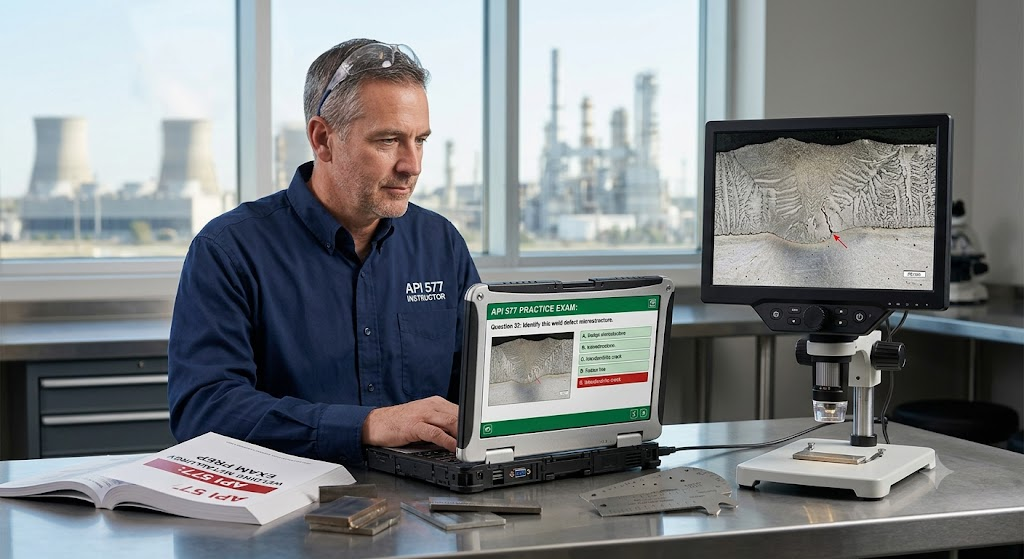
Additional Information
What the Course Entails and Exam Details
This comprehensive study guide and the accompanying practice exam are focused entirely on the Body of Knowledge specified by the American Petroleum Institute (API) for the API 577 certification. The core topics covered in depth include:
Welding Processes: A thorough review of common processes like SMAW, GTAW, GMAW, FCAW, SAW, and PAW, including their variables, advantages, and limitations.
Welding Metallurgy: The heart of the certification. Understanding how heating and cooling cycles during welding affect the microstructure and mechanical properties of various metals (carbon steel, stainless steel, and alloys). Topics include phase diagrams, carbon equivalence, preheat/post-weld heat treatment (PWHT), and hardening mechanisms.
Material Verification: Understanding material test reports (MTRs) and ensuring correct filler metal selection and base metal compatibility.
Non-Destructive Examination (NDE): Application of common NDT methods (VT, PT, MT, UT, RT) to identify specific welding defects and interpret results according to API standards.
Welding Discontinuities: Learning to identify, classify, and understand the metallurgical causes of defects like cracking (hot/cold), porosity, slag inclusion, incomplete fusion, and undercut.
What to Expect in the Final Exam
The API 577 final exam is administered in a computer-based testing (CBT) format. It is a robust test of both theoretical knowledge and practical application. Candidates can typically expect the following format:
Exam Structure: The exam consists of approximately 80 to 110 multiple-choice questions. A portion of these questions is pre-test items that do not count toward your final score.
Open vs. Closed Book: This exam has both open-book and closed-book sections. The closed-book portion heavily emphasizes fundamental metallurgy concepts, welding processes, and NDT general knowledge. The open-book portion permits referencing the specified API codes, primarily API RP 577 itself.
Time Limit: Candidates are usually given approximately 3 to 4 hours to complete the entire exam. Effective time management is crucial, especially during the open-book section.
Passing Score: API does not publish a fixed percentage for passing. The passing score is determined through statistical scaling, but you must aim for a thorough understanding of the material, not just memorization.
How to Study and Exam Centers
Preparation is the absolute key to success for the API 577 exam. It is recommended that you allocate significant study time, often several months, before your testing date.
Study the Code: The primary and most critical resource is the API Recommended Practice 577 document itself. Read it entirely, multiple times. Focus on understanding why specific recommendations are made, especially regarding metallurgical effects.
Utilize Practice Exams: This is the best way to familiarize yourself with the question style, difficulty level, and time constraints. A strong practice exam will mimic the CBT interface and provide detailed explanations for both correct and incorrect answers.
Review Metallurgy Basics: If your metallurgy background is weak, supplement your study with fundamental metallurgy textbooks, focusing on ferrous alloys and the effect of welding heat.
Understand NDT Principles: Review the basic principles of common NDT methods to understand their capabilities and limitations in detecting specific defects.
Exam Centers: When you are ready, you will schedule your exam through API’s authorized testing partner, which is typically Prometric. They have physical testing centers located globally. Some API exams are also available through remote proctoring options, depending on current API policy.
Job Opportunities from the Course
Earning the API 577 certification can significantly elevate your career trajectory within the energy and inspection sectors. The specialized knowledge it validates is in high demand for critical infrastructure projects. Key job opportunities unlocked by this credential include:
API 577 Certified Inspector
Welding QA/QC Specialist
Metallurgical Testing Technician
Refinery/Petrochemical Plant Inspector
Pipeline Integrity Inspector
Asset Integrity Engineer (Welding Focus)
Welding Engineer Assistant
Quality Manager (Fabrication/Construction)
Third-Party Inspection Consultant
This certification provides concrete proof that you possess the advanced metallurgical understanding required to maintain the safety and reliability of critical static equipment.
Frequently Asked Questions
Reviews
5.0
Based on 0 reviews
Leave a Review
No reviews yet. Be the first to review!