
APCO Law Practice Exam
$69.00
- Buy to unlock unlimited access to all Quiz questions.
- After purchase you can print a PDF of the whole quiz at any point. The PDF will contain the questions and the correct answers.
About this Exam
Prepare effectively for your future in public safety communications by mastering the legal and procedural foundations of the industry. The APCO Law Practice Exam, specifically designed for public safety telecommunicators, dispatchers, and communications supervisors, is a crucial step in ensuring your readiness to handle the complex and critical legal and ethical aspects of emergency communications. This comprehensive examination is crafted to validate your knowledge of legal standards, liability concerns, confidentiality rules, and ethical guidelines within the dynamic environment of a Public Safety Answering Point (PSAP). Achieving a passing score on this exam demonstrates your commitment to professionalism, accuracy, and compliance with key legal mandates, positioning you as a knowledgeable and responsible public safety professional.
Ready to test your knowledge?
Buy Now to Access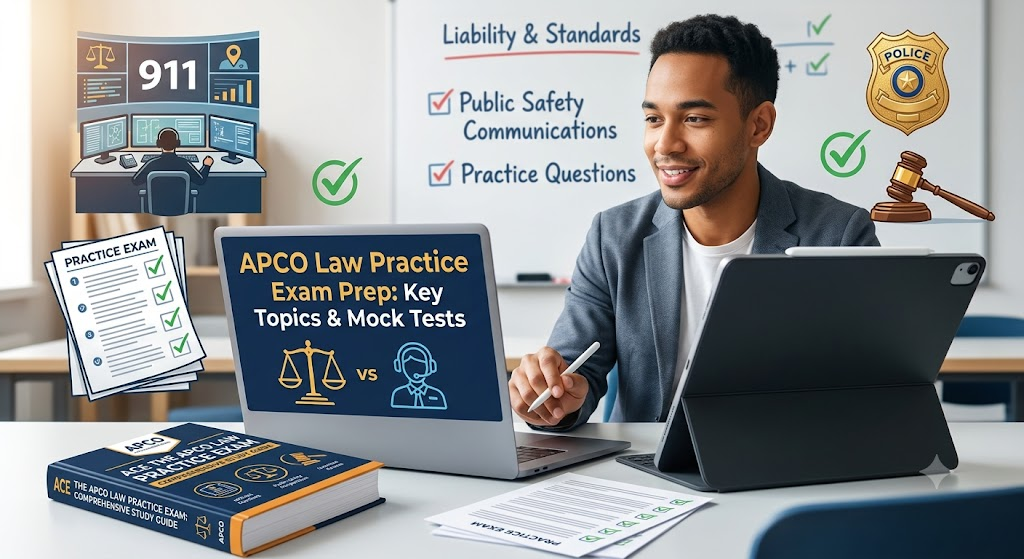
Additional Information
What the Course Entails and Exam Details
This examination is not a typical legal bar exam but rather a focused test on the practical application of law, regulations, and best practices within the specific context of public safety communications. The content commonly aligns with APCO's core training modules and standards. Key areas you can expect to be covered include:
Public Safety Communications Standards: Understanding the regulatory framework, agency policies, and national/international standards for emergency dispatch.
Liability and Ethical Considerations: Deep diving into scenarios and rules related to negligence, standards of care, specific duties, and ethical dilemmas faced by telecommunicators.
Confidentiality & Data Privacy: Knowledge of regulations (like HIPAA and CJIS, as applicable) and policies regarding the handling and dissemination of sensitive information.
Legal Processes and Documentation: Understanding courtroom testimony, records management, and the significance of proper call documentation as potential legal evidence.
Interagency Communications & Protocols: Knowing the legal implications of communication across different public safety agencies and jurisdictions.
Case Studies & Real-world Scenarios: Applying theoretical knowledge to practical situations to ensure you can make sound, legally compliant decisions in high-pressure scenarios.
The exam details, such as the exact course it correlates with (e.g., portions of APCO's Public Safety Telecommunicator certification, Supervisor course, or an instructor-level certification's liability module) may vary. It is essential to consult the official APCO Institute or your local authorized training center for the precise syllabus, course materials, and corresponding exam content and requirements. The format typically involves multiple-choice questions designed to test both knowledge recall and critical application.
What to Expect in the Final Exam
While specific details can change and should always be verified with the official APCO testing body, here is a general idea of what to expect from the APCO Law Practice Exam:
Format: The exam is typically delivered in a computer-based format and consists of a set number of multiple-choice questions. These questions range from straightforward knowledge checks to situational judgments that test your ability to apply legal concepts.
Time Limit: There is usually a strict time limit to complete the exam. This reflects the real-world need for efficient and accurate decision-making in emergency communications. Be prepared to manage your time effectively during the test.
Passing Score: The required passing score is set by APCO or the individual certifying body for the corresponding program. It is generally a percentile reflecting a solid understanding of the material, often in the 70-80% range or higher for certain applications.
Rules & Procedures: Standard proctoring rules often apply. For online exams, specific software, identification checks, and monitoring might be involved. Be sure to understand the specific testing guidelines and potential consequences of any rule violations.
Preparation Materials: Candidates typically prepare using official APCO textbooks, course manuals, practice questions (if available), and state-specific legal resources relevant to public safety communications.
How to Study and Exam Centers
Effective preparation is key to success. Here are actionable strategies and information on testing methods:
Actionable Study Strategies:
Deep Dive into Official Materials: Thoroughly read and understand all official APCO training materials for the corresponding course. Pay close attention to sections on law, ethics, liability, and procedures.
Practice, Practice, Practice: Seek out practice questions or mock tests, if available from official or reputable sources. This will help you get familiar with the question style and manage your time. Understand the rationale for both correct and incorrect answers.
Create Summaries and Study Aids: Summarize key legal terms, ethical rules, and relevant statutes/regulations. Use flashcards for memorization of definitions and key points.
Form a Study Group: Collaborating with peers can provide diverse perspectives and help clarify complex legal concepts through discussion and case study analysis.
Relate to Real-World Examples: Connect the legal and procedural content to real-life dispatch scenarios. This helps in understanding the practical application and importance of the rules.
Exam Centers & Formats:
Online Portals: Many APCO certifications and exams can be taken through official online testing portals from the comfort of your computer, subject to certain proctoring and security requirements.
Pearson VUE and Testing Centers: For certain high-stakes or proctored certifications, APCO may partner with established testing center networks like Pearson VUE, or exams may be administered in-person at specific testing sites or authorised educational institutions.
Authorized Schools & Training Facilities: Often, authorized public safety training academies, colleges, and regional centers are approved to host APCO training courses and their associated exams, either physically or as part of a supervised online session.
Always check the current APCO Institute website or contact your training coordinator for the definitive list of approved study resources, testing options, and exam center locations for your specific region and exam.
Job Opportunities from the Course
Successfully completing this exam and the corresponding certification program opens doors to various rewarding career paths within public safety communications. Demonstrating expertise in legal practice and compliance is highly valued. Potential job titles include:
Public Safety Telecommunicator
911 Dispatcher
Communications Officer
Emergency Medical Dispatcher (EMD) (with additional EMD specific training)
Fire Dispatcher
Law Enforcement Dispatcher
Public Safety Communications Supervisor
APCO Certified Agency Instructor
Public Safety Training Coordinator
By achieving this certification, you not only enhance your employability but also contribute significantly to the safety, legal integrity, and overall professionalism of the emergency communications field.
Frequently Asked Questions
Reviews
5.0
Based on 0 reviews
Leave a Review
No reviews yet. Be the first to review!