
APCO Fire Service Communications Practice Test
$69.00
- Buy to unlock unlimited access to all Quiz questions.
- After purchase you can print a PDF of the whole quiz at any point. The PDF will contain the questions and the correct answers.
About this Exam
The APCO Fire Service Communications program is a highly specialized certification designed for Public Safety Telecommunicators (PSTs).
It focuses specifically on the knowledge and skills required to effectively handle fire service emergency calls and dispatch.
This includes understanding fire protocols, resource management, and firefighter safety.
The [APCO Fire Service Communications Practice Exam] is an essential tool for candidates preparing for this critical certification.
It helps individuals build confidence, identify knowledge gaps, and become familiar with the exam format.
Ready to test your knowledge?
Buy Now to Access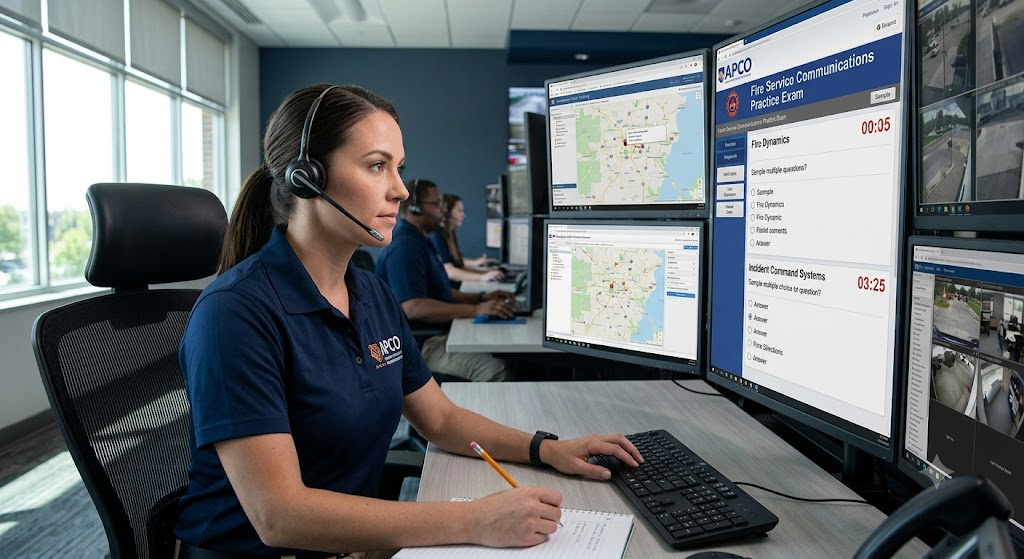
Additional Information
What the Course Entails and Exam Details
The certification curriculum follows standardized protocols developed by APCO International.
It covers a range of critical topics necessary for successful fire service dispatching.
Key areas of study include:
Fire Department Structure and Operations: Understanding the organization and functions of fire departments.
Emergency Call Handling: Specialized procedures for processing and prioritizing fire and rescue calls.
Dispatching Procedures: Radio protocols, resource deployment, and unit assignment strategies.
Fire Dynamics and Behavior: Basic knowledge of how fires behave and the hazards they present.
Fire Apparatus and Equipment: Identifying different types of firefighting vehicles and their capabilities.
Incident Command System (ICS): Integration with on-scene incident command structures.
Safety Procedures: Telecommunicator protocols for ensuring firefighter and civilian safety.
Telecommunications Technology: Operating modern communication systems in a fire dispatch environment.
The practice test rigorously assesses a candidate's grasp of these fundamental skills.
What to Expect in the Final Exam
The actual APCO Fire Service Communications certification exam is a formal evaluation of your readiness.
It is typically delivered in a computer-based format.
The exam consists of multiple-choice questions designed to test both knowledge retention and practical application through scenario-based problems.
While the exact length can vary based on the program version, you can typically expect between 50 and 100 questions.
The time limit is usually set to ensure efficiency, often providing 90 to 120 minutes for completion.
Candidates must achieve a passing score, which is typically around 70-80%, to earn their certification.
The [APCO Fire Service Communications Practice Exam] is designed to mimic this experience, preparing you for the questions you will encounter.
How to Study and Exam Centers
Effective preparation is the key to success.
Start by thoroughly reviewing the official APCO Fire Service Communications training materials and curriculum manuals.
Use the [APCO Fire Service Communications Practice Exam] repeatedly to test your knowledge.
Focus on scenario-based learning: practice identifying appropriate actions for common fire emergencies like structure fires, hazardous materials incidents, or vehicle accidents.
Create flashcards for fire terminology, radio codes, and procedures.
Consider forming a study group with colleagues who are also preparing for the exam.
APCO exams are typically administered through secure, proctored environments.
This may include established testing centers, such as Pearson VUE, which offer locations globally.
Alternatively, some programs may provide options for secure online proctoring.
Always verify the specific registration and testing details directly with APCO International or your authorized training provider.
Job Opportunities from the Course
Earning the APCO Fire Service Communications certification demonstrates a high level of expertise.
It significantly enhances career prospects within public safety.
Specific job opportunities unlocked by this certification include:
Fire Department Dispatcher
Fire Communications Operator
Emergency Medical Dispatcher (EMD) (often combined with fire services)
Lead Public Safety Telecommunicator
Communications Supervisor within Fire/EMS Services
Public Safety Telecommunications Trainer/Instructor
Emergency Management Coordinator
Frequently Asked Questions
Reviews
5.0
Based on 0 reviews
Leave a Review
No reviews yet. Be the first to review!