
AP Human Geography (APHG) Models & Theories Practice Test
$69.00
- Buy to unlock unlimited access to all Quiz questions.
- After purchase you can print a PDF of the whole quiz at any point. The PDF will contain the questions and the correct answers.
About this Exam
The AP Human Geography Models & Theories Practice Test is a vital diagnostic tool designed for high school students preparing for the official Advanced Placement (AP) Human Geography exam.
This practice test focuses exclusively on the critical component of models and theories, which form the bedrock of geographic inquiry and analysis.
Successfully navigating this test indicates a student's readiness for the complex theoretical questions on the AP Human Geography exam, paving the way for college credit and advanced placement in geography, international relations, or related fields.
It's the perfect gauge for students looking to understand how human patterns and processes shape our world through a conceptual lens.
Ready to test your knowledge?
Buy Now to Access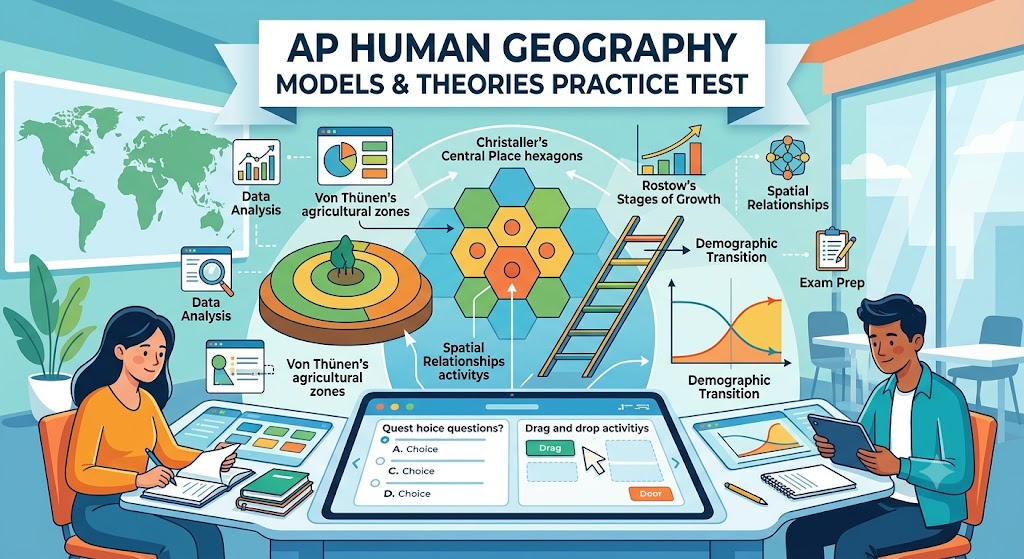
Additional Information
What the Course Entails and Exam Details
While this is a practice test, the AP Human Geography course covers a broad curriculum structured by the College Board. This test drills down specifically on how students can apply diverse geographic models and theoretical frameworks.
A strong performance on this practice test demonstrates proficiency in identifying, explaining, and connecting key concepts such as:
Demographic Models: Like the Demographic Transition Model (DTM), the Epidemiological Transition Model, and the Malthusian Theory of Population.
Land Use Models: Including von Thünen’s model of agricultural land use, Burgess’s Concentric Zone Model, Hoyt’s Sector Model, and Harris and Ullman’s Multiple-Nuclei Model of urban structures.
Economic Development Models: Such as Rostow’s Stages of Economic Growth, Wallerstein’s World Systems Theory (Dependency Theory), and Hotelling’s Model of Locational Interdependence.
Interaction Models: Covering Ravenstein’s Laws of Migration, Christaller’s Central Place Theory, and the Gravity Model of Spatial Interaction.
Cultural and Geopolitical Theories: For instance, the Rimland and Heartland Theories.
Success requires understanding the assumptions, applications, and critiques of each model.
What to Expect in the Final Exam
The actual College Board AP Human Geography Exam, where these models are tested, has two primary sections: Section I: Multiple Choice Questions (60 questions, 1 hour) and Section II: Free-Response Questions (3 FRQs, 1 hour 15 minutes).
The official exam lasts approximately 2 hours and 15 minutes. This practice test mirrors the types of questions found within that structure, often presenting stimuli like maps, graphs, data sets, and satellite imagery to prompt analysis through a model’s perspective.
Scoring on the final exam is complex, culminating in a scaled score from 1 to 5. While individual school policies vary, a 3, 4, or 5 is generally considered a strong performance, with 4 or 5 often required for credit at competitive universities. The passing score required varies widely. There are no penalty deductions for incorrect guesses on multiple-choice questions.
How to Study and Exam Centers
Developing specific study strategies is key to excelling. Actively create a dedicated "Model and Theory Cheat Sheet" for your study notebook. For each concept, clearly outline the core premise, a quick diagram, two major strengths, two major weaknesses or critiques (e.g., historical context bias), and one recent real-world application.
Supplement this with the use of digital flashcards (like Quizlet) and continuous practice using official AP Human Geography multiple-choice questions released by the College Board and reputable preparatory guides. Remember, applying the concept is more effective than simple rote memorization.
The official AP Human Geography exam is administered only once a year in May, primarily at high schools that have chosen to participate in the AP Program. Students register for the exam through their high school's AP Coordinator or school guidance office, which serves as the official exam center.
For independent learners or those at schools without AP programs, online AP instruction and authorized alternative testing sites are sometimes available through organizations that have gained College Board approval.
Job Opportunities from the Course
A strong foundation in AP Human Geography, validated by a top score, is a significant stepping stone toward academic and professional opportunities in fields where spatial analysis, cultural understanding, and global perspectives are paramount. While a single AP test isn't a professional license, mastering this material can jumpstart careers as:
Urban and Regional Planner: Applying models to design functional and sustainable cities.
Geographic Information Systems (GIS) Specialist: Analyzing complex spatial data for businesses and governments.
Geopolitical Analyst: Using theories to understand global conflicts, political movements, and international relations.
Cartographer: Integrating geographic concepts into map creation.
Environmental Consultant: Assessing human impact on landscapes through spatial patterns.
Community Development Manager: Directing programs focused on social and economic well-being at the local level.
Demographic Researcher: Analyzing population trends for public policy or private sector forecasting.
Frequently Asked Questions
Reviews
5.0
Based on 0 reviews
Leave a Review
No reviews yet. Be the first to review!