
AP Chemistry Exam Unit 9 Practice Test (Thermodynamics and Electrochemistry)
$69.00
- Buy to unlock unlimited access to all Quiz questions.
- After purchase you can print a PDF of the whole quiz at any point. The PDF will contain the questions and the correct answers.
About this Exam
The AP Chemistry Unit 9 examination on Thermodynamics and Electrochemistry is a pivotal assessment designed for advanced high school students aiming to demonstrate college-level proficiency. This comprehensive evaluation focuses on two critical and interconnected domains: the principles governing energy transfers in chemical reactions (thermodynamics) and the conversion between chemical and electrical energy (electrochemistry). It targets dedicated students seeking a deep understanding of spontaneity, cell potentials, and the foundational laws defining the physical universe, preparing them for advanced studies in science and engineering. This practice exam serves as an essential diagnostic tool to build confidence and mastery ahead of the actual College Board test.
Ready to test your knowledge?
Buy Now to Access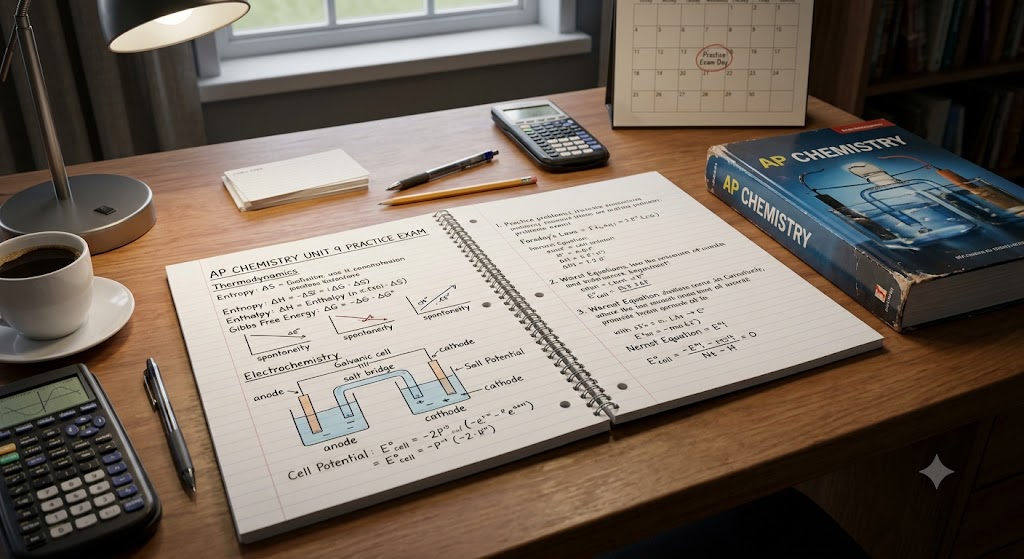
Additional Information
What the Course Entails and Exam Details
Unit 9 of AP Chemistry delves into complex concepts that quantify reaction viability and electron flow. The core syllabus includes entropy (ΔS) as a measure of disorder, enthalpy (ΔH), and the crucial calculation of Gibbs free energy (ΔG) to determine thermodynamic favorability and spontaneity. Students will explore the interplay between thermodynamics and dynamic equilibrium, linking cell potential (E°cell) to ΔG and equilibrium constants (K). The course also covers galvanic (voltaic) and electrolytic cells, emphasizing cell notation, electrode calculations, stoichiometry of electrochemical processes, and Faraday’s laws for quantifying electrochemical reactions.
What to Expect in the Final Exam
While a practice exam specifically for Unit 9 focusing purely on these topics is an excellent study resource, students must understand that the actual AP Chemistry Exam (the final assessment) is comprehensive. The final exam typically allocates approximately 7–9% of the overall score to content derived from Unit 9. It is divided into two equally weighted sections: a 60-question multiple-choice section (Section I, 90 minutes) and a 7-question free-response section (Section II, 105 minutes), covering material from all units. Thermodynamics and Electrochemistry concepts frequently appear in both sections, tested through quantitative calculations and conceptual explanations of reaction spontaneity and cell function. A score of 3, 4, or 5 is generally required for college credit.
How to Study and Exam Centers
Effective preparation requires a multi-faceted approach. Actively solve practice problems focusing on calculation heavy areas like ΔG, E°cell, and Faraday’s laws. Revisit lab experiments related to calorimetry, redox titrations, and constructing electrochemical cells to solidify conceptual understanding. Utilize active recall techniques to memorize key equations, constant values, and foundational principles like Le Chatelier's application in non-standard cell potentials. Group study sessions can provide fresh perspectives on complex problems. For the official AP Chemistry exam, students must register through their participating high school; exams are administered at designated physical testing centers and authorized schools worldwide. Practice exams, like this one, are typically self-administered as part of an independent study plan or classroom preparation.
Job Opportunities from the Course
Excelling in AP Chemistry, particularly mastering complex topics like Thermodynamics and Electrochemistry, builds a strong scientific foundation relevant to numerous high-impact careers.
Chemical Engineer
Biochemist
Materials Scientist
Environmental Scientist
Pharmacist
Forensic Scientist
Renewable Energy Researcher
Process Chemist
Frequently Asked Questions
Reviews
5.0
Based on 0 reviews
Leave a Review
No reviews yet. Be the first to review!