
Animal Control Officer Basic Training Practice Test
$69.00
- Buy to unlock unlimited access to all Quiz questions.
- After purchase you can print a PDF of the whole quiz at any point. The PDF will contain the questions and the correct answers.
About this Exam
The Animal Control Officer Basic Training Certification validates the fundamental knowledge necessary to excel as an ethical and safe Animal Control Officer (ACO). The associated training program and final exam are designed for individuals looking to enter the critical fields of animal welfare and public safety. This certification ensures that officers possess the baseline skills required for humane animal handling, effective communication, accurate knowledge of animal control laws, and proper field safety protocols. It is essential for entry-level candidates aiming to serve their communities and protect animals, working within municipal, county, or private animal services departments.
Ready to test your knowledge?
Buy Now to Access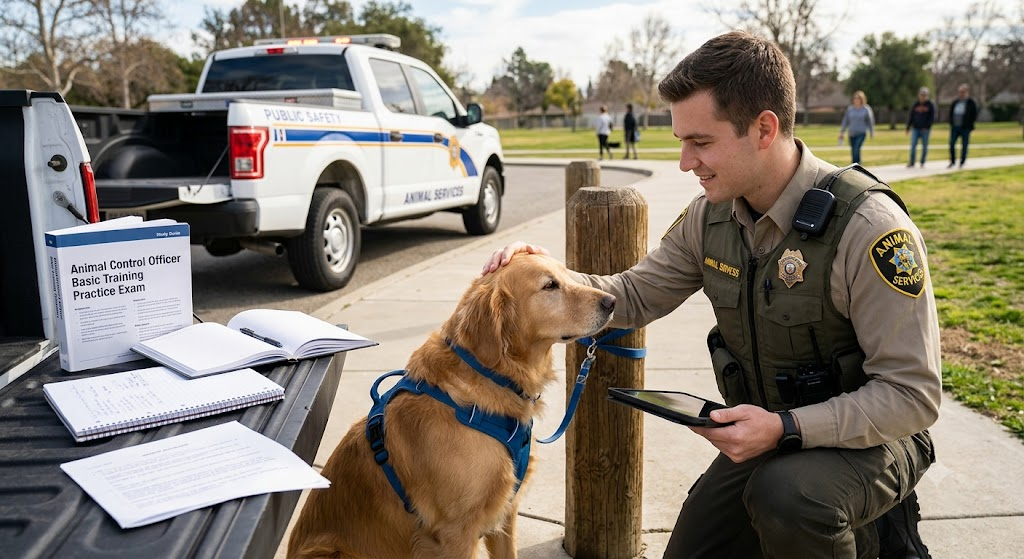
Additional Information
What the Course Entails and Exam Details
A standard Animal Control Officer Basic Training curriculum focuses on diverse critical subject areas. Preparation for the practice test and final exam typically covers topics such as:
Animal Law and Legislation: Comprehending state laws, local ordinances, and common cruelty, neglect, and containment regulations.
Humane Animal Handling: Mastering safe and respectful capture, restraining techniques for various species (dogs, cats, common wildlife), and utilizing specialized equipment effectively.
Breeds and Identification: Recognizing various domestic breeds and understanding different animal behaviors.
Shelter Operations and Sanitation: Following proper animal care procedures, feeding protocols, and disease prevention strategies within shelter environments.
Zoonotic Diseases: Understanding public health risks associated with diseases transmissible from animals to humans, such as rabies.
Officer Safety and Ethics: Maintaining field safety, proper reporting, investigative procedures, and professional conduct.
Community Education: Interacting professionally with the public, educating on responsible pet ownership, and managing conflict resolution.
Report Writing and Record Keeping: Generating accurate legal documentation and maintaining comprehensive records necessary for effective enforcement.
What to Expect in the Final Exam
While specific formatting and rules may vary by state or authorizing agency, the structure generally includes the following components for the cognitive section:
Format: The final exam is primarily administered as a multiple-choice assessment. Questions are designed to evaluate recall of key concepts, legal definitions, and best practices.
Passing Score: To obtain certification, candidates must typically achieve a score ranging from 70% to 80% correct answers. This demonstrates a solid foundation of essential knowledge.
Time Limit: A specified time limit is enforced, usually between one and two hours. Practice tests help candidates manage their time and answer efficiently.
Specific Rules: Some comprehensive certification programs may require a separate practical, hands-on evaluation of animal handling skills. Practice tests focus heavily on the cognitive knowledge portion.
How to Study and Exam Centers
Actionable Study Strategies:
Utilize Authorized Study Guides: Always start with the official curriculum materials provided by your state agency or training organization. These contain the specific rules and best practices for your jurisdiction.
Focus on Local Ordinances: Pay close attention to the unique animal control laws and definitions pertinent to the area where you intend to work. Regulations on leash laws, dangerous dogs, and cruelty definitions vary significantly.
Leverage Practice Tests: Repeatedly taking the Animal Control Officer Basic Training Practice Test is crucial. Practice tests familiarize you with multiple-choice question structures and test your ability to recall and apply specific knowledge quickly.
Practice Handling Techniques: While not part of a written practice test, actively practicing humane animal handling techniques (using correct equipment and body language) with safe animals or during a structured training course is imperative for the role and any potential practical exam.
Create Scenarios: Practice applying the legal concepts you've learned to hypothetical real-world animal control situations.
Exam Centers and Formats:
Authorized Schools and Agencies: In many states, basic training and the final exam are administered internally by municipal, county, or regional animal services training academies.
State Agencies: Department of Agriculture offices or specific state police/public safety organizations may hold and authorize exams for state-mandated certifications.
Pearson VUE: Certain statewide or nationally recognized certifications partner with professional testing services like Pearson VUE for computer-based testing at standardized locations.
Authorized Training Providers: Authorized private training schools and humane societies may also be approved to conduct basic training and associated exams.
Job Opportunities from the Course
Successfully completing the Animal Control Officer Basic Training and passing the final exam opens pathways to numerous vital roles in animal services, law enforcement, and public health. The foundational knowledge and skills validated by this certification are essential for positions such as:
Animal Control Officer (ACO) / Animal Services Officer: The primary career destination, enforcing animal welfare laws, responding to complaints, and ensuring public safety.
Animal Cruelty Investigator: Investigating reports of animal abuse or neglect for progressive humane organizations and law enforcement agencies.
Animal Shelter Manager: Overseeing daily operations, animal care protocols, staff training, and disease prevention in a public or private shelter.
Wildlife Control Operator: Safely handling nuisance wildlife and mitigating human-wildlife conflicts (may require additional permits in some jurisdictions).
Rabies Control Officer: Focused specifically on disease prevention, vector control, and public health education.
Veterinary Assistant (Public Sector): Assisting in the medical treatment of shelter animals and the administration of clinical care.
Humane Educator: Educating the community, particularly children, about responsible pet ownership and humane animal care.
Adoption Coordinator: Facilitating the responsible placement of shelter animals into new homes.
Animal Rescue Team Member: Utilizing knowledge of handling and transport in large-scale animal rescue scenarios.
Frequently Asked Questions
Reviews
5.0
Based on 0 reviews
Leave a Review
No reviews yet. Be the first to review!