
Anatomy and Physiology (ANAPHY) Battery Practice Exam
$69.00
- Buy to unlock unlimited access to all Quiz questions.
- After purchase you can print a PDF of the whole quiz at any point. The PDF will contain the questions and the correct answers.
About this Exam
Ready to test your knowledge?
Buy Now to Access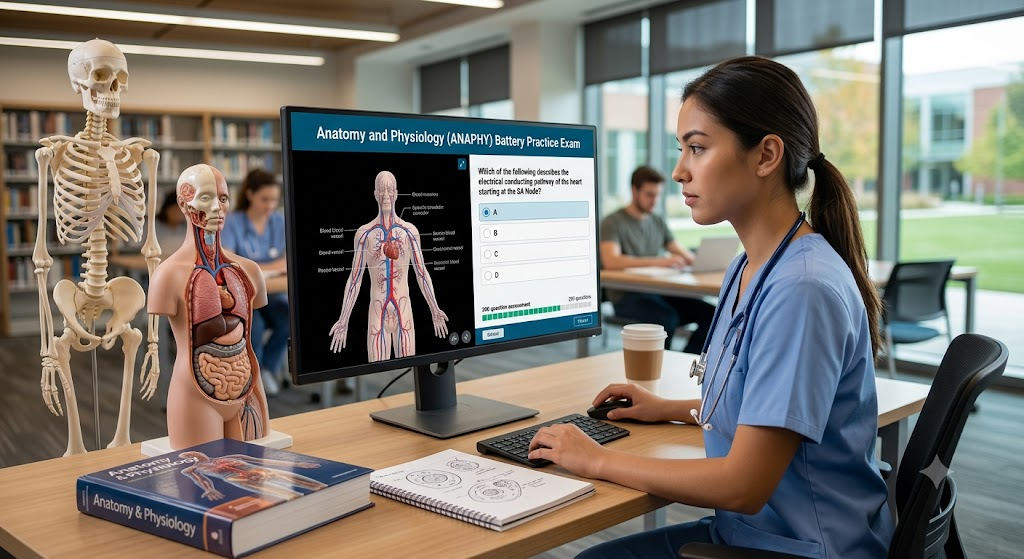
Additional Information
What the Course Entails and Exam Details
The core curriculum covered by the ANAPHY Battery encompasses the entire spectrum of a typical college-level, two-semester Anatomy and Physiology course sequence. This includes a foundational dive into the chemical, cellular, and tissue levels of organization, ensuring a robust starting point for all organ system studies. The subsequent "battery" of modules meticulously tests a student's grasp on the intricate mechanics and interconnectedness of every major human body system, including the Integumentary, Skeletal, Muscular, Nervous, Endocrine, Cardiovascular, Lymphatic, Respiratory, Digestive, Urinary, and Reproductive systems. Beyond system-specific details, the assessment heavily weighs critical concepts of homeostasis, physiological feedback loops, and anatomical terminology essential for clear medical communication. Students must navigate complex physiological processes, such as the action potential of a neuron, the cardiac cycle, the renal filtration mechanics, and hormonal regulation of metabolism.
What to Expect in the Final Exam
While the ANAPHY Battery is a simulation, it is structured to mirror the format and rigor of the final, high-stakes exams for which students are preparing. These final assessments are typically composed of multiple-choice questions, ranging from 100 to 200 items, and may include diagram identification tasks where candidates must accurately label anatomical structures or trace physiological pathways. Testing sessions are strictly timed, often allowing between two to four hours for completion, requiring both accuracy and efficient time management. Passing score requirements are determined by the specific institution or program, but a common benchmark for demonstrating core proficiency is 70% or higher, while competitive programs may require an even greater score. Success demands not just memorization but the ability to synthesize concepts and apply knowledge to clinical scenarios presented within the question stems.
How to Study and Exam Centers
A successful study strategy requires active engagement with the material across a long timeline. Spaced repetition is a key technique for retaining vast amounts of information, so students should review anatomical models, charts, and text sections regularly using an active recall approach, such as sketching diagrams from memory or teaching concepts aloud to a study partner. Creating a comprehensive anatomy atlas with personal labels and summary sheets for each system’s key physiological processes is a fundamental step. The practice exam itself is a central tool; taking the ANAPHY Battery iteratively identifies specific knowledge gaps that can then be targeted with focused, high-yield review. Regarding where and how to take the assessment, the ANAPHY Battery Practice Exam is often a digital resource provided directly through institutional learning management systems (LMS) or authorized third-party educational portals. This flexible, remote-access format allows students to practice under simulated exam conditions at any time. However, the official institutional and licensing exams the battery prepares for are typically administered in specific, secure environments. These locations can range from designated computer labs at your college or university to nationwide professional testing centers authorized by organizations like Pearson VUE or Prometric, ensuring standardized testing protocols for all candidates.
Job Opportunities from the Course
A strong foundatioin in Anatomy and Physiology, validated by comprehensive exam performance, is the indispensable entry-level requirement for nearly every patient-facing or health-supportive career path. This knowledge unlocks advanced specialized training and certification for many essential roles.
Key Job opportunities that depend directly on this foundational knowledge include:
Registered Nurse (RN)
Licensed Practical Nurse (LPN) / Vocational Nurse (LVN)
Emergency Medical Technician (EMT)
Paramedic
Radiology Technologist
Physical Therapist Assistant (PTA)
Occupational Therapist Assistant (OTA)
Respiratory Therapist
Dental Hygienist
Medical Assistant
Surgical Technologist
Diagnostic Medical Sonographer
Phlebotomist
Cardiovascular Technologist
Medical Laboratory Technician
Health Information Technician
Frequently Asked Questions
Reviews
5.0
Based on 0 reviews
Leave a Review
No reviews yet. Be the first to review!