
Analytical Chemistry Practice Test
$69.00
- Buy to unlock unlimited access to all Quiz questions.
- After purchase you can print a PDF of the whole quiz at any point. The PDF will contain the questions and the correct answers.
About this Exam
The Analytical Chemistry Practice Exam is an essential tool designed to help students and aspiring professionals master the principles of separation, identification, and quantification of chemical components. This comprehensive test is ideal for undergraduate chemistry students preparing for university finals, as well as professionals aiming for certifications in fields such as pharmaceuticals, environmental science, forensics, and quality control. By simulating the rigors of a final examination, it provides a crucial benchmark for evaluating readiness and identifying areas for further study, ensuring confidence on test day.
Ready to test your knowledge?
Buy Now to Access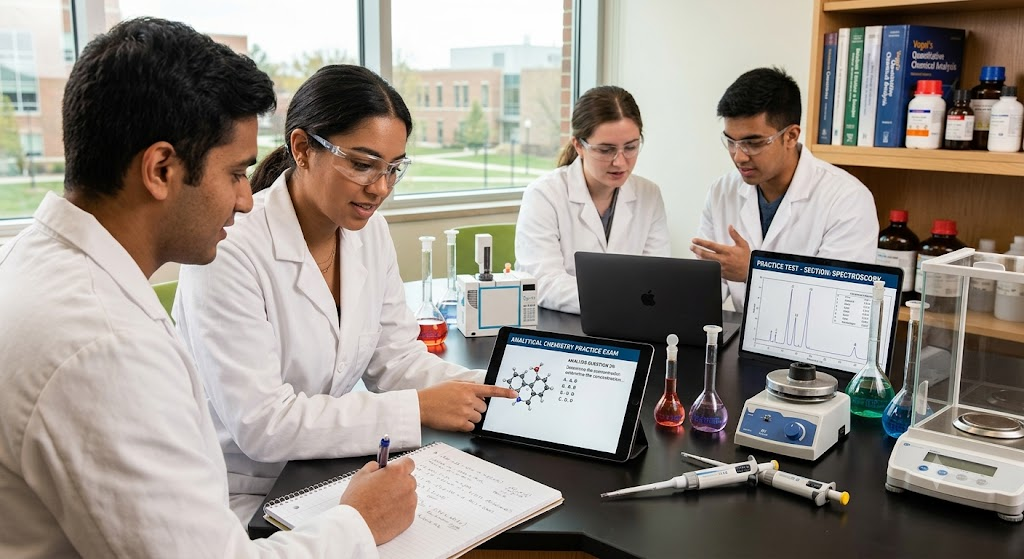
Additional Information
What the Course Entails and Exam Details
A foundational course in analytical chemistry typically covers a wide array of theoretical concepts and practical laboratory skills. The examination assesses your proficiency in both classical and modern instrumental methods. Key topics include:
Fundamentals and Data Handling: Reviewing units of measurement, scientific notation, significant figures, chemical stoichiometry, error analysis (accuracy vs. precision), and statistical methods for data interpretation.
Sample Preparation and Handling: Understanding sampling techniques, sample dissolution, digestion, extraction, and preservation to ensure representative and valid results.
Classical Methods of Analysis: Mastery of titrimetric (acid-base, redox, complexometric) and gravimetric analysis techniques.
Instrumental Methods: Extensive coverage of spectroscopic methods (UV-Visible, Infrared, Atomic Absorption), chromatographic methods (Gas Chromatography, High-Performance Liquid Chromatography), and electroanalytical methods (potentiometry, voltammetry, coulometry).
Quality Assurance and Control: Implementing Good Laboratory Practices (GLP), method validation, calibration procedures, and proficiency testing.
What to Expect in the Final Exam
While the exact structure can vary depending on the institution or certifying body, a final exam for analytical chemistry is typically a robust assessment of both knowledge and application. You should expect the following format for a standard comprehensive test:
Format: A combination of multiple-choice questions to test theoretical knowledge and problem-solving scenarios that require mathematical calculations, chemical reactions, and data interpretation. Some exams may also include short-answer questions or structured essay components.
Time Limit: Usually ranges from two to four hours, demanding efficient time management and a steady pace.
Passing Score: The required score to pass often falls between 60% and 70%, but this is highly variable.
Specific Rules: In a formal testing center, strict rules apply. You may be permitted to use a non-programmable scientific calculator, but electronic devices and personal notes are strictly prohibited. The environment is proctored to ensure academic integrity.
How to Study and Exam Centers
Preparation is the key to success. Employ these actionable strategies to build your skills:
Structured Study Plan: Dedicate specific times to review each major topic, focusing on your weak areas first. Use standard textbooks and comprehensive study guides as your primary resources.
Practice, Practice, Practice: Work through as many practice problems and past exam papers as possible. This is the most effective way to understand the application of formulas and the logic of analytical methods.
Focus on the ‘Why’: Don’t just memorize procedures; understand the underlying chemical and physical principles of each analytical technique.
Simulate Exam Conditions: Take a full-length practice test in one sitting with no distractions and strict timing to build your stamina and identify pacing issues.
For this practice test: You can take it instantly from the comfort of your own home on our online portal, receiving immediate feedback and performance breakdown.
For a formal final exam/certification: When you are ready to take a recognized final exam, such as the ACS (American Chemical Society) examinations or various professional certification tests, you will typically need to register through the official organization. They will direct you to authorized academic testing centers or a network of physical testing locations, such as Pearson VUE, which offer proctored environments worldwide.
Job Opportunities from the Course
A strong performance on an analytical chemistry exam and the subsequent completion of a relevant degree or certification can unlock diverse and rewarding career paths. Employers in many sectors value the precision and problem-solving skills of a trained analytical chemist. Potential job titles include:
Analytical Chemist
Quality Control (QC) Analyst
Quality Assurance (QA) Specialist
Research Scientist (analytical development)
Forensic Scientist
Environmental Chemist
Pharmaceutical Scientist
Laboratory Supervisor
Instrumentation Specialist
Technical Support Scientist (analytical instruments)
This practice exam is your first step towards proving your expertise in this critical field. Start practicing today to build the knowledge and confidence required to excel.
Frequently Asked Questions
Reviews
5.0
Based on 0 reviews
Leave a Review
No reviews yet. Be the first to review!