
AMPP Cathodic Protection Technician (CP2) Practice Exam
$69.00
- Buy to unlock unlimited access to all Quiz questions.
- After purchase you can print a PDF of the whole quiz at any point. The PDF will contain the questions and the correct answers.
About this Exam
The AMPP Cathodic Protection Technician (CP2) Certification is an intermediate-level program designed for individuals who possess several years of field experience in cathodic protection or come from a technical and engineering background.
This certification validates a professional's ability to execute advanced field testing, perform sophisticated troubleshooting, and interpret complex data on both galvanic and impressed current CP systems. The typical candidate is responsible for supervising installations, evaluating CP system performance, and mitigating interference.
Ready to test your knowledge?
Buy Now to Access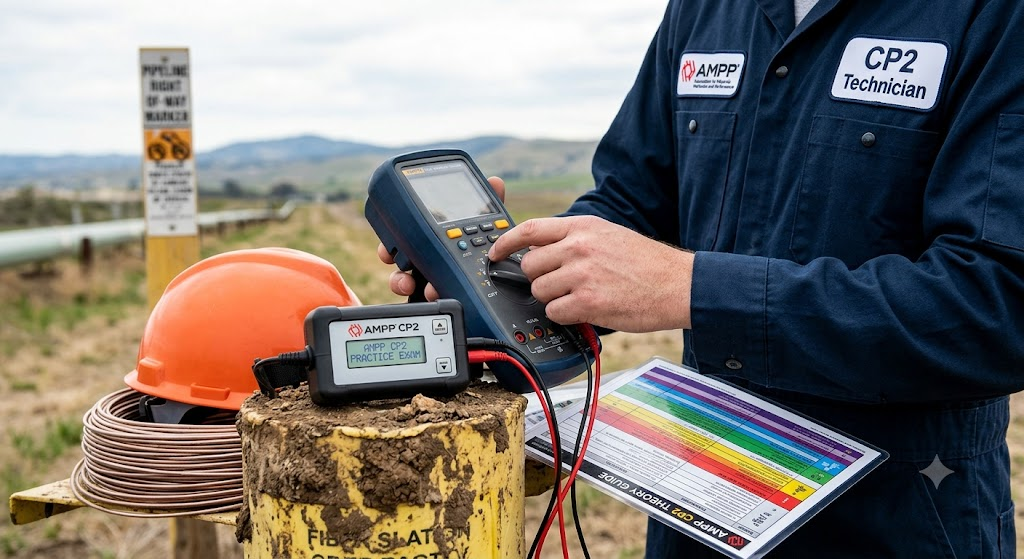
Additional Information
What the Course Entails and Exam Details
Preparing for the CP2 certification, including its practice and final exams, requires a deep understanding of the core Cathodic Protection Body of Knowledge (BOK).
The syllabus and associated course, which is strongly recommended, cover the following technical areas:
Intermediate Corrosion Theory: Understanding Faraday’s Law, polarization effects (activation, concentration), and the E log I relationship.
CP Fundamentals and Criteria: Applying standard CP criteria and managing voltage (IR) drops in measurements.
Types of CP Systems: Deep dives into galvanic and impressed current (ICCP) systems, including deep anode groundbeds.
ICCP Power Sources: Theory, safety, and troubleshooting of rectifiers, including circuit components and operation modes.
Field Testing and Data Interpretation: Mastering complex tests, including interrupted structure-to-electrolyte potentials, current requirements, continuity, road/railroad casing shorts, and layer soil resistivity testing.
Interference and Mitigation: Identifying and mitigating stray current interference, primarily related to underground pipelines.
What to Expect in the Final Exam
The final assessment for the AMPP CP2 certification is a rigorous, two-part process. You must pass both components to earn the credential.
Part 1: The Theory (Written) Exam
Test Name: AMPP CP 2 – Cathodic Protection Technician – Theory Exam
Test Code: NACE-CP2-001
Format: Computer-Based Testing (CBT)
Questions: 89 to 110 multiple-choice questions (the number can vary, and some might be unscored pilot questions).
Time Limit: 2.5 to 3 hours.
Location: Administered worldwide at authorized Pearson VUE testing centers.
Rules: The exam is closed-book, though reference materials are provided within the CBT interface.
Part 2: The Practical Exam
Test Name: AMPP CP 2 – Cathodic Protection Technician – Practical Exam
Format: Hands-on assessment.
Details: This exam requires you to demonstrate competency in performing actual field tests and using diagnostic equipment (e.g., voltmeters, ammeters, current interrupters, reference electrodes).
Location: This is typically administered on the last day of the corresponding AMPP CP2 course, but stand-alone practical exam sessions may be available.
How to Study and Exam Centers
Preparation must be strategic, blending technical knowledge with practical application.
Actionable Study Strategies:
Master the AMPP CP2 Course Material: If you attended the course, your student manual is your primary resource. If not, purchase the corresponding preparation guide from AMPP.
Review Your Basics: Ensure your knowledge of Basic Corrosion (CP1), algebra, and basic electricity (Ohm’s Law, series and parallel circuits) is solid.
Leverage Practice Exams: Using high-quality AMPP Cathodic Protection Technician (CP2) practice exams is critical. They help you get used to the CBT format, manage your time, and identify knowledge gaps.
Focus on Data Interpretation: The CP2 exam tests your ability to take a data set (e.g., "On" vs. "Instant Off" potentials across a section of pipeline) and diagnose the system health. Practice this type of evaluation.
Hands-on Field Practice: For the practical exam, spend time in the field. Practice interrupting rectifiers, taking synchronized potentials, and performing soil resistivity tests until you are seamless.
Exam Center Information:
You can register for the CBT Theory Exam through your AMPP account, where you will receive an authorization to test. You will then schedule your exam at a Pearson VUE testing center. To find your nearest location, visit the official Pearson VUE website and search for AMPP. The Practical Exam, being hands-on, is managed directly by AMPP or its global authorized training providers and is usually tied to a specific training location.
Job Opportunities from the Course
Earning the AMPP CP2 certification distinguishes you in the industry, proving you possess the analytical skills required for intermediate roles. It unlocks a variety of career paths within the energy, utility, marine, and infrastructure sectors.
Key job titles and career paths this certification enables include:
Cathodic Protection Technician (Level 2)
Corrosion Control Technician
Pipeline Integrity Technician
Stray Current Specialist
Corrosion Inspector (for CP focus)
CP Project Supervisor
Path to CP3 Cathodic Protection Technologist
This comprehensive study guide ensures you approach your AMPP CP2 journey with clarity and confidence. By mastering the core technical areas and utilizing practical and practice-based study methods, you will be well-equipped for success in both the theoretical and practical examinations.
Frequently Asked Questions
Reviews
5.0
Based on 0 reviews
Leave a Review
No reviews yet. Be the first to review!