
AMP - Aviation Maintenance Technician Powerplant Practice Exam
$69.00
- Buy to unlock unlimited access to all Quiz questions.
- After purchase you can print a PDF of the whole quiz at any point. The PDF will contain the questions and the correct answers.
About this Exam
The FAA Aviation Maintenance Technician (AMT) Powerplant rating is a critical certification for anyone seeking a comprehensive career in aircraft maintenance. This rating specifically authorizes a technician to perform maintenance, preventive maintenance, and alterations on aircraft engines, their systems, and propellers. It is one of the two primary ratings, along with the Airframe rating, that make up the complete "A&P" license (Airframe and Powerplant). This study guide for the AMP - Aviation Maintenance Technician Powerplant Practice Exam is designed as a comprehensive tool to help aspiring mechanics prepare for the official Federal Aviation Administration written examination. It serves as a simulation to build knowledge, improve speed, and familiarize candidates with the exact types of questions they will encounter. This guide is ideal for students enrolled in FAA-certified Part 147 maintenance schools, those working through military experience pathways, or individuals using documented practical experience to gain eligibility for certification.
Ready to test your knowledge?
Buy Now to Access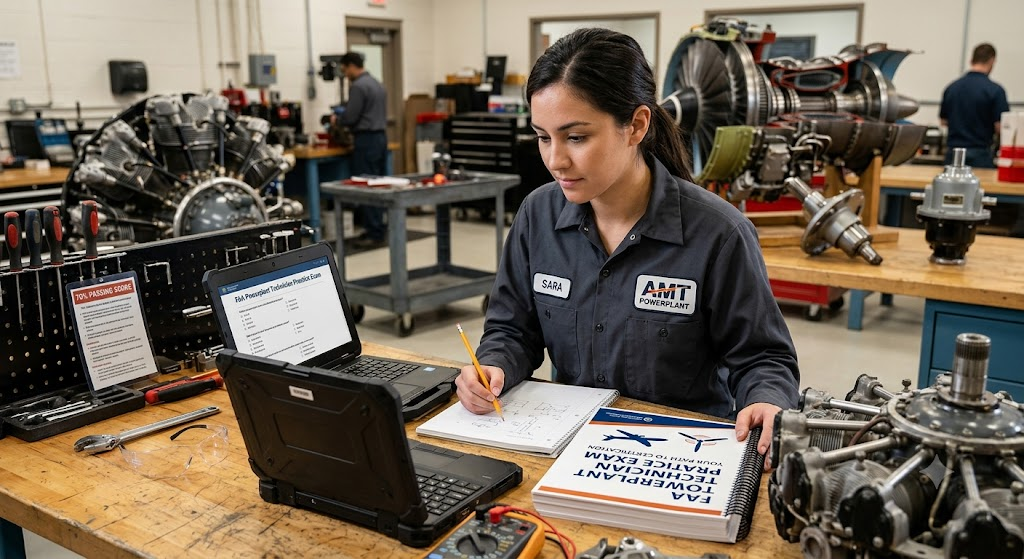
Additional Information
What the Course Entails and Exam Details
This practice exam covers the wide-ranging subject matter tested by the FAA for the Powerplant rating. A complete course of study, which this exam simulates, involves deeply understanding both the mechanical systems and the underlying physical principles of aircraft propulsion. The core topics, derived directly from the FAA's latest Airman Certification Standards (ACS), include:
Reciprocating Engines: Theory, operation, construction, maintenance, and overhaul.
Turbine Engines: Theory, operation, construction, maintenance, and overhaul.
Engine Instrument Systems: For both reciprocating and turbine engines.
Engine Fire Protection Systems.
Engine Electrical Systems.
Lubrication Systems.
Ignition and Starting Systems.
Fuel Metering Systems.
Engine Fuel Systems.
Induction and Engine Airflow Systems.
Engine Cooling Systems.
Engine Exhaust and Reverser Systems.
Propellers: Theory, operation, construction, maintenance, and auxiliary systems.
Unducted Fans.
Auxiliary Power Units (APUs).
While this practice tool focuses on the written component, achieving an FAA Powerplant rating ultimately requires passing a rigorous two-part certification process: the Written (Knowledge) Test and the Oral and Practical Examinations (O&Ps).
What to Expect in the Final Exam
For the actual FAA Written (Knowledge) Test, candidates can expect a robust evaluation. The written part is a computer-based examination featuring multiple-choice questions. For the Powerplant rating, the test consists of 100 questions. Candidates are allotted a maximum of 2 hours (120 minutes) to complete the entire exam. The minimum passing score is 70 percent. It is crucial to remember that the written test is only step one. After passing the written exam, you must complete the Oral and Practical Exams with a Designated Mechanic Examiner (DME). In the O&Ps, you will have to orally answer technical questions and practically perform hands-on maintenance tasks to demonstrate your skill and knowledge to the DME. Your written practice here is foundational to success in those final steps.
How to Study and Exam Centers
Effective preparation is key to success on the FAA Powerplant Written Test. To succeed, students are encouraged to use a comprehensive strategy:
Utilize Official FAA Resources: The FAA provides free, detailed handbooks, specifically the "Aviation Maintenance Technician Handbook—Powerplant" (FAA-H-8083-32A). These are the definitive guides.
Engage with Detailed Textbooks: Supplement FAA materials with trusted, in-depth industry textbooks.
Leverage Practice Exams: Take this practice exam repeatedly in simulated test conditions (timed and without notes) to assess your readiness, improve speed, and identify knowledge gaps.
Create or Join Study Groups: Discussing complex concepts like engine troubleshooting or propeller synchronization with peers is a powerful way to reinforce learning.
The actual FAA Powerplant Written (Knowledge) Test must be taken at an authorized FAA knowledge testing center. Currently, the FAA utilizes PSI Services as the sole contractor to manage these testing networks. To schedule your real exam, you must first obtain an FAA Tracking Number (FTN) via the IACRA portal and then create an account and schedule your test through PSI’s online system. You can locate convenient authorized testing centers, which are often located at airports or Part 147 aviation schools, through the PSI portal.
Job Opportunities from the Course
A certified Aviation Maintenance Technician with a Powerplant rating possesses a high-demand, universal skill set that opens a vast array of career paths within the aerospace industry. This certification is a required step for working on any type of certified aircraft engine, from a small piston-powered trainer to a massive turbofan on a commercial jetliner. Key job titles and areas of employment include:
Aviation Maintenance Technician (AMT)
Aircraft Mechanic, Powerplant
Turbine Engine Mechanic
Reciprocating Engine Technician
Aircraft Engine Repairer / Overhaul Technician
Line Maintenance Technician
Shop Maintenance Technician
Engine Test Cell Technician
Quality Control Inspector (with additional experience)
Maintenance, Repair, and Overhaul (MRO) Technician
Technical Instructor (Aviation Maintenance)
These opportunities exist across several sectors, including major and regional commercial airlines, general aviation operators, corporate flight departments, helicopter operators, aerospace manufacturers, government agencies, and defense contractors. Achieving your Powerplant rating is a significant milestone that provides a robust foundation for a secure and rewarding career in aviation maintenance.
Frequently Asked Questions
Reviews
5.0
Based on 0 reviews
Leave a Review
No reviews yet. Be the first to review!