
American Chemical Society (ACS) Chemistry Practice Exam
$69.00
- Buy to unlock unlimited access to all Quiz questions.
- After purchase you can print a PDF of the whole quiz at any point. The PDF will contain the questions and the correct answers.
About this Exam
The American Chemical Society (ACS) Chemistry exams are standardized assessments widely recognized for their rigor and comprehensive coverage of core chemistry concepts. These exams are typically administered as final examinations in undergraduate chemistry courses across the United States. They serve as a powerful benchmark, allowing both instructors and students to evaluate the level of mastery achieved in a specific area of chemistry. The ACS Chemistry Practice Exam is an invaluable official resource designed by the ACS Examinations Institute itself. It allows students to familiarize themselves with the style, structure, and difficulty level of the actual final exam, providing a realistic assessment of their readiness and helping them identify specific areas for further study. It is an essential tool for any student aiming to excel in their ACS final and demonstrate their expertise to future academic institutions and employers.
Ready to test your knowledge?
Buy Now to Access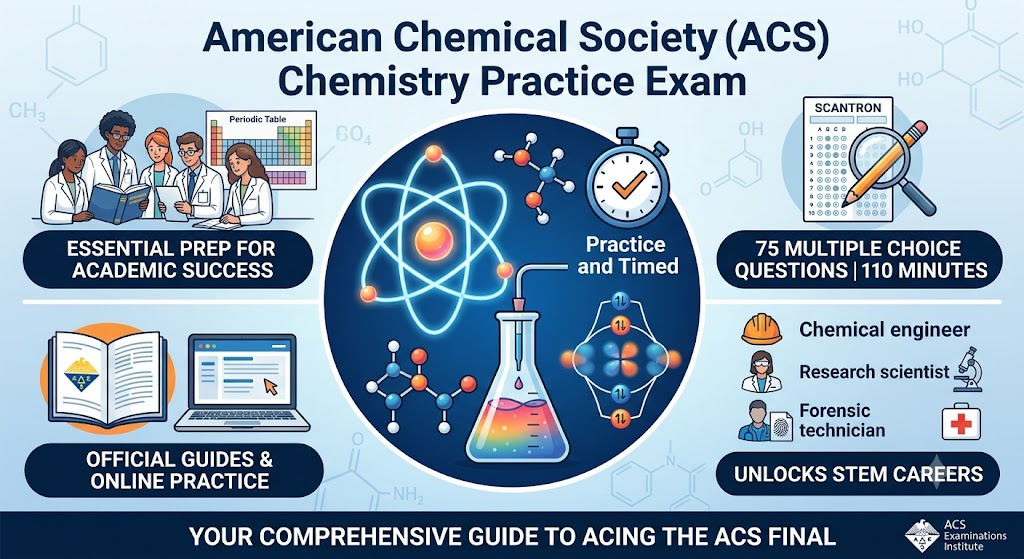
Additional Information
What the Course Entails and Exam Details
It is important to clarify that the ACS Chemistry Practice Exam is not a course itself; rather, it is a preparation tool designed to simulate the final exam of a university-level chemistry course. A typical "ACS Chemistry" sequence is most often represented by General Chemistry (first and second terms) or Organic Chemistry. Using the standard General Chemistry sequence as an example, the content entails a full year of rigorous study covering foundational chemical principles.
The ACS General Chemistry exam covers major topics, including, but not limited to:
Atomic Structure and Periodicity
Stoichiometry (Mass and Molar Relationships)
States of Matter (Gases, Liquids, Solids)
Chemical Bonding and Molecular Structure
Energetics and Thermodynamics
Chemical Kinetics
Chemical Equilibrium
Solutions
Acids and Bases
Electrochemistry
Descriptive Chemistry and Laboratory Techniques
The specific details of the Practice Exam vary. The ACS Examinations Institute offers online tutorials that explain how questions are designed, as well as timed online practice exams that mimic the format of the official test.
What to Expect in the Final Exam
While the practice exam helps you prepare, the official ACS Final Exam itself is the culminating moment. You can expect a highly standardized, multiple-choice assessment that tests your conceptual understanding, problem-solving abilities, and recall of key chemical factual information.
Here are typical details for an ACS General Chemistry Final Exam:
Format: 75 multiple-choice questions. Each question has four or five options, and there is only one correct answer.
Time Limit: Approximately 110 minutes (1 hour and 50 minutes). This requires efficient time management.
Passing Score: The ACS does not set a universal "passing" score. Scores are reported to the student's institution as raw scores and national percentiles. Individual course instructors determine how these scores are used to calculate the final grade.
Rules: The exam is strictly closed-book. You will be provided with a periodic table and typically are allowed to use a standard, non-programmable scientific calculator. No other materials, such as notes, mobile phones, or textbooks, are permitted.
Scoring: Scoring is typically done using a scantron sheet or an equivalent digital optical mark reading system. There is no penalty for guessing; therefore, it is in your best interest to answer every question.
How to Study and Exam Centers
Effective study for an ACS Chemistry exam requires a strategic approach that combines deep conceptual understanding with targeted practice. This is not an exam that can be mastered by rote memorization alone.
Actionable Study Strategies:
Use the Official ACS Study Guide: The ACS offers official study guide books. These guides are essential, as they explain the rationale behind question design and provide numerous practice problems categorized by topic.
Take Multiple Practice Exams: The official online timed practice exams are the best simulation of the actual test. Take them under realistic, timed conditions to build stamina and manage time pressure.
Active Learning over Passive Reading: Don't just read your textbook. Work through problems, draw mechanisms (for organic chemistry), solve stoichiometry calculations, and explain concepts aloud.
Analyze Your Mistakes: When using practice materials, don't just check the answer key. Understand why you got a question wrong. Was it a conceptual error, a calculation mistake, or a misreading of the question?
Focus on Concepts, Not Just Math: ACS questions often require you to apply a principle to a new situation. Ensure you understand the underlying "why" of a chemical phenomenon.
Exam Centers: The final, official ACS exams (not the practice version) are not administered at public test centers like Pearson VUE. Instead, they are administered directly by the student's college or university's chemistry department. Your instructor will provide you with the specific time, date, and on-campus location for your exam. The ACS practice exams are available online for individual purchase and can be taken at your convenience on your own computer.
Job Opportunities from the Course
A strong performance on a standardized ACS exam is more than just an academic achievement; it is a respected credential that demonstrates foundational chemical knowledge. This mastery is a critical prerequisite for advanced studies and a wide variety of careers in science, engineering, and medicine.
Potential Career Paths and Job Titles:
Chemical Engineer
Lab Technician / Laboratory Analyst
Research Scientist
Analytical Chemist
Quality Control Chemist
Forensic Scientist
Geochemist
Environmental Chemist
Materials Scientist
Science Writer / Educator
Pharmaceutical Sales Representative
Professional Health Student (Pre-Medicine, Pre-Pharmacy, Pre-Dental)
High School Chemistry Teacher (with necessary licensure)
By using the ACS Chemistry Practice Exam effectively, you are investing in a deeper understanding of the chemical world and opening doors to these diverse and rewarding professional opportunities.
Frequently Asked Questions
Reviews
5.0
Based on 0 reviews
Leave a Review
No reviews yet. Be the first to review!