
American Board of Surgical Assistants (ABSA) Orthopedic Practice Test
$69.00
- Buy to unlock unlimited access to all Quiz questions.
- After purchase you can print a PDF of the whole quiz at any point. The PDF will contain the questions and the correct answers.
About this Exam
Elevate your career in the operating room with a focus on musculoskeletal procedures. The American Board of Surgical Assistants (ABSA) Orthopedic Practice Test is a critical, specialized tool for surgical assistants aiming to demonstrate and refine their expertise in the complex field of orthopedic surgery. Designed for dedicated professionals seeking the prestigious Surgical Assistant-Certified (SA-C) credential with a declared focus on orthopedics, this study resource bridges the gap between general surgical knowledge and the nuanced demands of bone and joint care. It provides an indispensable opportunity to assess your readiness, build confidence, and master the specialized anatomy, instrumentation, and techniques required to assist on procedures ranging from total joint replacements to trauma reconstruction. This practice test is a cornerstone for those committed to delivering exceptional surgical support and achieving peak performance in an orthopedic surgical environment.
Ready to test your knowledge?
Buy Now to Access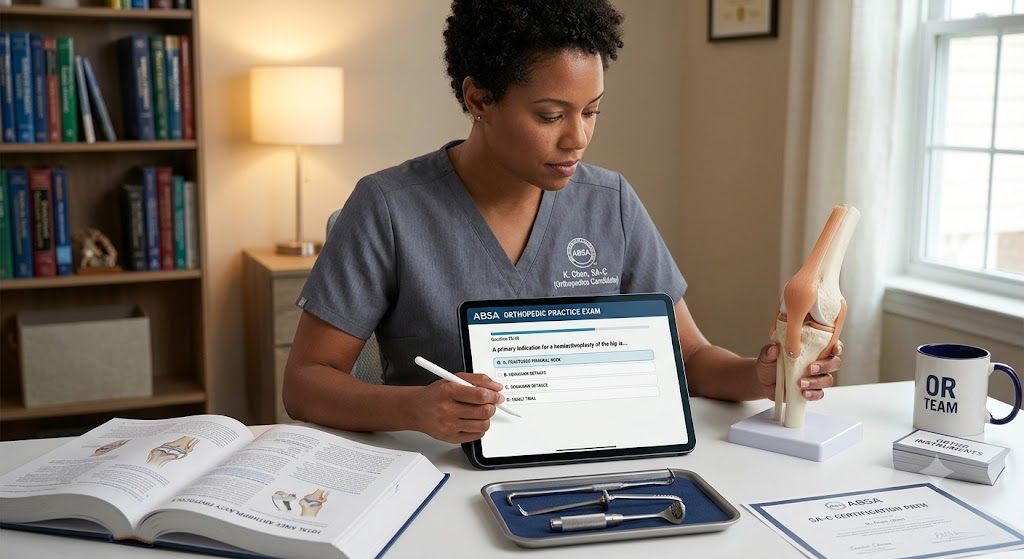
Additional Information
What the Course Entails and Exam Details
This specialized practice test is intricately tied to the broader scope of ABSA's SA-C certification but tailors its content to the core competencies essential for a high-level Orthopedic Surgical Assistant. While the full SA-C certification process requires a deep understanding of comprehensive surgical science, this orthopedic focus within your preparation sharpens your knowledge on specific, high-yield topics. The practice test mimics the practical application of these skills, ensuring you are prepared to meet the surgeon's needs in real-time. Core areas covered include:
Advanced Orthopedic Anatomy: A master-level comprehension of the musculoskeletal system, focusing on intricate joint structures, ligamentous support, neural pathways, and blood supply.
Orthopedic Surgical Instrumentation: Expert identification, handling, and application of the specialized tools unique to orthopedics, from power equipment to highly specific retractors and fixation devices.
Procedural Mastery: Pre-operative, intra-operative, and post-operative steps for key orthopedic procedures, including total hip, knee, and shoulder arthroplasty, spinal surgery, fracture management, and arthroscopic techniques.
Positioning and Draping: Precise and safe positioning methods for different orthopedic approaches and effective draping techniques to maintain a sterile field.
Surgical Assisting Skills: Flawless execution of duties, including dynamic retraction, tissue handling, hemostasis, and assist with complex suturing, tailored for orthopedic contexts.
What to Expect in the Final Exam
It is crucial to understand the distinct difference between this practice tool and the actual ABSA Surgical Assistant Certification (SA-C) Exam, which is the required endpoint for obtaining your credential.
The ABSA Orthopedic Practice Test: This is a preparatory study aid. While variations exist, it typically consists of a smaller, targeted subset of questions—for example, 40 multiple-choice questions—designed to simulate the topic distribution of the orthopedic portion of the actual exam. It allows for multiple attempts, providing immediate feedback on your answers and a calculated score to help you identify weaknesses.
The Actual ABSA SA-C Certification Exam: This is the comprehensive, final examination. To achieve the SA-C credential, you must sit for a computer-based test that covers the full range of surgical assistant duties across all specialties. Key details include:
Format: Typically 150 multiple-choice questions, with four options and a single best answer.
Time Limit: Candidates are generally given three (3) hours to complete the entire exam.
Content: A comprehensive outline, with a significant portion dedicated to orthopedic concepts, mirroring the breakdown that the ABSA Orthopedic Practice Test helps you prepare for.
Passing Score: The passing score is determined through standard psychometric methods, ensuring that successful candidates possess the minimum competency to practice safely. Results are often delivered as a pass/fail notification.
How to Study and Exam Centers
Preparation for the ABSA Orthopedic Practice Test and the final SA-C exam must be strategic and multi-faceted. The practice test itself is your primary tool for diagnostic assessment. After your initial attempt, analyze your results. Don't just look at the score; review every explanation for the questions you missed. This defines your study roadmap. Integrate this with other effective methods:
Deep Dive into Reference Texts: Revisit your fundamental anatomy and surgical technology textbooks, specifically the sections dedicated to orthopedics, as recommended by ABSA.
Master the Instrumentation: Utilize virtual labs, flashcards, or physical access to an operating room to memorize the name, purpose, and proper handover procedure for every orthopedic instrument.
Review Procedural Guidelines: For every major orthopedic surgery, understand the typical steps, common challenges, and the surgical assistant’s specific role throughout the entire case.
Join Study Groups: Collaboration with peers specializing in orthopedics can provide fresh perspectives and shared knowledge.
Exam Center Logistics: The actual ABSA SA-C Certification Exam is a computer-based test delivered through a secure network. You will not take it at a school or localized training center. Instead, ABSA utilizes a network of authorized, independent physical testing centers, such as those within the Pearson VUE or similar professional testing networks. When you register for the exam through your official ABSA account, you will be able to search for and select a convenient, proctored testing center near your location. A significant benefit of this national network is its wide availability, allowing you to choose a time and place that minimizes travel and stress.
Job Opportunities from the Course
Earning the Surgical Assistant-Certified (SA-C) credential with a focus on orthopedics significantly broadens your professional horizons. Hospitals, specialized orthopedic clinics, and surgery centers are in continuous need of skilled, certified assistants to optimize OR performance and patient outcomes. The investment in your education and certification will pay dividends through a versatile, high-demand, and rewarding career path. Here is a clear breakdown of potential job titles and career avenues:
Orthopedic Surgical Assistant (Certified)
Certified Surgical Assistant (Orthopedic Specialty)
Surgical First Assistant - Orthopedics
Lead Orthopedic Surgical Assistant
Clinical Coordinator, Orthopedic Surgery
Traveling Orthopedic Surgical Assistant
Orthopedic Physician Assistant (requires further education, but this is a strong foundation)
Operating Room Director (career advancement with experience)
This comprehensive study guide ensures you have all the essential information to dominate the ABSA Orthopedic Practice Test and move decisively toward securing your SA-C certification, opening the door to a premier career in the highly specialized world of orthopedic surgical assisting. Start your journey today!
Frequently Asked Questions
Reviews
5.0
Based on 0 reviews
Leave a Review
No reviews yet. Be the first to review!