
American Board of Orthodontics (ABO) Practice Exam
$69.00
- Buy to unlock unlimited access to all Quiz questions.
- After purchase you can print a PDF of the whole quiz at any point. The PDF will contain the questions and the correct answers.
About this Exam
The American Board of Orthodontics (ABO) is the global leader in orthodontic board certification. This prestigious designation signifies that an orthodontist has completed voluntary examinations to demonstrate their commitment to the highest level of patient care. The ABO Practice Exam is an invaluable resource designed specifically for orthodontic residents and practicing orthodontists preparing to take the rigorous ABO Written Examination. This preparatory tool helps candidates gauge their current knowledge across core concepts, familiarize themselves with the exam format, and refine their test-taking skills, moving them one step closer to achieving prestigious board-certified status.
Ready to test your knowledge?
Buy Now to Access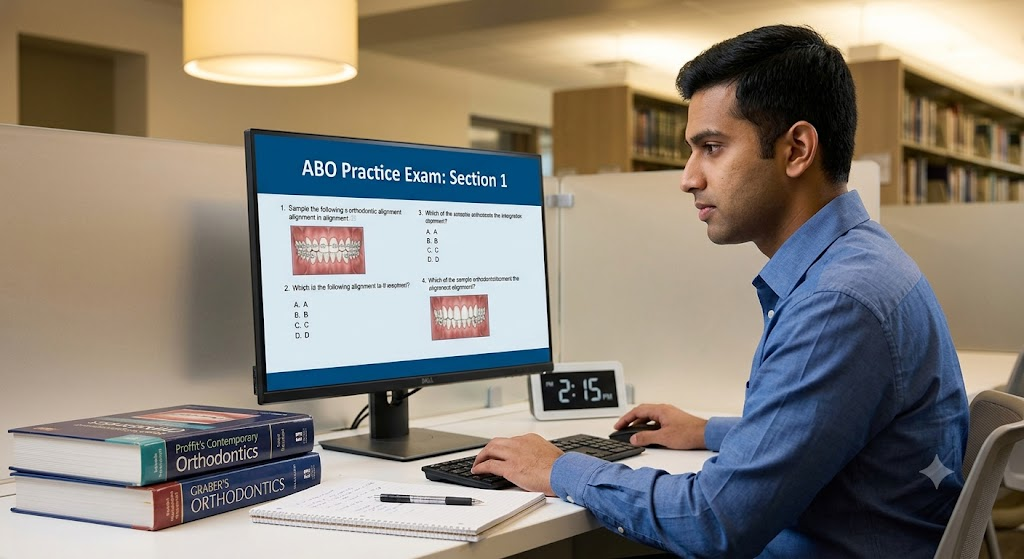
Additional Information
What the Course Entails and Exam Details
Preparing for the ABO Practice Exam is not a formal course, but rather a focused simulation of the comprehensive knowledge required for board certification. The official practice materials mirror the breadth of the actual Written Examination. Candidates will encounter questions covering critical domains including: Craniofacial Growth and Development, Orthodontic Biomechanics and Mechanics, Diagnosis and Treatment Planning (addressing diverse malocclusions and age groups), Dental Materials Science, Biology of Tooth Movement, TMJ Disorders, and Ethical Standards and Jurisprudence related to orthodontic practice. Accessing these practice questions is an essential step for mastering the extensive syllabus.
What to Expect in the Final Exam
While the exact details can vary slightly from year to year, the ABO Written Examination is typically a computerized, multiple-choice assessment taken in a proctored environment. It usually consists of approximately 240 questions designed to test knowledge, analytical ability, and clinical reasoning. The exam is structured in sections with scheduled breaks, often lasting for about four hours of testing time. There is no predetermined fixed passing percentage; scaled scores are calculated to maintain consistent standards. Results are communicated to candidates in a timely manner. Mastery of the material and efficient time management are crucial for success in this challenging final hurdle toward board eligibility.
How to Study and Exam Centers
Effective preparation is the foundation of success. Start by prioritizing official ABO practice materials to understand the structure and type of questions asked. Candidates should create a comprehensive study schedule months in advance, allocating specific time for each domain. Reviewing core textbooks (such as Proffit or Graber), classic orthodontic literature, and current research journals is essential. Focusing on weaker knowledge areas identified during practice testing is critical. Form study groups with peers for collaborative learning and mock exams under timed conditions. For information on the actual exam administration, candidates register through the ABO website and subsequently schedule their appointment at standardized testing centers, typically Pearson VUE locations across the United States. The ABO website provides detailed registration and scheduling instructions.
Job Opportunities from the Course
Achieving ABO certification significantly elevates your professional trajectory and opens doors to advanced opportunities within the specialized field of orthodontics. The commitment to excellence demonstrated by passing these rigorous examinations is widely respected.
Board-Certified Orthodontist in Private Practice: Greatly enhances patient trust and distinguishes your practice in competitive markets.
Academic Faculty Member at Dental and Orthodontic Schools: Certification is often a prerequisite or highly preferred for teaching roles.
Researcher in Orthodontics and Craniofacial Biology: ABO status indicates a strong foundation suitable for pursuing advanced research.
Orthodontic Consultant for Dental Industry Organizations: Companies value the expertise associated with board certification for product development and advocacy.
Specialist Partner in Large Multi-Specialty Dental Practices: Positions you as an elite expert within comprehensive dental groups.
Frequently Asked Questions
Reviews
5.0
Based on 0 reviews
Leave a Review
No reviews yet. Be the first to review!