
American Board of Ophthalmology (ABO) Practice Exam
$69.00
- Buy to unlock unlimited access to all Quiz questions.
- After purchase you can print a PDF of the whole quiz at any point. The PDF will contain the questions and the correct answers.
About this Exam
The American Board of Ophthalmology (ABO) certification is a powerful and universally recognized mark of excellence for ophthalmologists in the United States. It serves as a voluntary pathway for physicians who have completed a rigorous medical and residency training program to further demonstrate their exceptional commitment to patient care and command of the field. Achieving diplomate status signifies that you have not only met extensive educational and training requirements but have also successfully navigated a challenging two-part evaluation process. This comprehensive guide and the importance of practice are specifically designed to help you prepare for the crucial first step: the Written Qualifying Examination (WQE). The ABO exam is for MDs and DOs who are driven to achieve the highest professional standard in their ophthalmic career.
Ready to test your knowledge?
Buy Now to Access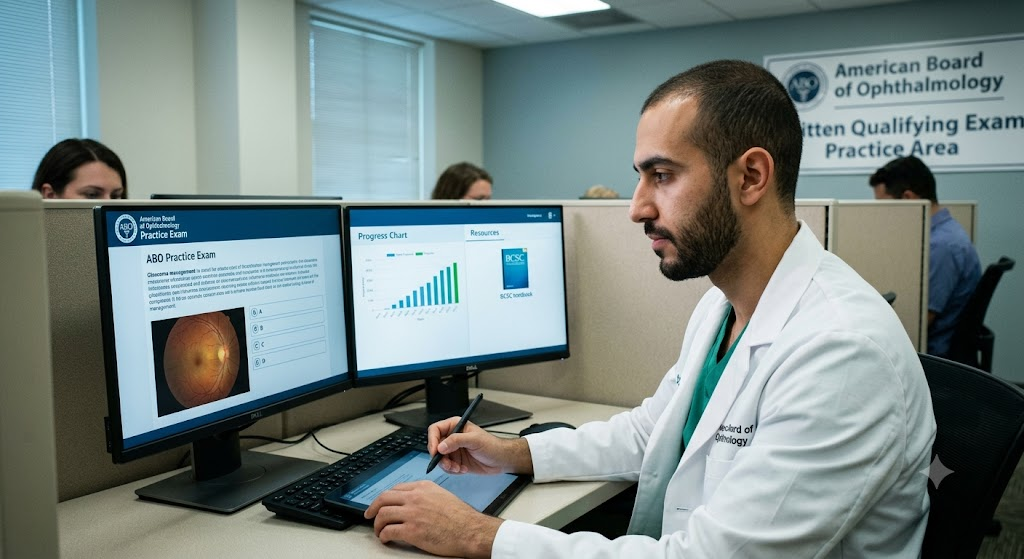
Additional Information
What the Course Entails and Exam Details
The path to ABO certification involves a two-tiered examination system: the Written Qualifying Exam (WQE) and, upon passing, the Oral Examination. While our focus here is on the foundational WQE, both steps are essential to earning your 10-year certificate.
The Written Qualifying Examination is designed to evaluate both the breadth and depth of your knowledge across the basic sciences and all major clinical subspecialties within ophthalmology. The syllabus is vast, encompassing critical subjects such as:
Lens and Cataract
Retina and Vitreous
Glaucoma
Cornea and External Disease
Pediatric Ophthalmology and Strabismus
Neuro-Ophthalmology
Oculofacial, Plastics, and Orbit
Uveitis and Intraocular Inflammation
The WQE does not just test factual recall; it assesses your ability to apply this knowledge to patient care scenarios. The questions are weighted by subject, and the ABO provides a content outline to help focus your study efforts.
What to Expect in the Final Exam
The Written Qualifying Examination is a formidable, full-day experience, meticulously designed to be a comprehensive test of your professional competence. The examination is computer-based and administered in a secure, proctored environment. You can expect a total of 250 multiple-choice questions, which are typically divided into two extensive sections of 125 questions each, separated by a planned break. The total testing time is approximately five to five and a half hours.
Each question features four potential answers, with only one being the single best response. A major advantage of the WQE is that there is no penalty for incorrect answers, so a blank response serves no purpose; it is always in your best interest to make an educated guess for every item. The scoring process is dynamic, meaning a scaled score is calculated based on psychometric standards of acceptable performance, rather than a fixed percentage. You will receive a pass/fail report within 60 days of the last administration window. Should you be unsuccessful on your first attempt, you have the opportunity to retake the written examination as many as three times to achieve a passing score and progress to the Oral Exam.
How to Study and Exam Centers
Preparing for the ABO Written Qualifying Exam demands a structured, multi-faceted study plan. Practice is the core of success.
How to Study
Utilize the Core Curriculum: The official Basic and Clinical Science Course (BCSC) series from the American Academy of Ophthalmology (AAO) is the gold standard for your content review. Create a personalized reading schedule to cover all high-yield sections well in advance.
Practice with Purpose: Do not just review content; solve questions. High-quality question banks are invaluable. Simulate full, timed practice exams to build your stamina and perfect your time management skills.
Join Study Groups: Interacting with peers can provide unique insights and keep you accountable. Discussing difficult cases and testing each other can solidify your understanding.
Analyze Your Performance: Review every question you answer, both correct and incorrect. Understand the rationale for the right answer and learn why the other options were sub-optimal. Focus extra attention on your weakest subject areas.
Exam Centers
The Written Qualifying Examination is not administered at a single, central location. Instead, it is offered on a unified date each fall at authorized Pearson VUE professional testing centers throughout the United States and Canada. To take the exam, you must first register through the ABO candidate portal and obtain approval. Once approved, you will use your identification number to schedule your specific appointment at a Pearson VUE center that is convenient for you. It is crucial to read the ABO Candidate Manual carefully to understand all testing regulations and what to bring on your assigned exam day.
Job Opportunities from the Course
Earning diplomate status from the American Board of Ophthalmology is not just a title; it is a professional passport that validates your expertise and unlocks access to the most prestigious and rewarding career opportunities in eye care. While many ophthalmologists find fulfillment in comprehensive practice, many others use their board certification as a launchpad into specialized fields. The specific job titles and career paths this certification validates include, but are not limited to:
Comprehensive Ophthalmologist
Cataract and Refractive Surgeon
Glaucoma Specialist
Retina and Vitreous Specialist
Cornea and External Disease Specialist
Pediatric Ophthalmologist and Strabismus Specialist
Neuro-Ophthalmologist
Ophthalmic Plastic and Reconstructive Surgeon
Academic Ophthalmologist (at universities and medical schools)
Military Ophthalmologist (serving in armed forces hospitals)
Government or Public Health Ophthalmologist
Ophthalmic Industry Consultant
By achieving ABO certification, you demonstrate to patients, peers, and employers that you are a medical professional at the forefront of your field, committed to the highest standards of ophthalmic practice.
Frequently Asked Questions
Reviews
5.0
Based on 0 reviews
Leave a Review
No reviews yet. Be the first to review!