
American Board of Medicolegal Death Investigators (ABMDI) Registry Practice Exam
$69.00
- Buy to unlock unlimited access to all Quiz questions.
- After purchase you can print a PDF of the whole quiz at any point. The PDF will contain the questions and the correct answers.
About this Exam
The American Board of Medicolegal Death Investigators (ABMDI) Registry Certification is a national, voluntary certification designed for individuals who are actively employed in medical examiner or coroner offices. It is the initial, basic level of certification for medicolegal death investigators. This program recognizes individuals who have demonstrated a mastery of foundational knowledge and skills required to conduct thorough, competent, and scientific death investigations. Achieving this certification documents your commitment to professional standards, ethical conduct, and the enhancement of the medicolegal death investigation field.
Ready to test your knowledge?
Buy Now to Access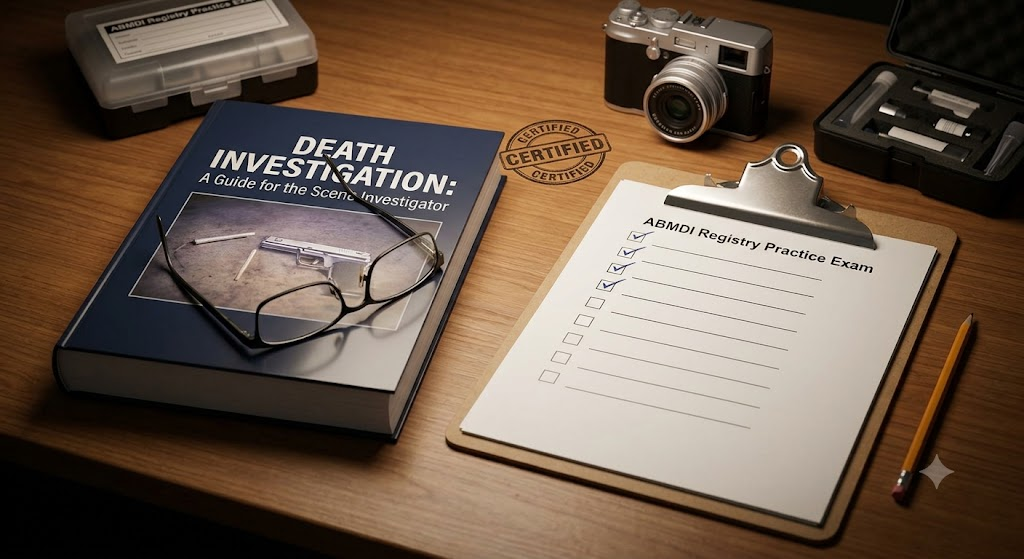
Additional Information
What the Course Entails and Exam Details
This comprehensive study guide helps you prepare for the ABMDI Registry Exam, which is an assessment of your knowledge across eight core competency areas. The curriculum does not follow a specific single course but is based on a body of knowledge that all proficient death investigators should possess. The core competencies are: Interacting with Federal, State, and Local Agencies; Communicating (written and oral); Interacting with Families; Investigating Deaths (scene response, body assessment); Identifying and Preserving Evidence; Maintaining Ethical and Legal Responsibilities; Demonstrating Scientific Knowledge (anatomy, medical terminology, postmortem changes); and Coping with Job-Related Stress. Your ability to integrate forensic science concepts, such as recognizing trauma patterns (e.g., blunt force, gunshot wounds), is crucial.
What to Expect in the Final Exam
The ABMDI Registry Exam is a rigorous proctored test. You will have a total of up to four hours to complete the examination. The exam consists of 240 multiple-choice questions that objectively assess your understanding of the core topics. The ABMDI uses a pass/fail grading system, rather than issuing a specific numerical or percentage score. A pass is awarded to candidates who meet or exceed a predetermined level of competence set by the board. This structure emphasizes demonstrated capability rather than competition. Results are typically provided through the ABMDI's official channels. If a candidate does not pass, there is a mandatory 30-day wait period before they can retake the exam.
How to Study and Exam Centers
Effective preparation is key to success. Your primary study reference must be the National Institute of Justice (NIJ) publication, Death Investigation: A Guide for the Scene Investigator. This is the foundational text on which the exam is built. We highly recommend that you complement this by utilizing official or reputable ABMDI Registry Practice Exams, flashcards, and online study groups. Create a consistent study schedule that focuses on medical terminology, basic human anatomy, and proper evidence handling procedures. Actively connect your daily work experience with the study material to reinforce practical application.
Regarding exam centers, you cannot take the ABMDI Registry Exam online in an unproctored setting. The exam is administered through authorized professional testing services. To find a physical location near you, you will need to check the official ABMDI website during your application process, as they often partner with testing networks like Pearson VUE to provide secure, proctored environments. Make sure to schedule your exam well in advance and bring the required identification.
Job Opportunities from the Course
Earning your ABMDI Registry Certification is a major step in your career, opening doors and enhancing credibility across multiple job titles. These include: Medicolegal Death Investigator, Forensic Death Investigator, Coroner Investigator, Medical Examiner Investigator, Death Investigator Trainee, and can be a vital step toward advancement into supervisory positions such as Investigations Manager or Chief Investigator.
Frequently Asked Questions
Reviews
5.0
Based on 0 reviews
Leave a Review
No reviews yet. Be the first to review!