
American Board of Medicolegal Death Investigators (ABMDI) Practice Exam
$69.00
- Buy to unlock unlimited access to all Quiz questions.
- After purchase you can print a PDF of the whole quiz at any point. The PDF will contain the questions and the correct answers.
About this Exam
The American Board of Medicolegal Death Investigators (ABMDI) offers highly sought-after certification programs for professionals involved in the official investigation into the cause and manner of unexpected or unattended deaths.
This guide focusing on the ABMDI Practice Exam is designed to assist aspiring medicolegal death investigators (MDIs), coroners, medical examiner investigators, and other forensic science practitioners in preparing for their certification. The comprehensive practice exam provides an excellent way to validate professional knowledge, identify weaknesses, and build confidence in essential investigative areas. Achieving ABMDI certification signifies a commitment to high professional standards and provides a path for career advancement. This study guide focuses on the "Registry" level certification, which is common for initial and practice tests.
Ready to test your knowledge?
Buy Now to Access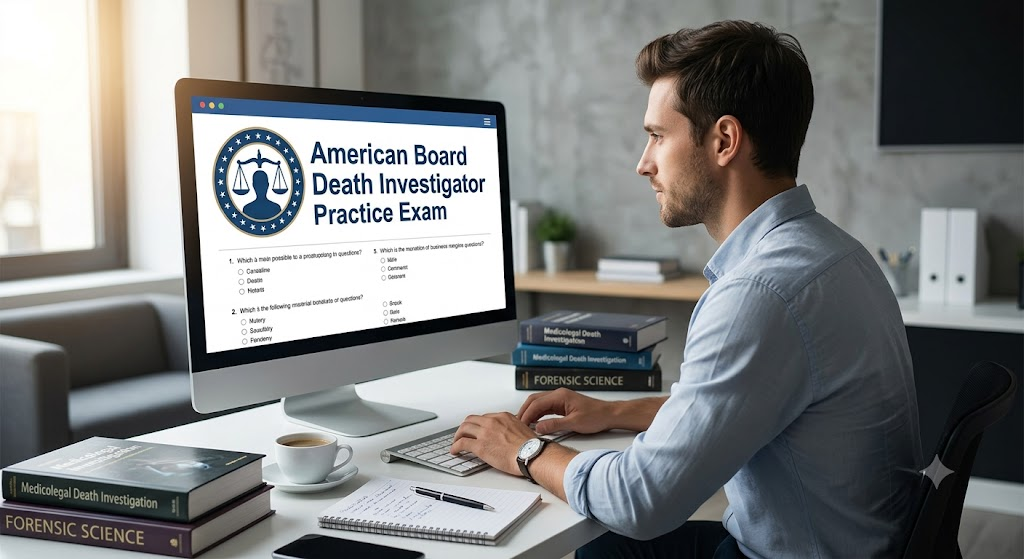
Additional Information
What the Course Entails and Exam Details
Preparing for the ABMDI certification exam through practice involves mastering a broad range of core competencies crucial for modern death investigation. The practice exam effectively tests your understanding and application of these principles, derived from extensive field studies and practical application.
The primary subject areas you will encounter in both study materials and the practice exam include:
Medicolegal Death Scene Investigation Procedures and Scene Management
Understanding Human Anatomy, Physiology, and the Processes and Body Changes After Death
Investigation of Specific Death Types (e.g., natural, accidental, suicidal, homicidal, infant, and unexpected deaths)
Evaluation and Management of Mass Fatality Incidents
Basic Forensic Toxicology and Toxicology Sample Collection
Postmortem Body Examination Support and Identification Techniques
Legal, Ethical, and Communication Issues in Medicolegal Death Investigation
Interacting with Law Enforcement, Families, and Other Agencies
The content in practice exams often reflects the material found in key forensic resources and textbooks, helping to ensure you are well-versed in industry standards and practical applications.
What to Expect in the Final Exam
The official ABMDI certification exam for the Registry level is typically a standardized, computer-based test designed to measure proficiency across the established competencies. Students should expect a structured, professional environment.
Here is a general outline of what to anticipate for the official exam:
Format: The final exam usually consists of approximately 100 to 150 multiple-choice questions. These questions range in difficulty and require practical problem-solving based on investigative scenarios.
Time Limit: Candidates are generally given between 2 and 3 hours to complete the examination.
Passing Score: The actual required percentage can vary but typically falls in the range of 70-75%, determined by standard setting methods used by the board.
Exam Delivery: The test is proctored to maintain exam integrity. Computer-based testing is the most common method, allowing for efficient administration and scoring.
Rules: The exam is closed-book, with no outside materials allowed in the testing area. Candidates must present valid identification.
How to Study and Exam Centers
Successfully preparing for the ABMDI exam requires dedicated study and strategic practice. Using practice exams is one of the most effective ways to familiarize yourself with the question styles and manage exam-day anxiety.
Study Strategies:
Read core texts and references recommended by the ABMDI (e.g., Spitz and Fisher’s Medicolegal Investigation of Death, or DiMaio’s Forensic Pathology).
Review all official ABMDI study guides and materials available for purchase.
Utilize detailed ABMDI practice exams frequently to assess your knowledge and pinpoint areas that need more attention. Review the rationale for each correct and incorrect answer.
Create flashcards for key terms, legal concepts, postmortem changes, and common toxicological findings.
Form study groups with colleagues to discuss complex investigative scenarios.
Attend workshops or conferences related to death investigation and forensics for practical application insights.
Exam Centers and Scheduling: The ABMDI does not generally offer the final exam as an open online test that you can take at any time. Registration and scheduling are managed through the board itself. Once your application is approved, you will be authorized to schedule your exam at a time and location that works best for you.
The official Registry exam is typically administered through computer-based testing at approved centers across the United States. Many licensing bodies partner with established test delivery networks like Pearson VUE. You will receive instructions on how to locate a convenient test center within these networks after your application is processed. Specific physical testing centers may also be designated, or in some instances, special proctoring arrangements might be available for large groups. Be sure to check the ABMDI official website for the most current information regarding scheduling and approved test center partners.
Job Opportunities from the Course
Earning the ABMDI certification demonstrates specialized expertise and a high level of professionalism in medicolegal death investigation. This credential can open doors to various rewarding career paths and advancement opportunities within county, state, and private organizations involved in death investigations.
Key job titles and career paths this certification unlocks or enhances include:
Medicolegal Death Investigator (MDI)
Deputy Coroner / Coroner Investigator
Medical Examiner Investigator (MEI)
Forensic Investigator
Crime Scene Investigator / Scene Evidence Technician (in specialized capacities)
Forensic Autopsy Technician / Assistant
Police Officer / Detective (with forensic science specializations)
Private Death Investigator / Forensic Consultant
Laboratory Manager / Supervisor in forensic facilities
Public Health Analyst related to mortality data and unexpected death investigation
In many jurisdictions, this certification is increasingly required or highly preferred for hiring and promotion within medicolegal systems, highlighting its critical role in professionalizing the field and improving the accuracy and quality of death investigations.
Frequently Asked Questions
Reviews
5.0
Based on 0 reviews
Leave a Review
No reviews yet. Be the first to review!