
American Board of Cardiovascular Perfusion (ABCP) Board Practice Exam
$69.00
- Buy to unlock unlimited access to all Quiz questions.
- After purchase you can print a PDF of the whole quiz at any point. The PDF will contain the questions and the correct answers.
About this Exam
The American Board of Cardiovascular Perfusion (ABCP) is the preeminent certifying body for cardiovascular perfusionists in the United States. Its primary purpose is to ensure that individuals practicing in this critical field possess the requisite knowledge, skills, and judgment to provide safe and effective patient care during open-heart surgery and other procedures requiring extracorporeal circulation. ABCP certification is the gold standard, demonstrating professional competence and a commitment to lifelong learning. This study guide is designed to help graduates of accredited perfusion education programs prepare for the ABCP’s rigorous certification process, which includes the Perfusion Basic Science Examination (PBSE) and the Clinical Applications in Perfusion Examination (CAPE). Utilizing a comprehensive ABCP Board Practice Exam is a crucial step in this preparation, allowing candidates to assess their readiness and familiarize themselves with the exam format.
Ready to test your knowledge?
Buy Now to Access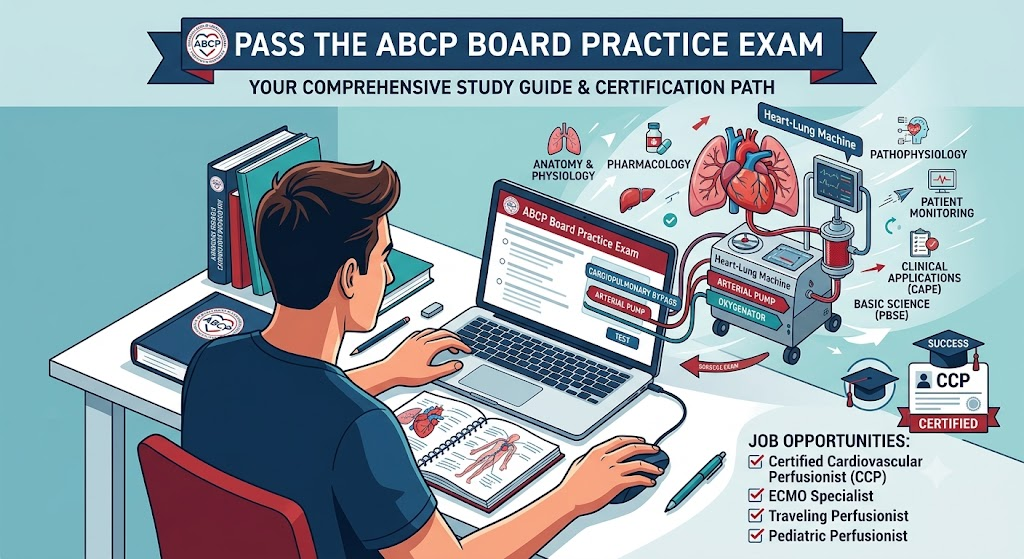
Additional Information
What the Course Entails and Exam Details
Preparing for the ABCP certification exams involves a deep dive into the complex world of extracorporeal circulation. Candidates must have a strong foundation in the medical sciences, specifically:
Anatomy and Physiology: Detailed knowledge of the cardiovascular, respiratory, and renal systems.
Pathophysiology: Understanding the disease processes that require cardiopulmonary bypass (CPB) and other support modalities.
Pharmacology: Comprehensive knowledge of drugs used during surgery and in the management of perfusion, including anticoagulants, vasoactive agents, and anesthetics.
Perfusion Equipment: In-depth understanding of the design, function, and operation of heart-lung machines, oxygenators, pumps, and monitoring devices.
Perfusion Techniques: Mastery of standard CPB procedures, myocardial protection, hypothermia, and circulatory support.
Patient Monitoring and Management: Skills in assessing and managing patient parameters during bypass, including blood gases, anticoagulation, and hemodynamics.
Special Procedures: Knowledge of techniques for pediatric perfusion, extracorporeal membrane oxygenation (ECMO), and other specialized assist devices.
The ABCP Board Practice Exam should mirror these comprehensive topic areas to effectively prepare candidates for the breadth and depth of the actual certification exams.
What to Expect in the Final Exam
The actual ABCP certification process consists of two distinct examinations. Candidates must pass both to become a Certified Cardiovascular Perfusionist (CCP).
Perfusion Basic Science Examination (PBSE): This exam covers the scientific foundations of perfusion and is typically taken after completion of the didactic portion of a perfusion program. It is a multiple-choice, computer-based test that assesses knowledge in anatomy, physiology, pharmacology, and perfusion theory.
Clinical Applications in Perfusion Examination (CAPE): The CAPE focuses on the clinical application of perfusion principles and is typically taken after completing the required clinical cases. It is also a multiple-choice, computer-based exam that presents clinical scenarios and assesses decision-making, problem-solving, and patient management skills.
Both exams are administered through a secure testing network and are designed to measure critical thinking as well as factual knowledge. Candidates should expect detailed questions, some of which may be based on case studies or clinical data. Passing scores are determined through a rigorous standard-setting process. For specific details on the number of questions, time limits, and the scoring system, candidates must consult the official ABCP examination guidebook, as these details can be updated.
How to Study and Exam Centers
Effective preparation for the ABCP exams requires a multi-faceted approach. Here are actionable study strategies:
Utilize Official ABCP Resources: Start with the latest ABCP examination guidebook and any sample questions or resources provided on the official ABCP website (abcp.org). This is the primary authority on exam content and structure.
Engage with an ABCP Board Practice Exam: Taking multiple, high-quality practice exams is essential. These exams should simulate the format and difficulty of the official PBSE and CAPE, helping you identify knowledge gaps and build test-taking stamina. Look for practice materials that offer detailed rationales for each answer.
Review Coursework and Textbooks: Thoroughly review all materials from your perfusion education program, including textbooks, lecture notes, and clinical guidelines.
Form Study Groups: Collaborating with peers can provide different perspectives and help you clarify complex concepts.
Focus on Clinical Application: For the CAPE, practice applying theoretical knowledge to real-world clinical scenarios. Discuss case studies and review management strategies for common and uncommon bypass situations.
Time Management: Develop a structured study schedule and stick to it. Practice taking timed exams to manage your time effectively on test day.
The official ABCP examinations are administered at authorized testing centers across the country, typically through major professional testing services such as Pearson VUE. Candidates will register for the exam and schedule their testing appointment at a convenient location. Practice exams, on the other hand, are often available online through educational institutions, professional organizations, and private test preparation companies.
Job Opportunities from the Course
Earning the ABCP certification opens doors to a rewarding and vital career in cardiovascular medicine. Certified Cardiovascular Perfusionists (CCPs) are in demand at major medical centers and heart hospitals throughout the United States. Job opportunities unlocked by this certification include:
Certified Cardiovascular Perfusionist (CCP): The standard role in operating rooms, managing the heart-lung machine during open-heart surgeries.
Pediatric Perfusionist: Specialized perfusionists who work in pediatric cardiac programs.
ECMO Specialist/Coordinator: Managing extracorporeal membrane oxygenation (ECMO) for patients in severe heart or lung failure.
Traveling Perfusionist: Providing perfusion services on a contractual basis at various hospitals.
Perfusion Educator/Instructor: Teaching in accredited perfusion education programs.
Clinical Support Specialist/Medical Device Representative: Working for manufacturers of perfusion and circulatory support equipment.
Research Perfusionist: Participating in clinical research and development related to extracorporeal technology.
Achieving ABCP certification is a vital milestone, demonstrating your qualifications and commitment to excellence in this life-saving profession.
Frequently Asked Questions
Reviews
5.0
Based on 0 reviews
Leave a Review
No reviews yet. Be the first to review!