
Alberta Welding AIT First Year Practice Exam
$69.00
- Buy to unlock unlimited access to all Quiz questions.
- After purchase you can print a PDF of the whole quiz at any point. The PDF will contain the questions and the correct answers.
About this Exam
The Alberta Welding AIT First Year Practice Exam is a critical milestone for individuals aiming to become a certified journeyperson welder in Alberta, Canada. This first-period assessment is designed for registered apprentices who have completed their initial block of technical training and required on-the-job hours. It evaluates a candidate's understanding of foundational welding principles, safety regulations, and practical skills. Success on this exam demonstrates the competency needed to progress to the next level of the apprenticeship program and ultimately achieve a recognized trade certificate.
Ready to test your knowledge?
Buy Now to Access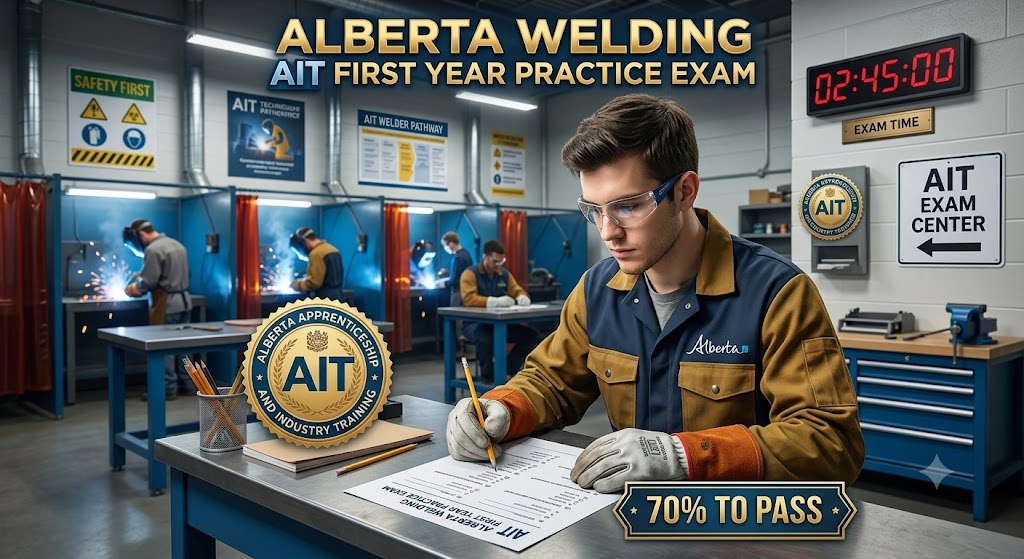
Additional Information
What the Course Entails and Exam Details
The first-period technical training for welders in Alberta focuses on core competencies essential for a safe and successful career in the trade. The curriculum covers a wide range of topics that are subsequently assessed in the final exam.
Core areas of study include workplace safety legislation, regulations, and industry policies. Apprentices learn safe practices for climbing, lifting, rigging, hoisting, and handling hazardous materials, as well as fire protection and specific welding safety protocols. They gain proficiency in the use of hand and power tools.
Technical training heavily features the principles of various welding processes. This includes comprehensive instruction on gas metal arc welding (GMAW), flux-cored arc welding (FCAW), metal-cored arc welding (MCAW), and submerged arc welding (SAW), focusing on equipment, filler metals, shielding gases, maintenance, and troubleshooting.
Furthermore, students are trained to identify weld faults and understand the causes and remedies of distortion. Other essential topics include trade mathematics, such as fractions, decimals, percentage, ratios, and geometric formulas, alongside metric and imperial measurement systems.
What to Expect in the Final Exam
The final AIT First Year evaluation consists of two primary components: a theory exam and a practical exam. Candidates must pass both to successfully complete the first period of their apprenticeship.
The theory exam is typically a multiple-choice assessment that tests a candidate's knowledge across all covered technical subjects, including safety, processes, materials, and trade math. It generally features between 70 and 100 questions. The time limit for this written exam is approximately three hours. The minimum passing score is 70%.
The practical exam requires candidates to demonstrate their hands-on welding abilities. This component is scheduled after the successful completion of technical training. The specific requirements involve performing various weld tests, such as creating sound, defect-free welds in specific positions using prescribed processes (like GMAW or FCAW). The passing standard for the practical exam is also 70%, based on an assessment of weld quality, dimensions, and adherence to procedure. Candidates should bring their own required personal protective equipment (PPE), including a welding helmet, gloves, and CSA-approved safety footwear, to the practical assessment.
How to Study and Exam Centers
Effective preparation for the AIT First Year exam involves a combination of theoretical study and practical practice.
Study Strategies
Apprentices should primarily focus their study on the Individual Learning Materials (ILMs) provided during their technical training. It is crucial to review all modules, taking detailed notes and paying close attention to safety codes and procedural standards. Utilizing practice exams and sample questions is highly recommended to become familiar with the multiple-choice format, question phrasing, and level of difficulty. For the mathematical component, candidates should practice trade-specific calculations until they are fluent. To prepare for the practical exam, apprentices must dedicate significant time to in-shop practice, refining their techniques on different metals and in all required positions. Seeking feedback from experienced journeypersons on the job can also provide valuable insights.
Exam Centers
The Alberta Apprenticeship and Industry Training (AIT) branch administers all apprenticeship exams. Theory exams are typically held at designated AIT testing centers throughout the province, often located in major cities like Edmonton, Calgary, Red Deer, Lethbridge, and Fort McMurray. Specific physical testing centers will be confirmed upon exam registration. Apprentices can manage their eligibility and schedule their exams online through their MyTradesecrets account, which requires an Alberta.ca Account. Practical exams are scheduled separately, typically at authorized physical locations, including the educational institutions that provide technical training.
Job Opportunities from the Course
Successfully passing the AIT First Year exam is a gateway to a rewarding career in a variety of sectors throughout Alberta. Upon completion of this first stage, apprentices become more valuable to employers and can unlock specific job opportunities.
Welders with a first-period completion are in demand for positions such as:
1st Year Apprentice Welder in structural steel fabrication shops, oil and gas construction projects, and manufacturing plants.
Apprentice Fabricator/Welder in specialized equipment manufacturing or repair facilities.
Field Welder Apprentice working on pipeline construction or maintaining infrastructure.
Shop Welder for modular construction and assembly.
Heavy Equipment Repair Apprentice focusing on welding and fabricating new or replacement parts for heavy machinery.
Production Welder in industrial manufacturing.
Frequently Asked Questions
Reviews
5.0
Based on 0 reviews
Leave a Review
No reviews yet. Be the first to review!