
Alaska DMV Practice Test
$69.00
- Buy to unlock unlimited access to all Quiz questions.
- After purchase you can print a PDF of the whole quiz at any point. The PDF will contain the questions and the correct answers.
About this Exam
The Alaska DMV Practice Test is an essential educational tool designed specifically for aspiring drivers in the Last Frontier.
This resource helps individuals prepare thoroughly for the official written knowledge exam required to obtain an Alaska learner's permit or standard driver's license.
It is crafted for new teenage drivers, new Alaska residents transferring an out-of-state license, and anyone needing to retake the written test.
By simulating the format and content of the actual DMV exam, this practice resource builds crucial test-taking confidence and ensures applicants possess the knowledge necessary to safely navigate Alaska's unique and challenging road conditions.
Ready to test your knowledge?
Buy Now to Access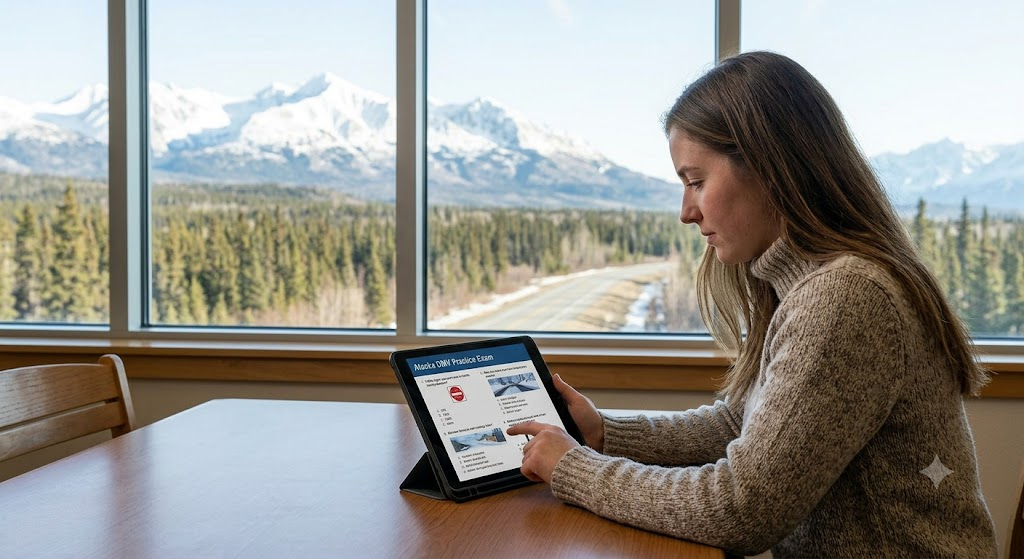
Additional Information
What the Course Entails and Exam Details
To pass the written knowledge test and earn an Alaska driver’s license, you must study the regulations and safe driving principles outlined in the official Alaska Driver Manual.
The practice test, and the actual exam it mirrors, covers three critical distinct categories.
First, it tests knowledge of Alaska traffic laws, which includes rules of the right-of-way, speed limits, parking regulations, and the legal consequences of driving under the influence (DUI).
Second, it focuses on safe driving practices, covering techniques for handling adverse weather conditions such as ice, snow, and low visibility, which are highly relevant in Alaska.
Third, the test covers the visual identification of regulatory, warning, and informational road signs, signals, and markings.
Specifically, topics include procedures for lane changes, signaling, sharing the road with pedestrians and cyclists, and required safety equipment for vehicles.
What to Expect in the Final Exam
The official Alaska written knowledge test is administered in person at authorized Division of Motor Vehicles (DMV) locations throughout the state.
It is typically a computer-based multiple-choice exam, although paper tests may be available upon request at some locations.
The test generally consists of approximately 20 questions based directly on the official Alaska Driver Manual.
To pass the exam, applicants must achieve a score of at least 80%, meaning you must correctly answer a minimum of 16 out of 20 questions.
There is usually no strict time limit to complete the written exam, although it is advisable to allow yourself plenty of time before the DMV office closes.
During the actual examination, you are strictly prohibited from referencing the driver manual or using any mobile devices.
Failing the test will require a waiting period before you are eligible to retake the exam.
How to Study and Exam Centers
The foundational study resource is the official Alaska Driver Manual, which is readily available online through the official Alaska DMV website or in print at local DMV offices.
It is highly recommended that you read the manual comprehensively, paying close attention to road signs, right-of-way rules, and state-specific regulations regarding driving in winter conditions.
Once you have reviewed the manual, the most effective study strategy is the repeated use of updated online practice tests.
Using practice tests helps you familiarize yourself with the phrasing of questions and allows you to identify areas where your knowledge may be lacking.
It is crucial to ensure you are using a reputable practice test source that reflects current Alaska traffic laws.
Once you are consistently passing the practice exams with high scores, you are ready for the official test.
The official written knowledge test must be taken in person at an authorized Alaska DMV field office or partner location.
These centers are located throughout the state, including in major hubs like Anchorage, Fairbanks, Juneau, Palmer, and Wasilla.
It is strongly recommended that you visit the official Alaska DMV website to schedule an appointment for your written knowledge test, as this significantly reduces wait times.
Many locations accept walk-ins for testing, but appointments are prioritized.
Job Opportunities from the Course
While passing the written DMV exam grants a learner's permit and is the required step toward obtaining a standard Class D license, this credential itself serves as a critical foundation for several career paths rather than a specific vocational certificate.
Possessing a valid driver’s license is a requirement for countless entry-level and service-oriented positions.
Career paths that require or highly prioritize a standard driver's license include:
Local delivery drivers for retail, food services, or courier companies.
Rideshare drivers (such as Uber or Lyft) or local taxi drivers.
Home health care positions and visiting nurse roles that require travel to clients' homes.
Field service technicians and trade apprenticeships (plumbing, electrical, HVAC).
Security personnel responsible for patrolling properties.
Frequently Asked Questions
Reviews
5.0
Based on 0 reviews
Leave a Review
No reviews yet. Be the first to review!