
Alaska Certified Nursing Assistant (CNA) Practice Exam
$69.00
- Buy to unlock unlimited access to all Quiz questions.
- After purchase you can print a PDF of the whole quiz at any point. The PDF will contain the questions and the correct answers.
About this Exam
Becoming a Certified Nursing Assistant (CNA) in Alaska is a vital and rewarding first step into the healthcare field, allowing individuals to make a tangible difference in the lives of residents and patients throughout the state. The Alaska Certified Nursing Assistant (CNA) certification process is designed for compassionate individuals who wish to work directly with people in hospitals, long-term care facilities, and home health settings, providing essential daily care and support. The core of this process, the practice exam, and the formal state test itself, evaluate a candidate’s understanding of basic nursing principles and their practical ability to apply these skills safely and effectively. Alaska, with its distinct healthcare needs and high demand for medical professionals, offers a robust path for those wishing to enter this field, and passing this exam is your crucial milestone.
Sample Questions
Explanation:
Explanation:
Explanation:
Explanation:
Explanation:
Ready to test your knowledge?
Buy Now to Access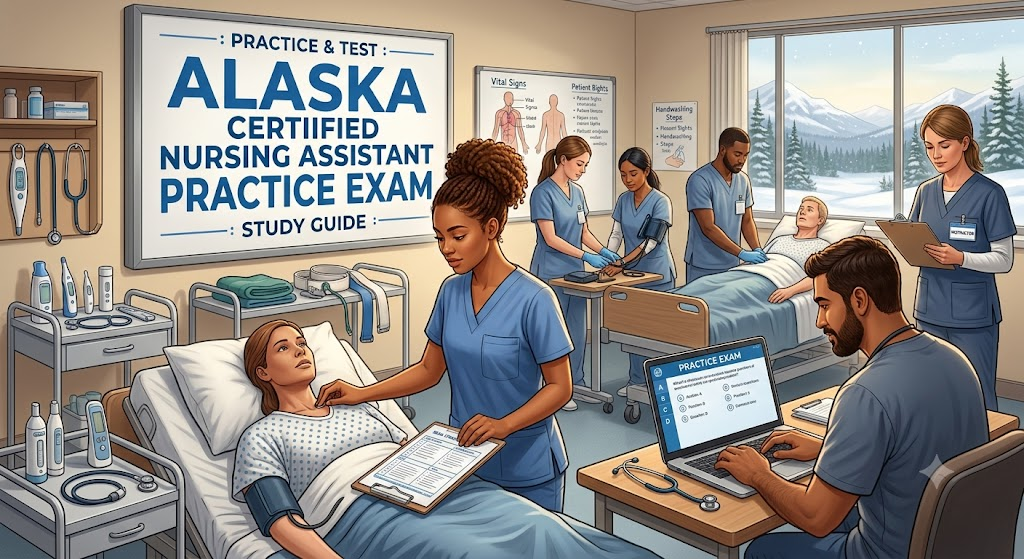
Additional Information
What the Course Entails and Exam Details
To even qualify for the exam in Alaska, you must first complete a state-approved nurse aide training program. This comprehensive course must entail a total of at least 140 hours, carefully split between at least 60 hours of classroom or online instruction and a crucial 80 hours of supervised clinical skills training. This ensures you are not only knowledgeable about the theory of patient care but are also competent and comfortable in applying those skills in a real-world healthcare environment. The course curriculum covers fundamental topics, including activities of daily living (ADLs) such as bathing, dressing, and feeding; basic nursing skills like taking vital signs; client rights and safety protocols; effective communication; and legal and ethical behaviors in healthcare. The exam you will subsequently face is the National Nurse Aide Assessment Program (NNAAP) exam, administered in Alaska by Credentia Nurse Aide Credentialing Services. This exam is a single event, but it is divided into two distinct components: a Knowledge Test and a Skills Assessment.
What to Expect in the Final Exam
The Knowledge Test, a major part of the NNAAP exam, can be taken in a written multiple-choice format or as an oral examination for those who may have reading difficulties. It typically consists of approximately 70-100 questions, depending on the provider and current state requirements, and candidates are given a specific time limit, often around 2 hours, to complete this section. The questions are broken down into specific content domains, ensuring a balanced evaluation of your understanding of nursing care and safety. The Skills Assessment is the other critical portion and is what most students find the most challenging. Here, you will be evaluated on your performance of 5 randomly selected nursing skills out of a predefined list of state-mandated competencies, all under the direct observation of an examiner. You will have approximately 30 minutes to demonstrate these 5 skills, which might include anything from proper hand hygiene and taking blood pressure to transferring a patient to a wheelchair or assisting with feeding. Crucially, you must pass both the knowledge test and the skills assessment with a score generally of 70% or higher to become a certified CNA. Candidates have up to three attempts within a certain timeframe to pass both sections.
How to Study and Exam Centers
Effective studying requires a multi-pronged approach that targets both your theoretical knowledge and practical performance. Start by reviewing your entire course textbook, all the notes you took during lectures, and all distributed materials, paying special attention to safe care practices, client rights, and infection control. For the written test, use practice exams to get accustomed to the multiple-choice format, identify knowledge gaps, and become comfortable with the timing. For the skills assessment, practice, practice, practice is the key to confidence. Don’t just read about the steps; go through the motions in a simulated environment, with classmates, friends, or even household items. Pay careful attention to the critical, bolded steps for each skill as outlined in your candidate handbook. In Alaska, you will schedule your exam through the Credentia platform. The knowledge part can sometimes be taken at regional test sites or conveniently via online proctoring, allowing you to test from home. The skills assessment, however, must be completed in person at an authorized testing location. Regional test centers are typically located in major Alaskan communities such as Anchorage, Fairbanks, and Palmer, often within the state-approved training programs themselves, like vocational schools, community colleges, or within the very healthcare facilities that offer training. Make sure to consult your candidate handbook for specific, up-to-date lists of these locations.
Job Opportunities from the Course
Upon successfully passing the Alaska CNA exam and receiving your certification, a variety of meaningful and challenging career paths in healthcare will be open to you. The highest average CNA salary in the nation makes Alaska an attractive place for this profession.
Certified Nursing Assistant (CNA)
Patient Care Technician
Home Health Aide
Certified Nurse Aide - Travel
Acute Care CNA
Restorative Nursing Assistant
Clinical Aide
Furthermore, the experience and knowledge gained as a CNA serve as an excellent foundation for pursuing further healthcare education and advancing into roles such as a Licensed Practical Nurse (LPN), Registered Nurse (RN), or a nursing home administrator.
Frequently Asked Questions
Reviews
5.0
Based on 0 reviews
Leave a Review
No reviews yet. Be the first to review!