
Air Traffic Control (ATC) Basics Block 4 Practice Test
$69.00
- Buy to unlock unlimited access to all Quiz questions.
- After purchase you can print a PDF of the whole quiz at any point. The PDF will contain the questions and the correct answers.
About this Exam
The Air Traffic Control (ATC) Basics course is the foundational training program for individuals pursuing a career as an Air Traffic Control Specialist with the Federal Aviation Administration (FAA). This intensive program, typically held at the FAA Academy in Oklahoma City, covers essential aviation knowledge and procedural basics. Block 4 specifically focuses on initial radar and non-radar procedural training. It is designed for newly hired air traffic control trainees who have successfully completed the initial application and screening process and are ready to begin their technical instruction. Mastering the content in Block 4 is crucial for progressing to facility-specific training.
Ready to test your knowledge?
Buy Now to Access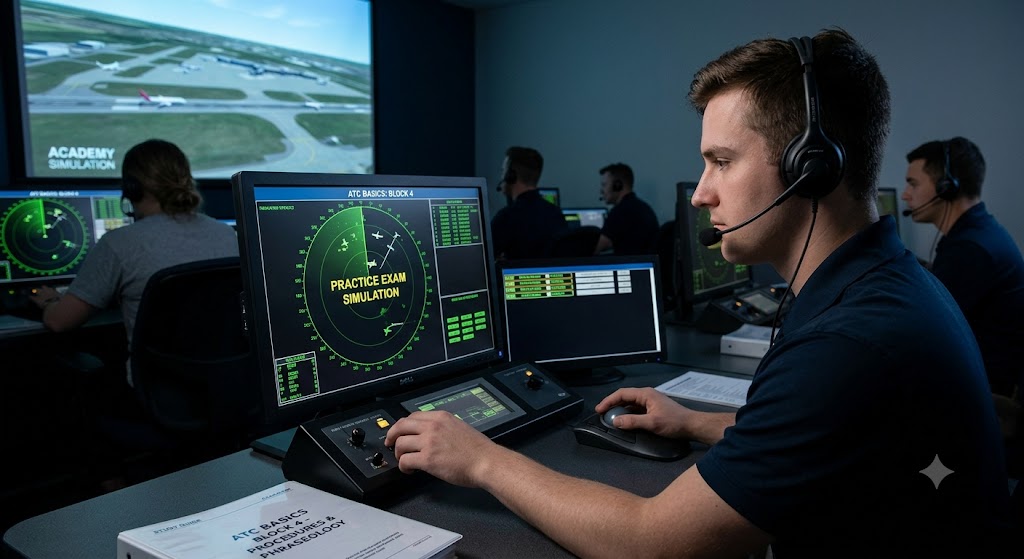
Additional Information
What the Course Entails and Exam Details
The ATC Basics Block 4 course builds upon the foundational
aviation knowledge acquired in previous blocks and introduces trainees to the
practical application of air traffic control procedures. The primary focus is
on learning and applying radar and non-radar separation standards in a
simulated environment. Key topics include mastering clear and concise
phraseology for pilot communications, understanding strip marking procedures,
interpreting radar displays, and managing aircraft sequencing and spacing.
Trainees will learn fundamental separation techniques for
en-route and terminal environments. They will also practice identifying
aircraft, issuing traffic advisories, and coordinating with adjacent
controllers or facilities. The coursework involves a combination of classroom
instruction and hands-on simulation exercises, where students apply learned
procedures to increasingly complex traffic scenarios. The assessment in Block 4
is rigorous, typically including written exams on procedures and phraseology, as
well as graded simulation evaluations testing practical application and
decision-making skills under pressure.
What to Expect in the Final Exam
The evaluation for ATC Basics Block 4 is multifaceted,
combining both knowledge-based and performance-based assessments. Trainees can
expect a comprehensive written final exam covering phraseology, separation
rules, and procedural requirements, often in a multiple-choice format. The
passing score for written exams at the FAA Academy is strictly enforced, usually
requiring a minimum score of 70% to 80%, depending on the specific test.
Equally important are the performance-based evaluations
conducted in the radar or non-radar simulation labs. During these
"problems," instructors assess a trainee's ability to apply
procedures accurately, communicate effectively, maintain situational awareness,
and handle traffic safely and efficiently. These practical evaluations are
often graded as Pass/Fail based on critical errors or a point deduction system.
Trainees must pass both the written comprehensive exam and the practical
simulation evaluations to successfully complete Block 4 and advance in the
program.
How to Study and
Exam Centers
Success in ATC Basics Block 4 requires disciplined study and
consistent practice. Utilize all materials provided by the FAA Academy,
including the 7110.65 (Air Traffic Control manual), student workbooks, and
phraseology guides. Actively participate in class and take detailed notes. The
most effective strategy is to practice relentlessly. Form study groups to drill
on phraseology and separation standards. Utilize any available simulator
practice time or desktop simulation software provided by the Academy.
Mentally visualizing traffic scenarios and practicing
standard phraseology out loud can significantly improve performance. Reviewing
graded simulation problems and understanding instructor feedback is essential
for improvement. The ATC Basics course and all associated exams and evaluations
are conducted exclusively at the FAA Academy, located at the Mike Monroney
Aeronautical Center in Oklahoma City, Oklahoma. There are no external testing
centers; this is a centralized training program.
Job Opportunities from the Course
Successfully completing the ATC Basics course, including
Block 4, is a major milestone in the path to becoming a certified Air Traffic
Control Specialist. While this practice test supports training, the career
opportunities are directly tied to successful completion of the entire FAA
Academy program and subsequent facility training. The primary career path is
with the Federal Aviation Administration (FAA).
Key job opportunities and career paths include:
- Certified
Professional Controller (CPC)
- En
Route Air Traffic Controller
- Terminal
Air Traffic Controller (Tower and TRACON)
- Air
Traffic Control Specialist
- Traffic
Management Coordinator (TMC)
- FAA
Academy Instructor
- Airspace
and Procedures Specialist
This training also opens doors to related roles in the
broader aviation industry, such as:
- Contract
Tower Air Traffic Controller
- Flight
Service Specialist
- Aviation
Safety Inspector
- Airline
Dispatcher
- Airport
Operations Manager
Frequently Asked Questions
Reviews
5.0
Based on 0 reviews
Leave a Review
No reviews yet. Be the first to review!