
Air Traffic Control (ATC) Basics Block 1 Practice Test
$69.00
- Buy to unlock unlimited access to all Quiz questions.
- After purchase you can print a PDF of the whole quiz at any point. The PDF will contain the questions and the correct answers.
About this Exam
The Air Traffic Control (ATC) Basics Block 1 Practice Test serves as a critical checkpoint for aspiring air traffic controllers in the United States. It is an essential component of the initial training phase, ensuring candidates have a firm grasp of the fundamental concepts required to safely and efficiently manage the nation's airspace. This exam is designed for individuals who have demonstrated a strong aptitude for this challenging career and are already enrolled in an authorized ATC training program, often at the FAA Academy in Oklahoma City. This test validates the knowledge acquired in the first foundational block of the curriculum, setting the stage for more complex training blocks. Successful completion is mandatory to progress in the ATC training pipeline.
Ready to test your knowledge?
Buy Now to Access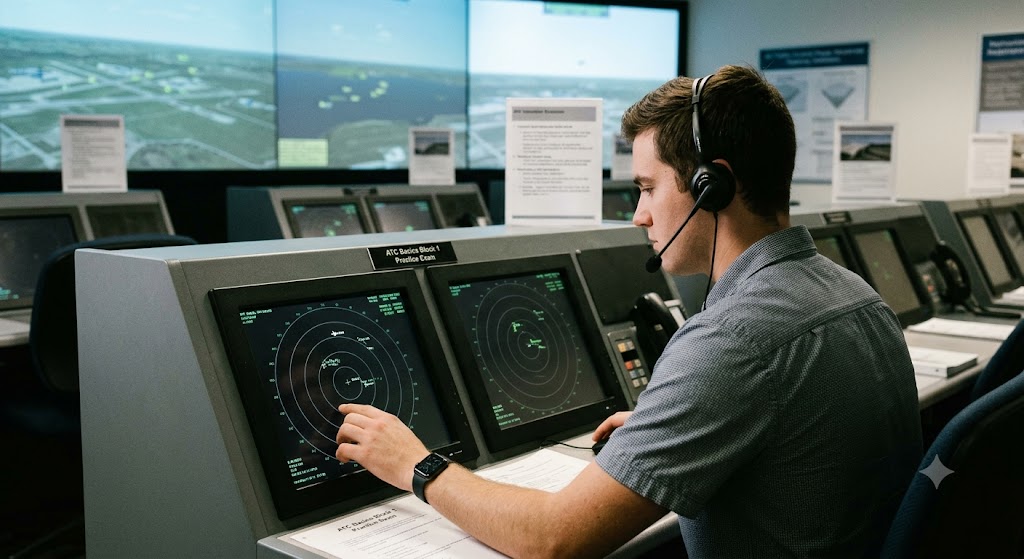
Additional Information
What the Course Entails and Exam Details
The course content for ATC Basics Block 1 is the bedrock
upon which all future air traffic control knowledge is built. It moves quickly
and covers a broad range of topics essential for an entry-level understanding
of the National Airspace System.
Core topics include: Federal Aviation Regulations (FARs)
relevant to air traffic control, providing the legal framework for operations.
Comprehensive study of different airspace classes (Class A, B, C, D, E, and G),
their dimensions, and equipment/communication requirements. Fundamental
understanding of aviation weather reports (METARs, TAFs), weather phenomena,
and how weather affects aircraft and ATC operations. Navigation and Flight
Planning principles, covering basic VOR navigation, airways, and understanding
flight plans. ATC communications, focusing on standard phraseology, radio
procedures, and coordination techniques between different control positions.
Aircraft performance characteristics, recognizing the different types of
aircraft, their basic capabilities, and limitations.
The associated exam, for which this practice test prepares
you, evaluates a student's retention and application of this foundational
knowledge.
What to Expect in the Final Exam
The actual ATC Basics Block 1 exam is a formal, computerized
assessment. Candidates can expect the following structure:
The exam consists primarily of multiple-choice questions, requiring
students to select the single best answer from a list of options. There may
also be some True/False and matching questions. Students must achieve a minimum
score, which is typically 70% or higher, although specific passing thresholds
can sometimes vary by program or FAA requirements. There is a strict time limit
for the exam, ensuring that candidates can retrieve and apply critical
information under pressure, a vital skill for an air traffic controller. This
is typically a closed-book exam. No external study materials, notes, or
electronic devices are permitted during the testing session.
A high score on this exam demonstrates readiness for the
intense simulation and hands-on training that follows in later blocks.
How to Study and Exam Centers
Effective preparation for the ATC Basics Block 1 exam
requires a dedicated and structured approach. The information is dense, and
rote memorization is often insufficient; true understanding is key.
Strategies for success include: Your primary resource must
be the official manuals and textbooks provided in your ATC course. The FAA's
own Orders (like JO 7110.65) and manuals are the definitive source for this
material. Consistently taking the ATC Basics Block 1 practice tests is one of
the most effective study methods. Use these to identify knowledge gaps and
focus your efforts on weak areas. Practice tests also help you become
accustomed to the phrasing and types of questions used. Utilize flashcards for
key definitions, acronyms, and regulations to facilitate quick recall. Active
recall, by testing yourself without looking at notes, is proven to enhance
long-term memory and retrieval. The final exam is not taken at public testing
centers like Pearson VUE. It is administered within the controlled environment
of the approved ATC training facility, such as the FAA Academy or potentially
certain university programs that have formal training partnerships with the
FAA.
Candidates must strictly follow the scheduling and
administration procedures provided by their specific training program.
Job Opportunities from the
Course
Passing the ATC Basics Block 1 is not a certification in
itself, but it is an absolute prerequisite to continue training for the actual
Air Traffic Control Specialist certification. Successfully navigating this
entire training pipeline opens the door to high-paying and highly respected
career paths within the Federal Aviation Administration (FAA).
Career paths unlocked upon full certification include:
- Air
Traffic Control Specialist (Terminal): Controllers working in the tower or
TRACON (Terminal Radar Approach Control) facilities, managing aircraft
arriving and departing from specific airports.
- Air
Traffic Control Specialist (En Route): Controllers working at Air Route
Traffic Control Centers (ARTCCs), managing high-altitude traffic between
major terminal areas.
- Traffic
Management Specialist: An advanced role focused on managing the overall
flow of traffic across large sections of the National Airspace System.
The journey begins with mastering the basics. Good luck with
your ATC Basics Block 1 Practice Test preparation!
Frequently Asked Questions
Reviews
5.0
Based on 0 reviews
Leave a Review
No reviews yet. Be the first to review!