
AICE Chemistry Practice Exam
$69.00
- Buy to unlock unlimited access to all Quiz questions.
- After purchase you can print a PDF of the whole quiz at any point. The PDF will contain the questions and the correct answers.
About this Exam
The Cambridge AICE Chemistry qualification is a prestigious, internationally recognized advanced high school program. It is designed for academically ambitious students, often seeking to earn college credits or advanced standing in university. This rigorous course moves far beyond introductory chemistry, challenging students to develop a deep, conceptual understanding of atomic structure, reaction mechanisms, kinetics, thermodynamics, and organic chemistry. It emphasizes critical thinking, problem-solving, and practical laboratory skills essential for success in STEM fields. For students aiming for careers in medicine, engineering, research, and science, AICE Chemistry offers a powerful foundation. This practice exam is an indispensable tool for mastering the demanding curriculum and building exam-day confidence.
Ready to test your knowledge?
Buy Now to Access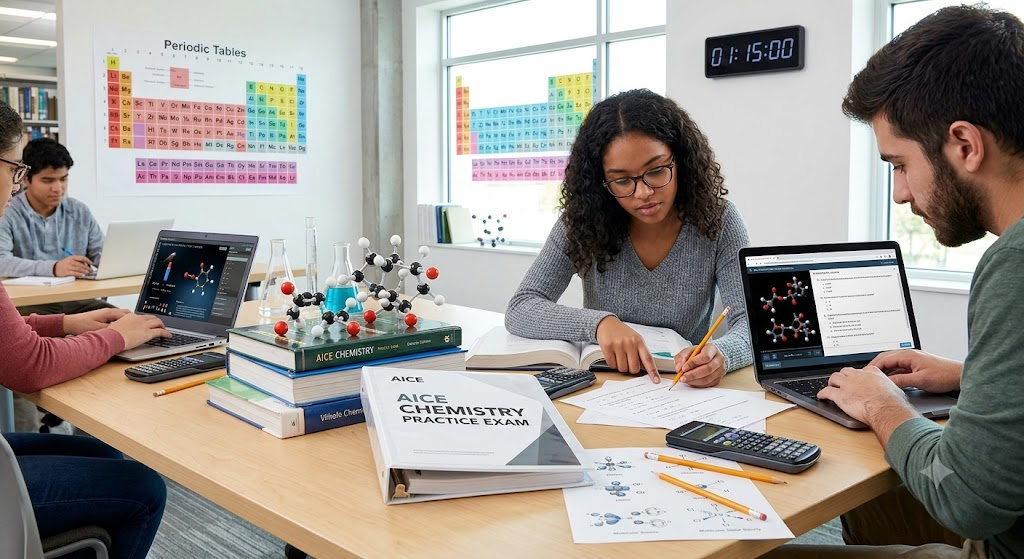
Additional Information
What the Course Entails and Exam Details
The AICE Chemistry syllabus (primarily structured around the Cambridge International AS & A Level) encompasses a wide array of theoretical principles and practical applications. Key areas of study include: Physical Chemistry (Atomic structure, bonding, states of matter, energetics, kinetics, chemical equilibria, redox processes); Inorganic Chemistry (Trends and patterns across groups, transition metals); Organic Chemistry (Functional groups, naming, polymerization, and typical reaction types and mechanisms); and Practical Skills (Experiment design, data analysis, and laboratory techniques).
The final examination typically consists of multiple components or "papers," testing different facets of understanding. For the full Advanced Level (A Level), these usually include five separate papers. These are not taken in one sitting but over a period of weeks. Papers 1 and 2 cover theory (AS Level equivalent). Papers 3 is a practical assessment conducted in a laboratory. Papers 4 and 5 are advanced theory and structured thinking. This comprehensive structure ensures that students grasp both core concepts and their advanced applications, alongside essential scientific practices.
What to Expect in the Final Exam
Students must be prepared for a series of distinct exam papers, each demanding focused skills. The format generally includes: Paper 1 (Multiple Choice): A 1-hour session testing broad understanding through roughly 40 questions; Paper 2 (AS Structured Questions): About 1 hour 15 minutes of structured, short-answer theory questions; Paper 3 (Advanced Practical Skills): A rigorous, 2-hour laboratory session where students perform experiments, record data, and analyze results; Paper 4 (A Level Structured Questions): Similar to Paper 2 but with more advanced, detailed theory questions; and Paper 5 (Planning, Analysis, and Evaluation): A theoretical paper focusing on designing experiments and interpreting data, often without direct lab work.
Passing scores are not a single number but are graded on a scale (e.g., from A* down to E, or similar), with results often being used for college credit. Students should expect challenging questions that require linking concepts across the entire curriculum. Scientific calculators and a specific data booklet (containing periodic tables and useful constants) are typically permitted.
How to Study and Exam Centers
Effective preparation is key. Master the official Cambridge AICE Chemistry syllabus, understanding every objective. Dive deep into textbooks specifically designed for the program. Practice with past exam papers extensively—this is the most crucial strategy. Treat them as simulated exams: timed, without notes, and then carefully review your answers against official marking schemes to understand expected detail and structure. Create flashcards for definitions and reactions. Form study groups to discuss complex topics.
AICE exams are administered only at authorized schools and colleges that are registered centers with Cambridge Assessment International Education. You cannot register and take them independently at commercial test centers like some other exams. Candidates generally take the examinations at the school where they are enrolled in the AICE course. Contact your school's examination coordinator or guidance counselor for information regarding exam dates, registration, and costs, as they manage all logistics for students within their institution.
Job Opportunities from the Course
Successfully completing AICE Chemistry and a subsequent STEM-focused degree opens doors to numerous rewarding and impactful careers. While the exam itself doesn't guarantee a job, it is a critical stepping stone on paths like:
Medical Doctor (after further medical school)
Pharmacist
Chemical Engineer
Biochemist
Research Scientist (e.g., in pharmaceuticals or biotechnology)
Environmental Scientist
Forensic Scientist
Veterinarian
Toxicologist
Science Teacher or University Lecturer
Clinical Laboratory Scientist
Chemical Sales Representative or Technical Consultant
Higher Education Credits towards degree programs are also common.
Frequently Asked Questions
Reviews
5.0
Based on 0 reviews
Leave a Review
No reviews yet. Be the first to review!