
AHA BLS Practice Test 2023 OLD
$69.00
- Buy to unlock unlimited access to all Quiz questions.
- After purchase you can print a PDF of the whole quiz at any point. The PDF will contain the questions and the correct answers.
About this Exam
Basic Life Support (BLS) is the foundation for saving lives after cardiac arrest. This crucial training equips individuals with the skills to recognize life-threatening emergencies, perform high-quality CPR, use an Automated External Defibrillator (AED), and relieve choking in a safe, timely, and effective manner. The American Heart Association (AHA) BLS course is designed specifically for healthcare professionals, first responders, and anyone in public safety or healthcare environments who must respond to cardiovascular emergencies. Holding this certification demonstrates competency in fundamental resuscitation techniques and is often a prerequisite for a wide range of careers.
Ready to test your knowledge?
Buy Now to Access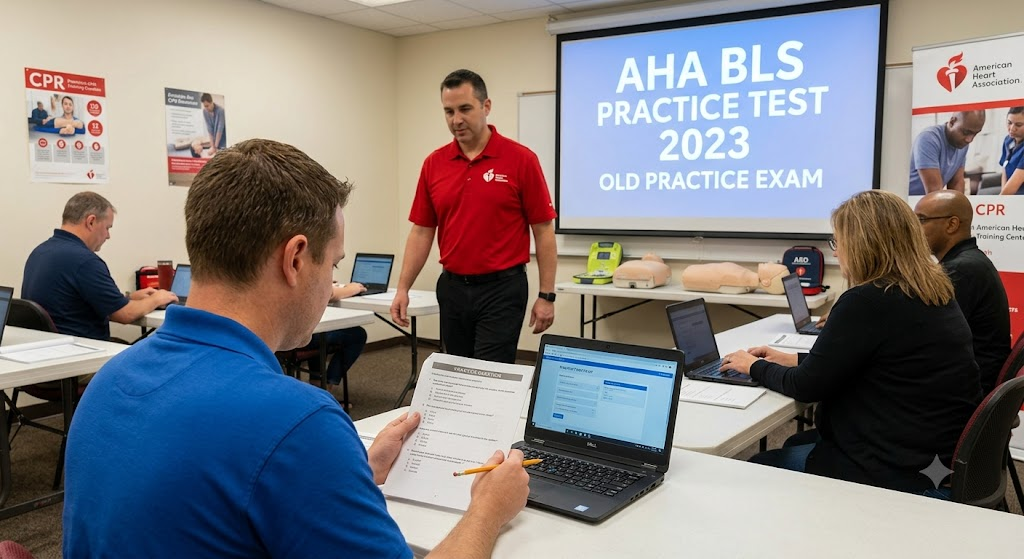
Additional Information
What the Course Entails and Exam Details
The AHA BLS course covers a comprehensive range of critical life-saving skills. Over the duration of the training, which is based on the latest guidelines, participants will learn the Chain of Survival, which emphasizes the critical steps for successful resuscitation. Specific skill sets include performing high-quality CPR for adults, children, and infants, including both single-rescuer and multi-rescuer techniques. You will also learn the correct and safe operation of an AED. The course provides instructions on how to use barrier devices for ventilation and how to manage ventilation using a bag-mask device.
Furthermore, the curriculum covers foreign-body airway obstruction (choking) relief for all ages. Throughout the training, a strong emphasis is placed on effective team dynamics and coordinated rescue efforts in various scenarios. The training and assessment protocols are built upon the most recent evidence-based research and standards set forth by the American Heart Association for emergency cardiovascular care.
What to Expect in the Final Exam
The final assessment for AHA BLS certification is dual-faceted, combining a cognitive written exam and a physical skills evaluation. Both components must be successfully passed to achieve certification. The cognitive exam is typically a multiple-choice test designed to measure your theoretical knowledge of the BLS protocols, algorithms, and key concepts. You can expect questions related to CPR procedures, AED use, and airway management across different patient ages.
A passing score, often 84% or higher, is required. The second part of the assessment is the hands-on skills test, where an authorized AHA instructor observes and evaluates your performance. This assessment is not about speed but rather about demonstrating proficiency and correct technique. Feedback manikins or precise measurement tools are frequently utilized to evaluate critical steps like compression depth and rate, recoil, and ventilation volume. While there may be a suggested time frame for the cognitive portion set by individual training centers, the skills test focuses solely on accuracy and proper execution of the algorithms.
How to Study and Exam Centers
Effective preparation is essential for success on the BLS exam. The official AHA BLS Provider Manual is your comprehensive resource; study it thoroughly, as all test questions and skills assessments are derived directly from its content. Focus on understanding the rationales behind the procedures, not just memorizing the steps. Utilize flashcards for key acronyms and the exact ratios for CPR for adults, children, and infants. Create a simple step-by-step checklist to practice the skills, especially the high-quality CPR and AED protocols.
Taking several practice tests, such as those modeled after the "AHA BLS Practice Test 2023 OLD" structure, will help familiarize you with the formatting and types of multiple-choice questions you can expect on the cognitive exam. To complete your certification, you must enroll in a course offered by an authorized AHA Training Center or Training Site. These official locations can be found through the AHA’s official website or by contacting local hospitals, community colleges, or fire departments. Online-only 'certification' programs are not accepted, as they lack the critical hands-on skills assessment required for true BLS proficiency.
Job Opportunities from the Course
Earning your AHA BLS certification is an indispensable requirement for numerous professions across the spectrum of healthcare and public safety. This credential not only enhances your skillset but also fulfills a critical hiring mandate for diverse career paths. A partial list of specific job titles that often require BLS certification includes:
Registered Nurse (RN) and Licensed Practical Nurse (LPN/LVN)
Emergency Medical Technician (EMT) and Paramedic
Physician and Physician Assistant
Respiratory Therapist
Dental Hygienist and Dentist
Physical Therapist and Occupational Therapist
Medical Assistant
Home Health Aide
Certified Nursing Assistant (CNA)
Firefighter
Police Officer and Security Personnel
Lifeguard and Recreation Staff
Various Specialized Medical Technicians
Caregivers and Staff in Assisted Living or Nursing Facilities
Frequently Asked Questions
Reviews
5.0
Based on 0 reviews
Leave a Review
No reviews yet. Be the first to review!