
Advanced Technician Firefighter Certification Practice Test
$69.00
- Buy to unlock unlimited access to all Quiz questions.
- After purchase you can print a PDF of the whole quiz at any point. The PDF will contain the questions and the correct answers.
About this Exam
The Advanced Technician Firefighter Certification is an elite credential designed for experienced fire service professionals who have already mastered the fundamentals and are ready to validate their technical expertise and leadership potential in dynamic, high-stakes environments.
This certification is not for entry-level personnel; it targets firefighters who are preparing to take on specialized roles and command positions. It transitions individuals from being vital team members to becoming operational leaders who can manage complex technical rescue operations, advanced hazardous materials scenarios, and overall incident scene command with precision and authority.
Successful candidates demonstrate that they possess the strategic thinking and tactical proficiency required of modern fire service leaders, making this a critical step for career advancement into officer ranks and specialized teams.
Ready to test your knowledge?
Buy Now to Access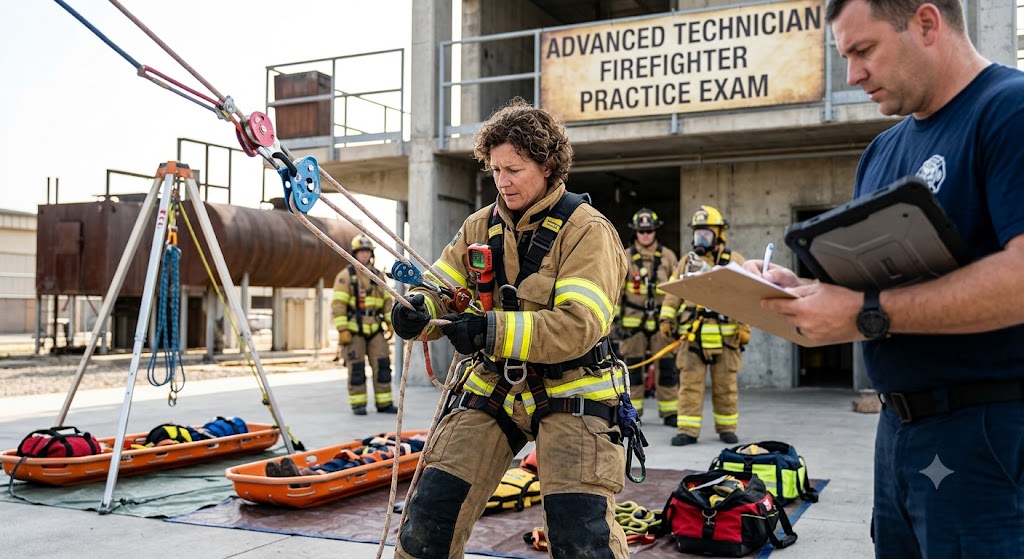
Additional Information
What the Course Entails and Exam Details
The path to Advanced Technician Firefighter Certification is
a blend of intense cognitive learning and extensive hands-on training, often
involving hundreds of hours of combined instruction and industrial training
(depending on the specific accrediting body).
The core syllabus delves deep into the science and strategy
of modern firefighting, moving beyond basic suppression to encompass leadership
and specialized technical skills.
Key training modules typically include:
- Fire
Department Incident Command System: Mastering standard command
procedures to manage all types of emergencies safely and effectively.
- Advanced
Fire Behavior and Suppression: Studying fire dynamics in complex
structures and utilizing advanced techniques for extinguishment and
ventilation.
- Technical
Rescue Operations: Comprehensive training in vehicle extrication, rope
rescue (high and low angle), structural collapse, and confined space
rescue.
- Assisting
Special Rescue Teams: Coordination and support functions for
specialized water and hazardous materials (HazMat) response units.
- Fire
Detection, Suppression, and Smoke Control Systems: Understanding,
inspecting, and managing built-in building fire protection systems.
- Fire
Origin and Cause Investigation: Gaining foundational knowledge in
scene preservation and the preliminary steps for determining how a fire
started.
- Advanced
Ladders and Fireground Tools: Specialized and complex applications of
standard equipment.
- Fire
and Life Safety Initiatives: Developing and implementing effective
community risk reduction programs.
The educational component is demanding, requiring a
comprehensive understanding of National Fire Protection Association (NFPA)
standards and local operational guidelines.
What to Expect in the Final Exam
The final examination process for Advanced Technician
Firefighter is typically multi-faceted, designed to test both theoretical
knowledge and practical competence to ensure safe, effective performance at a
high level.
It is structured into two main components:
The Written (Cognitive) Examination
This part assesses your command of the advanced theory and
knowledge covered in the curriculum.
- Format:
The test is usually comprised of 100 to 120 multiple-choice questions,
with only one best answer for each question.
- Time
Limit: Candidates are generally given around 120 minutes (2 hours) to
complete this section.
- Scoring:
A passing score is typically set between 70% and 80%, with results often
provided immediately or shortly after the testing window closes. The
Practical (Skills) Assessment
This is the cornerstone of the advanced certification, where
you must demonstrate your ability to execute critical skills under the
observation of certified evaluators. This section is often split into command
and specialized skill assessments.
- Command
Proficiency: You will likely need to act as the Incident Commander in
simulated multi-company drills, demonstrating safe, accurate, and
effective scene management, communication, and strategic decision-making.
- Technical
Skill Evolutions: Candidates must perform a series of randomly
selected technical rescue or advanced suppression operations (e.g.,
complex vehicle extrication, establishing a rope rescue system, or a
high-rise fire attack) safely and efficiently. Evaluators use detailed
skill sheets to ensure every step is performed according to standard
operating procedures.
To achieve overall certification, you must pass both the
written and practical examinations, confirming you are a well-rounded and
capable advanced technician.
How to Study and Exam Centers
Preparation for this advanced exam requires a structured and
dedicated approach, moving beyond simple memorization to a conceptual
understanding and fluid practical application.
Targeted Study Strategies
- Analyze
the Exam Blueprint: If provided, study the official exam content
outline (sometimes called a curriculum matrix or job task analysis) to
know exactly which NFPA standards and topics carry the most weight. Focus
your efforts where it counts.
- Utilize
High-Quality Practice Tests: Seek out reputable Advanced Technician
Firefighter practice exams. Use these not just for answers, but to
understand the logic behind the questions and to identify your conceptual
weaknesses.
- Engage
in Hands-On Drilling: The practical exam cannot be aced by reading.
Actively participate in advanced company-level drills. Practice
scenario-based training, taking turns as the Incident Commander and
specialized team leader. Focus on the nuances of coordination and safety.
- Form
or Join a Study Group: Collaborating with other experienced
firefighters allows you to share knowledge, debate tactical decisions, and
peer-evaluate each other’s practical skills, reinforcing learning through
different perspectives.
- Review
Case Studies and After-Action Reports: Study real-world complex
incidents. This enhances your situational awareness and decision-making by
understanding the practical application of command principles in
high-pressure scenarios.
Official Exam Administration
The final, official examination is rarely taken at a general
computer testing center like Pearson VUE.
Administration is typically coordinated through the
authorized accrediting bodies, which are:
- State
Fire Academies or Offices of the State Fire Marshal: In the United
States and Canada, these are the primary entities that administer and
issue state/provincial certifications, adhering to Pro Board or IFSAC
standards.
- Authorized
Regional Training Centers or Colleges: Many certified fire science
programs and regional academies are approved to host both the written and
practical components of the exam.
- Specific
International Bodies: In other regions, specific organizations like
the Institution of Fire Engineers (IFE) may handle advanced technician
testing and certification (e.g., using KNQF levels).
To register for the official exam, you must typically follow
the prerequisites and application process outlined by your specific
jurisdiction’s fire service certifying authority, which almost always requires
proof of prerequisite certifications and completion of an approved training
program.
Job Opportunities from the Course
Earning the Advanced Technician Firefighter Certification
makes a strong statement about your dedication and competence, making you a
highly desirable candidate for specialized and promotional roles within the
fire service.
This certification directly unlocks, or provides a critical
advantage for, numerous advanced career paths, including:
- Specialized
Rescue Team Member: Joining elite units such as Heavy Rescue,
Technical Rescue, Urban Search and Rescue (USAR), or Confined Space Rescue
teams.
- Hazardous
Materials (HazMat) Technician: Moving from operational support to a
technical role within HazMat units.
- Fire
Officer (Lieutenant/Captain): A crucial stepping stone to achieving
leadership ranks, validating your operational command capabilities.
- Fire
Department Safety Officer: Utilizing your advanced technical and
command knowledge to ensure personnel safety at emergency scenes and in
training.
- Training
Officer or Coordinator: Shaping the future of the department by
teaching advanced curriculum to other personnel.
- Incident
Commander: Serving as the dedicated scene manager for larger,
multi-unit incidents.
- Fire
and Life Safety Educator: Developing and leading community risk
reduction initiatives that require a deeper understanding of advanced fire
science and protection systems.
Frequently Asked Questions
Reviews
5.0
Based on 0 reviews
Leave a Review
No reviews yet. Be the first to review!