
Advanced Pulmonary Function Testing (PFT) Practice Test
$69.00
- Buy to unlock unlimited access to all Quiz questions.
- After purchase you can print a PDF of the whole quiz at any point. The PDF will contain the questions and the correct answers.
About this Exam
The Advanced Pulmonary Function Testing (PFT) certification represents the pinnacle of expertise for healthcare professionals dedicated to the intricacies of lung function assessment. This certification validates your in-depth understanding and proficiency in performing, interpreting, and managing sophisticated pulmonary function tests. Designed for seasoned respiratory therapists, exercise physiologists, sleep technicians, and other dedicated clinical staff who have a solid foundation in pulmonary physiology, this advanced certification demonstrates a high level of specialized knowledge. Achieving this status signifies your commitment to quality patient care, meticulous testing protocols, and your readiness to play a crucial role in diagnosing, monitoring, and managing complex respiratory conditions. It’s a key step for those looking to elevate their career, secure supervisory positions, or make significant contributions in clinical research, demonstrating to employers and patients alike that you possess advanced knowledge in the field of pulmonary diagnostics. The Advanced PFT Practice Test is a crucial tool in your preparation, allowing you to gauge your readiness and identify areas for improvement before taking the actual certification exam.
Ready to test your knowledge?
Buy Now to Access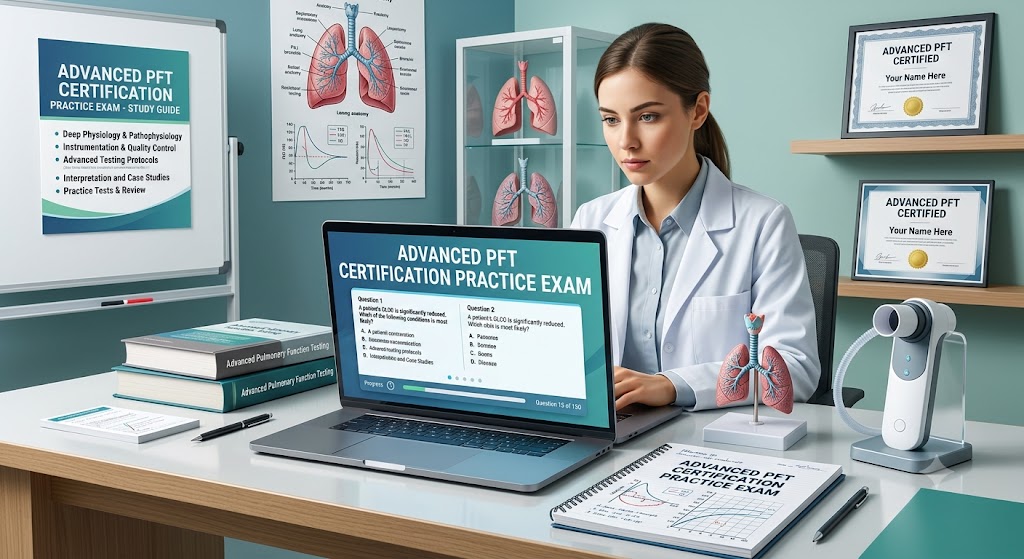
Additional Information
What the Course Entails and Exam Details
The content covered in the Advanced PFT Certification exam
delves deep into both the theoretical underpinnings and practical application
of advanced pulmonary diagnostic testing. Expect the comprehensive exam and any
preparation courses to encompass a wide range of topics, including:
- Deep
Physiology & Pathophysiology: Detailed analysis of lung mechanics,
gas exchange, and the physiological basis of standard and complex PFT
findings across various respiratory diseases and conditions (e.g.,
restrictive, obstructive, and combined lung disorders).
- Instrumentation
& Technology: In-depth knowledge of the principles, operation,
maintenance, and quality control of advanced pulmonary function testing
equipment, including spirometers, plethysmography boxes, gas analyzers,
and diffusion testing systems. Understanding technology enables you to
troubleshoot effectively and ensure accurate data collection.
- Advanced
Testing Protocols: Proficiency in performing complex tests beyond
standard spirometry and lung volumes. This includes diffusion capacity of
the lung for carbon monoxide (DLCO), bronchial provocation testing (such
as methacholine challenge), arterial blood gas (ABG) analysis, specialized
lung volumes, respiratory muscle strength assessment, and potentially high-altitude
or hypoxic testing simulations.
- Quality
Assurance & Control: Rigorous standards for equipment calibration,
leak checks, biological controls, and data validation, ensuring the
reliability of patient test results. You will learn the importance of
identifying and mitigating errors that can compromise accuracy.
- Data
Interpretation & Reporting: The skill to analyze complex PFT
results in the context of clinical history and other diagnostic
information, synthesizing findings to produce accurate and insightful
reports for interpreting physicians. You will learn to recognize critical
values, common artifacts, and potential pitfalls in interpretation.
- Patient
Management & Safety: Essential procedures for preparing patients,
ensuring their comfort and compliance, identifying contraindications for
testing, and managing potential adverse reactions during testing,
including infection control.
- Research
Applications: Understanding the use of PFTs in clinical research
studies, including study design, standardization of test methods, and data
analysis in a research context.
What to Expect in the Final Exam
The actual Advanced PFT Certification exam is a challenging
assessment designed to rigorously evaluate your advanced knowledge and clinical
decision-making. You can typically expect the following components:
- Format:
The exam is predominantly computer-based and primarily consists of
multiple-choice questions. These questions range from straight knowledge
recall to complex clinical scenario interpretations requiring critical
thinking. There may be questions incorporating diagrams, flow-volume
curves, charts, or simulated test results.
- Questions:
Expect a challenging number of questions, often between 100-150, demanding
focused attention throughout the allotted time. The questions will be
distributed across the core topics listed in the “What the Course Entails”
section, with a substantial portion dedicated to advanced testing, data
interpretation, and clinical management.
- Time
Limit: A generous yet rigorous time limit, typically ranging from 2 to
3.5 hours, will be in place. Time management is crucial, as the complexity
of interpretation questions can be time-consuming.
- Content
Emphasis: Questions will test your theoretical understanding as well
as your practical application. Be prepared for detailed scenarios
involving artifact identification, quality control interpretation, complex
pathology recognition, and troubleshooting equipment issues.
- Passing
Score: While specific scores can vary, expect a demanding passing
score, typically ranging from 70% to 80%. Results are often available
immediately upon completion.
- Rules:
The exam is strictly proctored, either at a physical testing center or
through an online proctoring service. Valid photo identification is
required. No external notes, electronic devices (unless integrated), or
aids are typically allowed, with strict protocols against any form of
misconduct. The rigorous testing conditions ensure the validity and
credibility of the certification.
How to Study and
Exam Centers
Your preparation should be systematic and comprehensive to
ensure you are ready for both the practical implications and theoretical depth
of the exam. Here’s a strategy for success:
- Review
Official Resources: Begin with the study guides and reference
materials provided by the certification body. Thoroughly understand the
syllabus, recommended texts, and any preparation courses. Ensure you are
using the most current materials, as guidelines can change.
- Utilize
Practice Exams: This is crucial. Use the provided Advanced PFT
Practice Test and other reputable practice tests repeatedly. Don’t just
answer questions; study the explanations for why answers are
correct or incorrect. Identify your weak areas and revisit the
corresponding material in your studies. Treat every practice exam as a
mock real exam, setting aside the same time and eliminating distractions.
Track your progress and aim to consistently score well above the passing
threshold on practice tests.
- Create
Flashcards: Condense key formulas, terminology, test protocols, normal
ranges for common and complex measures, and typical PFT patterns for
various respiratory conditions into flashcards for efficient and
repetitive review.
- Analyze
Clinical Data: Practice interpreting diverse PFT reports, including
challenging and complex cases. Focus on identifying specific pathologies
from lung volumes, diffusion capacity, and flow-volume curves, and
explaining the physiological basis of the findings.
- Form
Study Groups: Collaborating with colleagues and peers also preparing
for the exam can be highly beneficial. Discussing complex topics, sharing
study resources, and quizzing each other will enhance your understanding
and memory retention.
- Focus
on Problem Areas: Dedicate extra study time to the specific sections
identified as your weaker areas based on your practice test results or
initial review. Don’t gloss over challenging content.
Exam Centers and Locations
The Advanced PFT Certification exam is typically
administered by recognized certifying organizations, such as specific
respiratory care boards, medical societies, or standardized testing agencies.
These organizations ensure standardized and secure exam delivery through:
- Physical
Testing Centers: Partnering with established testing providers (like
Pearson VUE, Prometric, or dedicated educational centers), you can often
schedule your exam at a convenient physical location. These centers
provide a controlled and monitored testing environment. Search the
certifying organization’s website for approved testing locations and
search functions.
- Authorized
Training Schools/Institutions: Some specialized respiratory care
programs or accredited institutions may act as testing centers,
particularly if they also offer advanced PFT training courses.
- Online
Proctored Exams: An increasingly common option allows you to take the
exam remotely from a private and secure location, provided you meet
specific hardware, software, and room requirements and are continuously
monitored via webcam and screen sharing by a live or automated proctor.
Check the official certification details to see if this option is
available and what the specific requirements are.
It’s essential to check the official website of the specific
certifying body you are pursuing your certification through for precise details
on available study materials, practice tests, exam scheduling, locations, and
fees.
Job Opportunities
from the Course
Achieving the Advanced Pulmonary Function Testing
certification opens doors to specialized roles and enhanced career progression
within the field of respiratory care and pulmonary medicine. Specific job
titles and career paths this certification can unlock include:
- Lead
Respiratory Therapist (Pulmonary Services)
- Pulmonary
Diagnostic Lab Supervisor
- Specialized
Pulmonary Function Technologist (for complex diagnostics)
- Cardiopulmonary
Rehabilitation Specialist
- Clinical
Instructor in Respiratory Care (with specialized PFT focus)
- PFT
Quality Assurance Coordinator
- Respiratory
Care Research Assistant (specialized in pulmonary studies)
- Pulmonary
Disease Case Manager
- Medical
Equipment Sales and Support Specialist (Pulmonary Diagnostics)
- Consultant
for Pulmonary Testing Protocols and Best Practices
This certification not only validates your existing skills
but also positions you as a leader and resource within your department, significantly
increasing your value to employers and potentially leading to higher salaries,
improved job security, and more responsibility. It’s a clear investment in your
professional development and commitment to excellence in pulmonary patient
care.
Frequently Asked Questions
Reviews
5.0
Based on 0 reviews
Leave a Review
No reviews yet. Be the first to review!