
Advanced Patient Assessment Practice Exam
$69.00
- Buy to unlock unlimited access to all Quiz questions.
- After purchase you can print a PDF of the whole quiz at any point. The PDF will contain the questions and the correct answers.
About this Exam
The Advanced Patient Assessment (APA) certification is a sophisticated qualification designed for seasoned healthcare professionals, including nurse practitioners, physician assistants, and advanced practice nurses, who seek to elevate their clinical diagnostic skills to an expert level. This exam validates a clinician’s ability to perform comprehensive physical examinations, interpret complex diagnostic data, formulate accurate differential diagnoses, and develop evidence-based management plans for diverse patient populations. It signifies a mastery of assessment that goes beyond foundational training, preparing providers for high-acuity environments. This practice exam is an essential preparatory tool, mirroring the rigor and scope of the official certification to ensure candidates are fully equipped for success.
Ready to test your knowledge?
Buy Now to Access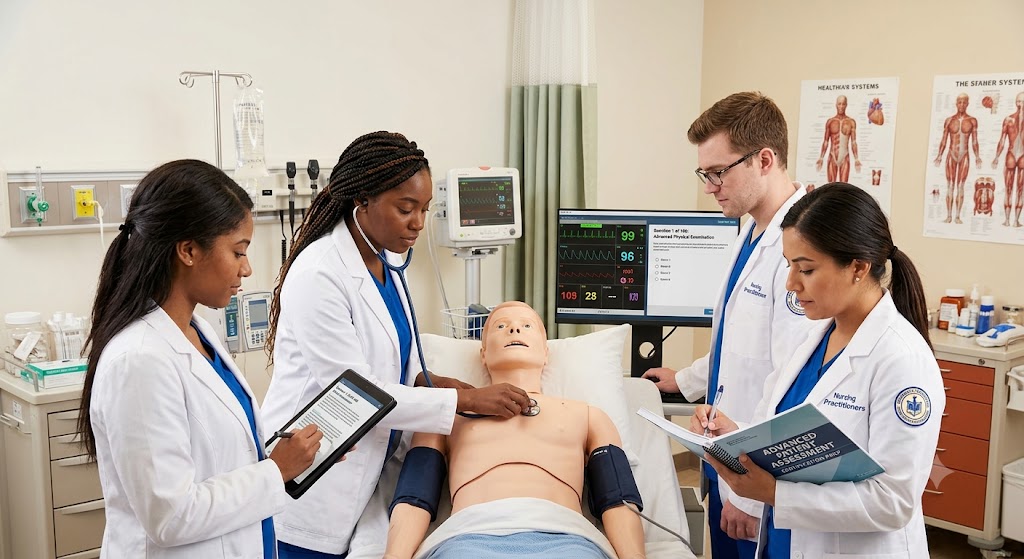
Additional Information
What the Course Entails and Exam Details
Preparing for the final exam involves a deep dive into
comprehensive clinical modules. The syllabus covers advanced techniques across
all major body systems. This includes, but is not limited to, the following
core competencies:
- Advanced
Health History Taking: Mastering complex interviewing techniques,
including identifying subtle behavioral and environmental factors
affecting health.
- Comprehensive
Physical Examination: Utilizing specialized assessment maneuvers for
cardiac, pulmonary, neurological, musculoskeletal, gastrointestinal, and
genitourinary systems across the lifespan.
- Diagnostic
Reasoning and Differential Diagnosis: Applying critical thinking to
synthesize assessment findings and formulate a prioritized list of
potential diagnoses.
- Interpretation
of Diagnostic Tests: Analyzing laboratory results, imaging (ECGs,
X-rays), and other diagnostic modalities.
- Documentation
and Communication: Mastering precise, legalistic documentation of
findings and effectively communicating assessment data to the
interprofessional team.
- Specific
Populations: Tailoring assessment techniques for geriatric, pediatric,
and obstetric patients.
What to Expect in
the Final Exam
The official Advanced Patient Assessment Certification Exam
is a rigorous, comprehensive assessment typically delivered in a computer-based
format. While specific formats may vary slightly by certifying body, candidates
should anticipate a mix of question types, predominantly complex
multiple-choice questions that require high-level synthesis and application of
knowledge, rather than simple recall.
Many exams also include video-based scenarios or interactive
'check-all-that-apply' questions. Candidates must achieve a passing score,
which is often statistically determined but generally hovers around 75-80%,
depending on the exam version’s difficulty. The time limit is typically
substantial, often ranging from 3 to 4 hours, reflecting the complex nature of
the scenarios presented. There is zero tolerance for outside resources, and the
exam is strictly proctored, whether taken at a physical center or via remote
proctoring.
How to Study and Exam Centers
Preparation must be methodical and multifaceted. Actively
utilizing this practice exam is the most effective starting point to identify
specific knowledge gaps. We recommend using a 'spaced repetition' strategy with
dynamic study tools and review courses that offer deep dives into weak areas.
Form study groups to practice complex history-taking and physical exam
maneuvers on mannequins or standardized patients. Memorize normal lab values
and ECG patterns, and practice interpreting them within varied clinical
contexts.
For the final certification, candidates must register
through an authorized certifying body, such as the American Nurses
Credentialing Center (ANCC) or the American Academy of Physician Associates
(AAPA). The official exam is generally administered at secure, standardized
testing centers globally, such as Pearson VUE centers. Some organizations also
offer live remote proctoring, allowing you to take the exam from a secure
location with a compatible computer and webcam, following strict environmental
guidelines.
Job Opportunities from the Course
Earning the Advanced Patient Assessment certification is a
career-accelerating milestone that unlocks specialized roles and leadership
opportunities across the healthcare continuum. This qualification validates the
expert diagnostic reasoning required for autonomous practice and specialized
care.
- Nurse
Practitioner (NP) in Family Practice or Internal Medicine
- Specialized
NP (e.g., Acute Care, Emergency, Cardiology, Gerontology)
- Physician
Assistant (PA-C) in Specialty Surgical or Medical Subspecialties
- Clinical
Nurse Specialist (CNS) in Critical Care or Medical-Surgical Units
- Flight
Nurse or Critical Care Transport Provider
- Healthcare
Educator or Clinical Faculty
- Clinical
Research Coordinator or Sub-Investigator
- Utilization
Reviewer or Case Manager (requiring advanced clinical judgment)
Frequently Asked Questions
Reviews
5.0
Based on 0 reviews
Leave a Review
No reviews yet. Be the first to review!