
Advanced Health Assessment Practice Exam
$69.00
- Buy to unlock unlimited access to all Quiz questions.
- After purchase you can print a PDF of the whole quiz at any point. The PDF will contain the questions and the correct answers.
About this Exam
The Advanced Health Assessment Practice Exam is a comprehensive tool designed for students preparing for advanced clinical certification or specialized licensure in healthcare. This rigorous evaluation targets professionals aiming for advanced practice roles, such as Advanced Practice Registered Nurses (APRNs), including Nurse Practitioners (NPs), Physician Assistants (PAs), and other advanced clinical providers. It serves as a critical simulation for individuals who must demonstrate their ability to conduct thorough, systematic, across-the-lifespan health evaluations. The primary focus is on proving competence in synthesizing complex clinical data and formulating differential diagnoses.
Ready to test your knowledge?
Buy Now to Access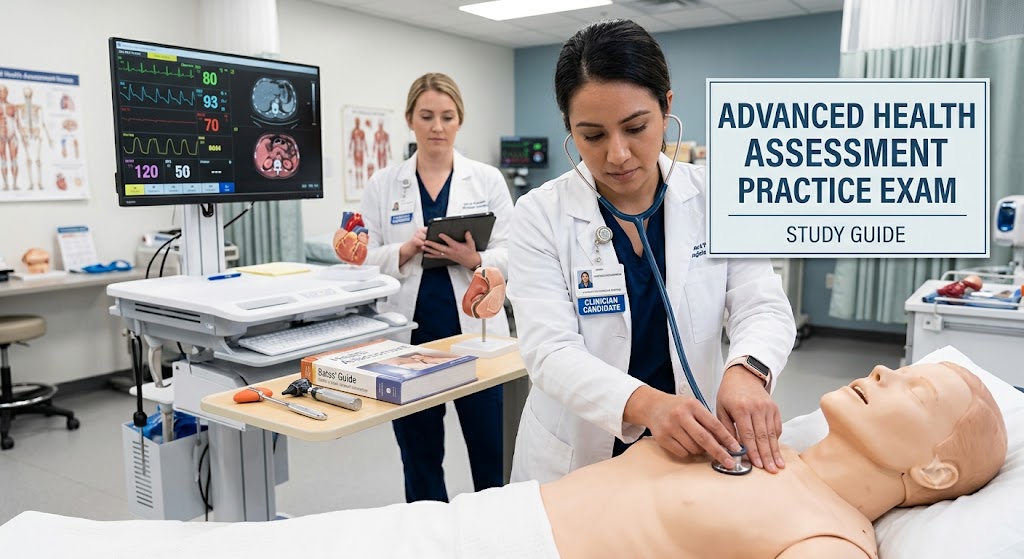
Additional Information
What the Course Entails and Exam Details
This examination does not merely test theoretical knowledge;
it rigorously assesses the practical application of advanced physical
assessment skills, interpersonal communication, and sophisticated clinical
reasoning.
The core domains covered usually include:
- Comprehensive
Health History: Master-level techniques for gathering detailed
biographical data, chief complaints, history of present illness (HPI), and
extensive medical, family, and social histories.
- Advanced
Physical Examination Techniques: Evaluation across all body systems,
including Head, Eyes, Ears, Nose, Throat (HEENT), cardiovascular,
pulmonary, gastrointestinal, musculoskeletal, neurological, mental status,
and integumentary.
- Differential
Diagnosis and Clinical Reasoning: The critical ability to analyze
assessment findings to create plausible differential diagnoses for acute,
chronic, and complex clinical scenarios.
- Special
Populations: Assessing modifications required for specialized groups,
including pediatric, geriatric, obstetric, and culturally diverse
patients.
- Evidence-Based
Practice: Applying current research and guidelines to inform health
promotion, disease prevention, and assessment methods.
What to Expect in the Final Exam
While the exact structure depends on the specific certifying
body (e.g., AANP, ANCC for NPs) or university program administering the test, a
comprehensive final exam typically involves a blended approach designed to
measure both knowledge and clinical proficiency.
Candidates can commonly expect a dual component structure:
- Theory
Component: This usually consists of multiple-choice,
select-all-that-apply, and case-based scenarios. These questions test
advanced knowledge of anatomy, physiology, pathophysiology, and diagnostic
reasoning. It is often computer-based and administered under strict time
constraints.
- Practical/Clinical
Component: This is often the defining section and may be formatted as
an Objective Structured Clinical Examination (OSCE). Students are
presented with simulated patient scenarios (potentially using standardized
patients or high-fidelity simulation manikins) and must perform specific, focused
physical examinations and formulate a diagnosis within a set time limit,
all while being observed by proctors.
- Passing
requirements: The specific passing score and criteria are set by the
administering organization. Some exams may require candidates to pass both
the theory and practical components independently.
How to Study and
Exam Centers
Preparation for this exam requires a multi-faceted and
diligent approach, combining knowledge retention with practical skill mastery.
High-Impact Study Strategies:
Simulate to Succeed:
Utilize high-fidelity simulations, virtual patients, or standard OSCE-style
practice scenarios. If a virtual platform (e.g., Shadow Health) was part of
your curriculum, master every assessment module.
Master the Standard Texts:
Commit to memory a standard advanced physical assessment reference, such as Bates'
Guide to Physical Examination and History Taking.
Physical Practice is
Paramount: Find a peer, colleague, or standardized patient. Practice the
"order" and specific techniques for every body system until they are
second nature. The physical component is about muscle memory as much as
knowledge.
Case Study Analysis: Work
through complex, multi-system case studies. Practice moving rapidly from a list
of symptoms to a comprehensive history, physical, and a list of five sensible
differential diagnoses.
Regarding Exam Centers:
Where and how you take the final Advanced Health Assessment
exam depends entirely on the context of your specific certification:
- University-Based
Programs: If taken as part of an APRN/NP academic program, the
practical OSCE is almost always held on campus within dedicated clinical
simulation labs.
- National
Certification Boards: For national certification (like the ANCC or
AANPCB family nurse practitioner exams, which contain a substantial
assessment component), candidates typically register for theory-based
components to be taken at a secure testing center, such as those managed
by Pearson VUE. They will assign a testing window.
Job Opportunities
from the Course
Successfully demonstrating competence via this final
examination is a defining milestone toward achieving licensure and entering
high-demand, autonomous advanced practice roles.
Unlock dynamic career paths and specific job titles, such
as:
- Family
Nurse Practitioner (FNP-C or FNP-BC)
- Adult-Gerontology
Acute Care Nurse Practitioner (AGACNP)
- Psychiatric
Mental Health Nurse Practitioner (PMHNP)
- Certified
Nurse-Midwife (CNM)
- Physician
Assistant (PA-C)
- Nurse
Anesthetist (CRNA)
- Primary
Care Provider (in private practice or clinics)
- Urgent
Care Clinician
- Clinical
Nurse Specialist (CNS)
Frequently Asked Questions
Reviews
5.0
Based on 0 reviews
Leave a Review
No reviews yet. Be the first to review!