
Advanced GIS Practice Exam
$69.00
- Buy to unlock unlimited access to all Quiz questions.
- After purchase you can print a PDF of the whole quiz at any point. The PDF will contain the questions and the correct answers.
About this Exam
The Advanced First Aid (AFA) certification is designed for individuals who require a level of medical training beyond basic first aid, often for specialized job roles, remote environments, or advanced workplace safety. This comprehensive course equips first responders, industrial safety officers, search and rescue personnel, and outdoor guides with the knowledge and skills necessary to assess and manage complex medical and trauma emergencies until higher-level medical care arrives. This article serves as your essential guide to navigating the study process and understanding what to expect from an AFA certification program and its associated practice exams
Ready to test your knowledge?
Buy Now to Access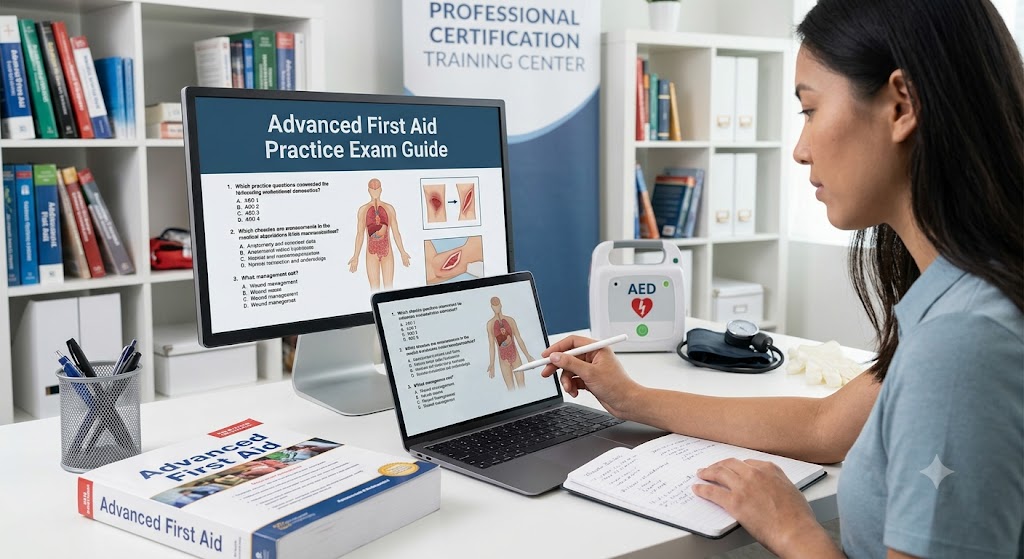
Additional Information
What the Course Entails and Exam Details
Advanced First Aid courses go deep into life-saving
protocols and advanced techniques. The curriculum typically covers:
- Comprehensive
patient assessment (primary and secondary surveys, vital signs).
- Airway
and breathing management (oxygen therapy, advanced suctioning).
- Cardiac
emergencies and AED use (multi-rescuer CPR).
- Advanced
wound care, burn management, and hemorrhage control (hemostatic agents,
tourniquets).
- Skeletal
and spinal injury stabilization (splinting, immobilization).
- Medical
emergencies (stroke, seizures, anaphylaxis, diabetic crises).
- Environmental
emergencies (hypothermia, heatstroke, altitude sickness).
- Triage
in multiple-casualty incidents.
- Administration
of certain medications (e.g., epinephrine, naloxone, aspirin) per local
protocols.
- Special
populations (pediatrics, geriatrics, obstetrics).
The course involves significant hands-on training and
scenario-based learning to ensure practical competence in all listed skills.
What to Expect in
the Final Exam
The Advanced First Aid final exam usually consists of two
distinct components that candidates must pass:
A. Cognitive (Written) Examination:
- Format:
Typically multiple-choice questions.
- Content:
Questions cover theoretical knowledge, protocols, anatomy, physiology, and
critical thinking based on the AFA curriculum.
- Time
Limit: Usually 1 to 2 hours, depending on the training provider.
- Passing
Score: Generally requires a score of 75% to 80% or higher.
B. Psychomotor (Practical) Examination:
- Format:
Scenario-based assessments. Candidates are evaluated on their ability to
perform specific skills (e.g., patient assessment, spinal immobilization,
airway management) in realistic simulated emergencies.
- Content:
A series of mandatory stations or comprehensive scenarios testing
practical proficiency and decision-making under pressure.
- Passing
Criteria: Critical fail criteria exist for essential life-saving
steps. Candidates must successfully complete all evaluated stations to
pass the practical component.
Candidates are typically required to pass both the cognitive
and psychomotor portions to achieve Advanced First Aid certification.
How to Study and Exam Centers
Preparation is key to succeeding in Advanced First Aid.
Utilize the following strategies:
Study Strategies:
- Review
Course Materials: Thoroughly read your AFA textbook, review lecture
notes, and study the detailed skills sheets provided during training.
- Utilize
Practice Exams: Take multiple practice exams to familiarize yourself
with the question format, identify weak areas in your knowledge, and
improve time management. This study guide article is designed to
support this crucial step.
- Form
Study Groups: Collaborating with classmates allows you to practice
skills, discuss scenarios, and quiz each other on protocols.
- Active
Recall and Spaced Repetition: Use flashcards for key terms, dosages,
and algorithms, and review them regularly over time.
- Practice
Practical Skills: Hands-on experience is critical. Dedicate
significant time to practicing physical skills (e.g., assessment
sequences, splinting) until they become second nature.
Exam Centers:
Advanced First Aid certification and testing are primarily
conducted through authorized training centers or organizations. These include:
- Local
chapters of major organizations like the American Red Cross, St. John
Ambulance, or the American Heart Association (for specialized advanced
modules).
- Community
colleges, universities, and technical schools offering EMT, First
Responder, or advanced health courses.
- Private
medical training companies and industrial safety training providers.
- Specific
employers or government agencies that conduct in-house training and
testing.
You must enroll in and complete a formal AFA course to be
eligible to take the final examination, which is usually administered at the
end of the course or at a scheduled date through the training provider.
Job Opportunities
from the Course
Earning an Advanced First Aid certification opens doors to
various rewarding careers and specialized roles, including:
- Workplace
Safety and Health Officer
- Industrial
First Aid Attendant
- Ski
Patrol Member
- Search
and Rescue Technician
- Emergency
Medical Responder (EMR)
- Firefighter
- Law
Enforcement Officer
- Construction
Site Medic
- Wilderness
Guide or Instructor
- Event
First Aid/Medical Staff for concerts or sporting events
- Offshore
Medic (with additional specialized certifications)
Frequently Asked Questions
Reviews
5.0
Based on 0 reviews
Leave a Review
No reviews yet. Be the first to review!