
Advanced Fetal Monitoring Practice Exam
$69.00
- Buy to unlock unlimited access to all Quiz questions.
- After purchase you can print a PDF of the whole quiz at any point. The PDF will contain the questions and the correct answers.
About this Exam
Welcome to your essential resource for the Advanced Fetal Monitoring certification. This comprehensive study guide is designed for experienced maternal-child healthcare professionals, including Registered Nurses (RNs), Certified Nurse-Midwives (CNMs), Nurse Practitioners (NPs), and Physicians, who are looking to validate their expertise in complex fetal heart rate (FHR) monitoring and interpretation. This advanced qualification, often achieved through the National Certification Corporation (NCC) as the Certification in Electronic Fetal Monitoring (C-EFM®), is the standard of excellence for those specializing in labor and delivery and antepartum care. It demonstrates your ability to apply sophisticated physiological principles and risk management strategies to ensure optimal outcomes for both mother and baby.
Ready to test your knowledge?
Buy Now to Access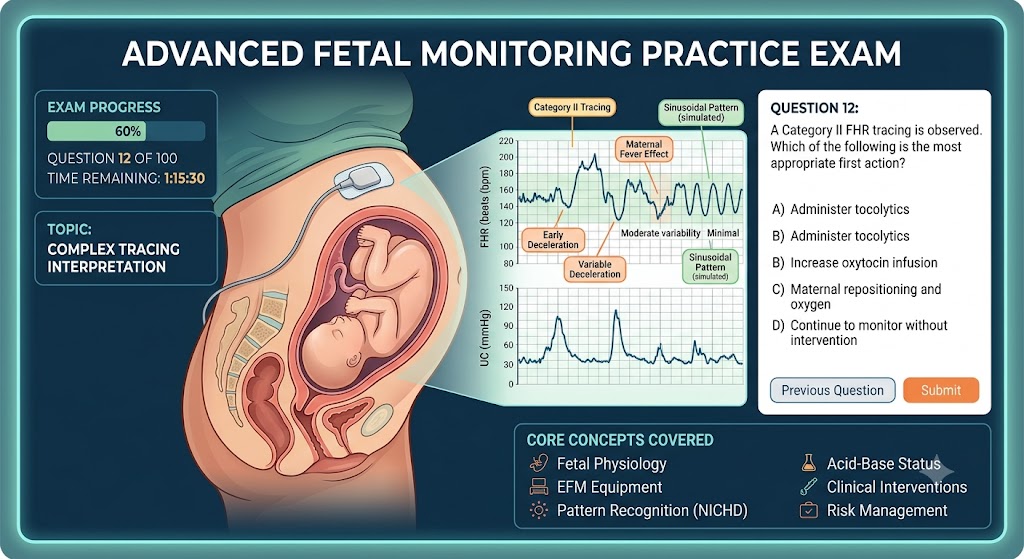
Additional Information
What the Course Entails and Exam Details
The path to advanced certification builds significantly on
intermediate fetal monitoring knowledge. A preparatory course or robust
self-study program typically covers an in-depth syllabus that includes:
- Advanced
Maternal-Fetal Physiology: Mastering oxygen transfer, acid-base
balance, and fetal responses to complex conditions.
- Pattern
Recognition & Interpretation: Expert analysis of intricate FHR
tracings, including standardized nomenclature for uterine activity,
baseline, variability, accelerations, and comprehensive categorization of
decelerations (Category I, II, and III).
- Complex
Clinical Scenarios: Applying knowledge to challenging cases such as
uterine tachysystole, sinusoidal patterns, and FHR response to maternal
complications or interventions.
- Equipment
and Technology: Advanced troubleshooting and appropriate use of both
internal and external monitoring modalities.
- Risk
Management & Communication: Developing legal defense strategies,
enhancing interdisciplinary communication, and adhering to evidence-based
practice standards.
The primary credentialing body is the NCC, and their exam
details for the C-EFM qualification are:
- Eligibility:
Requires an unencumbered license as a US or Canadian healthcare
professional (RN, MD, Midwife, etc.).
- Exam
Type: Competency-based examination.
- Valid
For: 3 years (requires maintenance via continuing education).
What to Expect in the Final Exam
The C-EFM final exam is a rigorous, computer-based test that
evaluates your application of knowledge rather than simple recall. You must
prepare for a test with the following format:
- Number
of Questions: 125 multiple-choice questions (100 are scored; 25 are
pre-test items that do not count toward your final score).
- Time
Limit: 2 hours.
- Passing
Score: The NCC does not publish a static passing percentage; instead,
they use a scaled score that is determined via a psychometric process, reflecting
the level of difficulty of the specific exam form you receive.
- Question
Distribution: The exam is structured around the following core content
areas (percentages are approximate):
- Pattern
Recognition and Interpretation (45-50%)
- Physiology
(20-25%)
- Equipment
(10-15%)
- Clinical
Interventions (10-15%)
- Professional
Issues (5-10%)
- Special
Rules: Candidates can test only twice per calendar year and must wait
45 days between attempts.
How to Study and Exam Centers
Effective preparation requires a combination of clinical
experience and structured study. We recommend the following strategies:
Actionable Study Strategies:
- Utilize
Official Resources: Start with the NCC's official C-EFM Candidate
Guide and Content Outline to understand exactly what is covered.
- AWHONN
Education: The Association of Women's Health, Obstetric and Neonatal
Nurses (AWHONN) is a primary provider of intermediate and advanced fetal
monitoring courses (both in-person and online), which are highly
recommended prerequisites.
- Practice
with Tracings: Dedicate significant time to interpreting real-world
FHR strips. The search indicates that many students find practice exam
books and online modules focused solely on tracing analysis essential.
- Focus
on 'Why' and 'Next': Don't just identify a pattern; ensure you
understand why it is happening physiologically and what the next
appropriate clinical intervention should be based on current guidelines.
Exam Centers and How to Register:
- The
NCC C-EFM exam is administered via computer.
- You
must first apply and be determined eligible by the NCC. Once approved, you
will receive an eligibility letter that opens a 90-day testing window.
- Computer
Testing Centers: You can schedule your exam at a secure, authorized
testing center, typically managed by PSI Services LLC, which has hundreds
of locations throughout the US and Canada.
- Live
Remote Proctoring (LRP): For convenience, NCC also offers LRP, allowing
you to take the exam from your home or office using your own computer
while being monitored by a live proctor via webcam. LRP is available 24
hours a day during your eligibility window.
Job Opportunities
from the Course
Earning the Advanced Fetal Monitoring/C-EFM qualification is
a significant career milestone that unlocks numerous opportunities and often a
higher salary tier. This certification is a powerful differentiator on a
resume, opening doors to these specific roles:
- Labor
& Delivery Nurse (Advanced/Charge Nurse)
- Antepartum
Nurse (High-Risk OB Unit)
- Obstetric
Nurse Navigator
- Clinical
Nurse Educator (OB/Perinatal Specialties)
- Certified
Nurse Midwife (Advanced C-EFM provides an accredited subspecialty
credential for Midwives)
- Perinatal
Quality Improvement Coordinator
- Travel
Nurse (OB Specialization, often a requirement for advanced contracts)
- Legal
Nurse Consultant (EFM expertise is critical in obstetric malpractice
cases)
Frequently Asked Questions
Reviews
5.0
Based on 0 reviews
Leave a Review
No reviews yet. Be the first to review!